Wednesday, December 01, 2021

Clinical Trial Design: Double-Blind Fixed Duration Trial with Long-term Double-Blind Various Treatment Duration

The randomized, double-blind, parallel-group design is the most common type of design for clinical trials (especially the confirmatory clinical trials). This type of design can be further classified into clinical trials with a fixed treatment duration or with various treatment durations. For clinical trials with a fixed duration, all patients are treated with study drugs for a fixed duration (for example, 16 weeks, 24 weeks, 52 weeks,...) and the primary efficacy endpoint will be estimated at the end of the fixed duration (for example, change from baseline in xxx measure at week 16, week 24, or week 52,...). For clinical trials with various durations such as event-driven study design, patients are treated with study drugs for various durations - the early enrolled patients may receive the study drugs for a much longer time than those later enrolled patients, and patients will stay in the study and receive the study drugs if no protocol-defined event occurs until the required number of events for the study has occurred and the entire study is closed. The event can be Clinical Worsening Event, MACE, Exacerbation, Hospitalization, Progression-free survival, Death,...

In the informed consent form, patients who participate in the clinical trial will be informed how long they may be treated with the experimental drug or placebo. The ethical issue arises if patients are randomly assigned to the placebo group and treated with placebo for a prolonged period of time.     

Lately, we saw several clinical trials with a hybrid approach containing a double-blind fixed duration and then followed by a double-blind various duration. The primary efficacy endpoint was measured at the end of the fixed duration (i.e., week 52 for INBUILD and ISABELLA trials and week 24 for STELLAR trial). The double-blind various duration was added to the trial to collect the information for secondary and exploratory endpoints that need a longer exposure time. The double-blind various duration depends on the enrollment speed and the timing of patients entering into the study. Early-enrolled patients will stay in the study much longer than the later-enrolled patients. The slower the enrollment speed is, the longer the double-blind various duration takes. 

INBUILD study: Nintedanib in Progressive Fibrosing Interstitial Lung Diseases 

For each patient, the trial consisted of two parts: Part A, which was conducted during the first 52 weeks, and Part B, which was a variable treatment period beyond week 52 during which patients continued to receive either nintedanib or placebo until all the patients had completed Part A. 


The primary assessment of benefit-risk of nintedanib in patients with PF-ILD will be based on efficacy and safety data over 52 weeks.

The primary analysis of this study will therefore be performed once the last randomized patient reaches the Week 52 Visit (Visit 9 at the end of Part A). At that time, a database lock will occur and all the data will be unblinded. Efficacy and safety analyses will be performed on the data from Part A of the trial to assess the benefit-risk of nintedanib over 52 weeks. In addition, data collected in Part B of the trial (after 52 weeks) and available at the time of data cut-off for the primary analysis will be reported together with data from Part A (i.e. over the whole trial).

Once the benefit-risk assessment of nintedanib over 52 weeks is confirmed to be positive, all patients receiving trial medication in Part B will be offered open-label treatment with nintedanib in a separate study.

Trial 1199.247 i.e. Part B will continue until all patients have been switched to open-label nintedanib or completed the Follow-up Visit. A final database lock will then occur and Part B data collected between the data cut off for the primary analysis and the final database lock will be reported together with data from Part A i.e. over the whole trial.

ISABELLA Studies: GLPG1690, a novel autotaxin inhibitor, in idiopathic pulmonary fibrosis

See the paper: Rationale, design and objectives of two phase III, randomised, placebo controlled studies of GLPG1690, a novel autotaxin inhibitor, in idiopathic pulmonary fibrosis (ISABELA 1 and 2)

In each study, approximately 750 subjects will be randomized 1:1:1 to receive oral GLPG1690 600 mg, GLPG1690 200 mg or matching placebo, once daily, in addition to local SOC. SOC is defined as either pirfenidone or nintedanib, or neither pirfenidone nor nintedanib (for any reason). Treatment will continue for at least 52 weeks (subjects will continue to receive randomized treatment until the last patient reaches 52 weeks in the study). A follow-up visit will be conducted 4 weeks after the end-of-study visit (figure 1 below).


STELLAR Study: Sotatercept in Pulmonary Arterial Hypertension

According to Acceleron's ATS 2021 INTERNATIONAL CONFERENCE ACCELERON INVESTOR AND ANALYST CALL, the STELLAR study was designed as the following:


The double-blind fixed duration is 24 weeks and the primary efficacy endpoint (6MWD) is measured at week 24. The double-blind various duration had a cap at 72 weeks, i.e., the maximum duration for the period is 72 weeks). Patients can be in the long-term double-blind treatment period for 0 (the last enrolled patient) to 72 weeks (early enrolled patients). 

Friday, November 26, 2021

Venn Diagram to Display the Distribution of the Adverse Events

Visualizing the clinical trial data is becoming more common and various plots can be drawn to visualize the data. In previous posts, we discussed various types of plots that can be used in describing the clinical trial data. 

Recently, we are discussing the use of the 'Venn diagram' for displaying the distribution of the adverse events - the number and percentage of overlapping AEs. See an example of a four-way Venn diagram below:


Wikipedia introduced the Venn diagram as the following: 
A Venn diagram is a widely-used diagram style that shows the logical relation between sets, popularized by John Venn in the 1880s. The diagrams are used to teach elementary set theory, and to illustrate simple set relationships in probability, logic, statistics, linguistics and computer science. A Venn diagram uses simple closed curves drawn on a plane to represent sets. Very often, these curves are circles or ellipses.
According to the paper "V is for Venn Diagrams!": 
Venn diagrams where introduced in 1883 by John Venn (1834-1923), the Hull born philosopher and mathematician. They are a great way to visualize elements that are unique to only one group and simultaneously visualize elements that intersect with other groups. They are symmetrical by nature and the number of groups in a Venn diagram = 2n (including the group outside the diagram).

In clinical trials or the pharmacovigilance field, Venn Diagram can be used to virtualize the distribution of the adverse events, especially to display the distribution and relationships of the frequent adverse events. 

In NIH's "Guidance on Reviewing and Reporting Unanticipated ProblemsInvolving Risks to Subjects or Others and Adverse Events", the Venn diagram was mentioned for summarizing the general relationship between adverse events and unanticipated problems. 


In a paper by Gattepaille et al"Prospective Evaluation of Adverse Event Recognition Systems in Twitter: Results from the Web‑RADR Project", the Venn diagram was used to summarize the relationship of the recall performance results of the first two components, the relevance filter, and the NER module. 


In a paper by Xie et al "Differential Adverse Event Profiles Associated with BCG as a Preventive Tuberculosis Vaccine or Therapeutic Bladder Cancer Vaccine Identified by Comparative Ontology-Based VAERS and Literature Meta-Analysis", Venn diagram was used to compare four groups of the AEs associated with BCG TB vaccine or bladder cancer vaccine using VAERS and literature resources.

Wednesday, November 24, 2021

Are data listings for clinical study reports still needed in the era of CDISC standard data sets (SDTM)?

Traditionally, all data fields that are collected in clinical trials, will be listed in so-called 'data listings'. The data listings are the basis for the summary and analysis tables or figures, and all together, tables, listings, and figures (TLFs) form the basis for the clinical study report (CSR). According to the ICH E3 "Structure and Content of Clinical Study Reports", these data listings are included in the CSR section 16.2 "Patient data listings". 


Now that the CDISC standard has become a mandate for regulatory submission of the clinical trial data, the data sets submitted to the regulatory agencies will follow the same standards (data structure, data set name, variable names,...). This will enable the regulatory reviewers to use the software (the data visualization software such as JMP-Clinical) to visualize and review the data and perform the data mining activities. Logical thinking is that in the era of CDISC standard data sets (SDTM - study data tabulation model), the data listings become obsolete and redundant. Some sponsors argue that there is no need to generate the data listings if the submitted data sets are in SDTM format. 

In a presentation "Alternatives to Static Data Listings for Clinical Study Reports" in a CDISC virtual conference, the presenters argued:
"Sponsors often create voluminous static listings for Clinical Study Reports (CSRs) and submissions, and possibly for internal use to review safety information.  This is likely due to the perception that they are required and/or lack of knowledge of various alternatives.   However, there are other ways of viewing clinical study safety data which can provide an improved user experience, and are made possible by standard structures for such data, such as the Study Data Tabulation Model (SDTM). The purpose of this paper is to explore some alternatives to providing a complete set of static listings and make a case for sponsors to begin considering these alternatives."
On Pinnacle 21's website, there was a blog article "FDA Final Guidance Webinar Q&A":
28. With the advent of a new "misc folder" instead of listings do you think that FDA is getting away from generating listings for each study? It seems that the data sets (SEND, SDTM, and ADaM) would stand alone to support any listings.
Answer: Once the standards requirements are in effect, the idea would be that listings would be replaced by the SDTM tabulations data, so yes.
It seems that FDA is ok not to receive the data listings since the CDISC-compliant data sets are submitted. However, it is still the sponsor's risk to take if data listings are not generated and not included in the CSR. The vast majority of the sponsors are still generating the data listings for the CSR and including the data listings in the submission even in the era of CDISC standard data sets. 

In deciding if the data listings need to be generated for CSR and submission, the sponsor needs to consider: 
  • The industry trend. Is it still the industry standard to generate the data listings even after CDISC compliant data sets are submitted?
  • Is there an official guideline indicating that the data listings should not be generated? 
  • How to handle CSR section 16.2 according to ICH E3 regarding patient data listings if data listings are not generated? 
  • Data listings may be used for internal reviews (medical review, medical writing, Quality Control review,…) even though FDA reviewers may not need the data listings because they have specific tools to review the SDTM data sets
  • Data listings may be needed if the submissions are needed for other regulatory agencies beyond the FDA.
  • Not all reviewers have the tools or can effectively use the tools to review the electronic data sets. Some reviewers still rely on the data listings to review the individual subject-level data. 
In the era of CDISC standards, more effort was spent on SDTM and ADaM data set programming. Once the SDTM and ADaM data sets are generated and the raw data sets are mapped to the standardized SDTM data sets, generating data listings is not so complicated. 

Sunday, October 17, 2021

Protocol Deviations - How is the Protocol Deviation Data Analyzed and Used?

For any clinical trial, the study protocol is the blueprint of how the clinical trial should be conducted. Clinical study protocols must be conducted according to the International Council for Harmonization (ICH) guidance on good clinical practice (GCP), which, among other things, helps safeguard the rights, safety, and well-being of study participants. If conducted as designed, the associated data should be reliable and reproducible and support clear interpretation of the results, while maintaining the participants’ protection. In light of this, one might reasonably assume that deviations from this protocol could be harmful to the participant or the accuracy of the data and should therefore be avoided.

However, the reality is that within clinical trials, protocol deviations do happen, despite best efforts in designing and conducting the clinical trial. According to the ICH E3 Q&A R1, the protocol deviation is defined as: 

"A protocol deviation is any change, divergence, or departure from the study design or procedures defined in the protocol.

Important protocol deviations are a subset of protocol deviations that may significantly impact the completeness, accuracy, and/or reliability of the study data or that may significantly affect a subject's rights, safety, or well-being."

In the early days, the term 'protocol violation' may be used and is still used in some clinical trial documents. According to the ICH E3 Q&A R1, the term 'protocol violation' should be replaced with 'protocol deviation'

"To avoid confusion over terminology, sponsors are encouraged to replace the phrase “protocol violation” in Annex IVa with “protocol deviation”,

There is considerable variability regarding the interpretation, and classification of what an important protocol deviation is, which creates challenges in the identification, collection, and reporting of deviations - resulting in over-reporting PDs that could potentially delay the identification of important patient safety information by increasing the noise in the system or under-reporting PDs that could influence the reliability of the study results and patient safety signals.

In order to reduce the variability in what, when, how the PDs should be collected, it might be helpful to take a look at how the data about the PDs are analyzed and used. 

After the protocol deviation data is collected, the data will be mapped into the CDISC data sets (DV data set in SDTM and ADDV data set in ADaM). Then a data listing will be generated to list all protocol deviations by subjects including the date the protocol deviation occurred, the description of the protocol deviation, the category of the protocol deviation (out of visit window, informed consent issue, SAE safety reporting issue, ......), and the classification of the protocol deviations (minor, major, critical, or important).  A statistical summary table will then be generated for all protocol deviations and for major protocol deviations. 

The protocol deviation data will then be used in the following aspects: 

For the clinical study report (CSR):

CSR must include a section to describe the protocol deviations that occurred during the conduct of the study. According to  ICH E3 (Structure and Content of Clinical Study Reports), the protocol deviations section is an essential part of the CSR. 

10.2 Protocol Deviations 

All important deviations related to study inclusion or exclusion criteria, conduct of the trial, patient managements or patient assessment should be described. 

In the body of the text, protocol deviations should be appropriately summarized by center and grouped into different categories, such as: 

  • Those who entered the study even though they did not satisfy the entry criteria. 
  • Those who developed withdrawal criteria during the study but were not withdrawn. 
  • Those who received the wrong treatment or incorrect dose. 
  • Those who received an excluded concomitant treatment. 

In Appendix 16.2.2, individual patients with these protocol deviations should be listed, broken down by center for multicenter studies. 

For FDA BIMO of NDA/BLA submission under Center for Drug Evaluation and Research (CDER):

The FDA Office of Scientific Investigations (OSI) requests that the by-site data and listing are provided for Bioresearch Monitoring (BIMO). The by-site data is used by OSI to select the investigational sites for inspections for CDER submissions.
The FDA Office of Scientific Investigations (OSI) requests that the items described in the draft guidance for industry Standardized Format for Electronic Submission of NDA and BLA Content for the Planning of Bioresearch Monitoring (BIMO) Inspections for CDER Submissions (February 2018) and the associated Bioresearch Monitoring Technical Conformance Guide Containing Technical Specifications be provided to facilitate development of clinical investigator and sponsor/monitor/CRO inspection assignments, and the background packages that are sent with those assignments to the FDA ORA investigators who conduct those inspections. This information is requested for all major
trials used to support safety and efficacy in the application (i.e., phase 2/3 pivotal trials).
One critical piece of the BIMO data is the protocol deviation data by site. The number of protocol deviations or important protocol deviations can be an indicator of protocol compliance and the study quality for specific investigational sites. According to BIORESEARCH MONITORINGTECHNICAL CONFORMANCE GUIDE Technical Specifications Document", the following protocol deviation data should be provided:

"Subject-level data line listings, by clinical site, should include consented subjects, treatment assignment, discontinuations, study population, inclusion and exclusion criteria, adverse events, important protocol deviations, efficacy endpoints, concomitant medications, and safety monitoring, as further described below"

7. Important Protocol Deviations Contains Nonbinding Recommendations 

This by-subject, by-clinical site listing should include all protocol deviations. The listing should include a description of the deviation and identify whether the sponsor considered the deviation to be an important or non-important protocol deviation.  

Clinical Site Data Elements Summary Listing

"Total number of important protocol deviations at a given site by treatment arm for subjects in the SAFPOP. A protocol deviation is any change, divergence, or departure from the study design or procedures defined in the protocol or associated investigational plans that is not implemented or intended as a systematic change. This value should include multiple deviations per subject and all major deviation types. Important deviations are those deviations that might significantly affect the completeness, accuracy, and/or reliability of the study data or that might significantly affect a subject's rights, safety, or well-being"

"Total number of protocol deviations, excluding important protocol deviations, at a given site by treatment arm for subjects in the SAFPOP. A protocol deviation is any change, divergence, or departure from the study design or procedures defined in the protocol or associated investigational plans that is not implemented or intended as a systematic change."

FDA's Good Review Practice: Clinical Review Template listed the protocol violation information as part of the review items for assessing the GCP compliance and the impact of the protocol violations on the data quality and the safety and efficacy results. 

3.2 Compliance With Good Clinical Practices

This section should include comments on compliance with good clinical practices, including informed consent, protocol violations, site-specific issues, and whether the clinical trials were conducted in accordance with acceptable ethical standards. 

If a DSI audit process and report is not requested, provide a brief summary on the quality and nature of other methods used to audit or check the applicant’s data and/or analyses. 

For DSI-requested audits, include a brief summary of the rationale for DSI audits and site selection such as: 

• A specific safety concern at a particular site based on review of adverse events, serious adverse events, deaths, or discontinuation 

• A specific efficacy concern based on review of site-specific efficacy data

 • A specific concern for scientific misconduct at one or more particular sites based on review of financial disclosures, protocol violations, clinical trial discontinuations, or safety and efficacy results  

For defining the per-protocol population for Sensitivity or Supplemental Analyses

Efficacy analyses are usually performed in full analysis set or intention-to-treat population. However, to test the robustness of the statistical results and to assess the impact of the protocol deviations on the statistical results, additional sensitivity or supplemental analyses are usually performed on the per-protocol population. 

According to ICH E9 (Statistical Principles for Clinical Trials), the per-protocol population is defined and sensitivity analyses based on per-protocol population are suggested:  

Per protocol set (valid cases, efficacy sample, evaluable subjects sample): The set of data generated by the subset of subjects who complied with the protocol sufficiently to ensure that these data would be likely to exhibit the effects of treatment according to the underlying scientific model. Compliance covers such considerations as exposure to treatment, availability of measurements, and absence of major protocol violations.


In practice, the per-protocol population is usually defined as "all randomized subjects who have no major protocol deviations" or "all randomized subjects who have no major protocol deviations that may have an impact on the efficacy assessment". The decision on the inclusion of subjects in per-protocol population needs to be decided before the database lock and study unblinding. The protocol deviation data may be reviewed at the blinded data review meeting. Subjects who are excluded from the per-protocol population need to be documented in the blinded data review report.

ICH E9 Addendum also discussed the per-protocol set (PPS) and analyses based on PPS are included as supplemental analysis: 

The meaning and role of an analysis of the per protocol set is also re-visited in this addendum; in particular whether the need to explore the impact of protocol violations and deviations can be addressed in a way that is less biased and more interpretable than naïve analysis of the per protocol set

Section 5.2.3. indicates that it is usually appropriate to plan for analyses based on both the FAS and the Per Protocol Set (PPS) so that differences between them can be the subject of explicit discussion and interpretation.

Additional Reference: Transcelerate Protocol Deviations

Sunday, October 10, 2021

Recommendations for DMC: How Many Statisticians Need to be Involved in Successful DMC Process?

Independent data monitoring committee (iDMC) is more commonly used in clinical trials than before for various reasons. For innovative and complex trials, an iDMC is usually a must-to-have external committee. For clinical trials containing the adaptations, interim analyses, iDMC can provide a way to review the unblinded data to recommend some critical suggestions about the ongoing clinical trial while maintaining the study integrity. In some cases, the sponsor just wants to have an independent body to oversee the study for extra credibility. 

There are plenty of regulatory guidelines for the general principles for establishing and operating a DMC. There are also recommendations from the industry/academic for successful DMC implementation. 

"What are some of the key factors that a sponsor should consider when deciding whether to suspend or continue an ongoing study or to initiate a new study during the COVID-19 public health emergency?

Involvement of a study’s DMC, if one has been established, can provide support for the assessments discussed above. Since a primary responsibility of the DMC is assuring the safety of participating trial participants, the DMC’s assessment of the impact of modifications of trial conduct due to COVID-19 on patient safety is important to consider."

When planning for a DMC, multiple statisticians need to be involved - at least three statisticians (blinded and unblinded statisticians) need to play a role in the successful conduct of a DMC. The diagram below lists three different statisticians that are needed for a successful DMC.  


DMC Statistician: 
  • One of the DMC members
  • the voting member
  • with biostatistical expertise, applying the statistical methods in the monitoring process. 
  • understands the complex clinical trial designs (group sequential design, adaptive design, ...), familiar with the application of the stopping rules, Type I error issue, multiplicity issue. 
  • According to FDA's guidance on DMC: "Most DMCs are composed of clinicians with expertise in relevant clinical specialties and at least one biostatistician knowledgeable about statistical methods for clinical trials and sequential analysis of trial data."
  • usually unblinded and have access to the unblinded data 
Trial Statistician: 
  • clinical trial study team member and can not be the DMC member
  • can attend the open session of the DMC meetings; can't attend the closed session of the DMC meetings
  • only have access to the blinded or pooled study data during the study
  • responsible for the statistical section of the study protocol including the statistical methods for group sequential design, adaptive design, stopping rules... 
  • responsible for simulations (if needed) to address questions about the alpha I error spending, multiplicity issue
  • maybe the author to develop the statistical analysis plan for DMC and for interim analysis
  • provide the blinded data sets to the SDAC (reporting) statistician
  • may work with SDAC statistician and review the blinded statistical outputs from the SDAC statistician to ensure the correctness of the statistical package (blinded version)
SDAC Statistician:
  • statistician on the Statistical Data Analysis Center (SDAC) - in industry, this is called reporting statistician or independent statistician. 
  • non-voting member
  • primary responsibility is to prepare the statistical outputs (tables, listings, and figures) for DMC. perform the analyses on unblinded interim data and provide the results of comparative interim analyses.
  • Reporting statistician will receive the data sets from the data management group and receive the randomization information (unblinded information) directly from the IRT (interactive response technology) group
  • Reporting statistician sends the statistical package (unblinded) to DMC for review. 
  • Reporting statistician is usually unblinded.
  • reporting statistician may have a programming team to help with generating the data sets, tables, listings, and figures. Anybody who is working with the reporting statistician needs to follow the same rules that are applicable to the reporting statistician. 
  • attend the DMC meeting (open and close sessions) and provide explanations for any issues raised by DMC members related to the DMC statistical outputs  
As indicated in the diagram above, the trial statistician and reporting statistician may have close discussions and interactions while working on the blinded data. The reporting statistician and the DMC statistician may also have close interactions while working on the unblinded data. There should be no direct interaction or very little interaction between the trial statistician and the DMC statistician (usually the interaction may be limited to the initial administrative meeting and the open session at the scheduled DMC meetings).

FDA guidance on DMC contains a lengthy section to discuss the reporting statistician's roles in the DMC process. FDA is very concerned about the potential risks that statisticians who conduct the interim analyses may comprise the integrity of the clinical trial. The primary trial statistician should not be the one who conduct the interim analysis. The statistician who conducts the interim analysis should not be in the sponsor's organization.  


Friday, October 08, 2021

Serial Blood Sample Timepoints for Comparing Pharmacokinetics Profiles Between Two Different Dose Frequencies

It is very common in the drug development process that the dosing frequency needs to be studied. The dosing frequency is usually based on the pharmacokinetic profiles. In multiple-dose studies, the dose frequency decides the dosing interval: QD for once daily, BID for twice daily, and TID for three times daily. 

Usually, to compare the pharmacokinetic profiles, serial blood samples will be taken over the period of the dosing interval (between the previous dose and the next dose).  The area under the curve (AUC) will then be calculated over the dosing interval (commonly denoted as tau).
  • For QD dose, Tau = 24 hours, AUCtau is AUC[0-24 hours]
  • For BID dose, Tau = 12 hours, AUCtau is AUC[0-12 hours]
  • For TID dose, Tau = 8 hours, AUCtau is AUC[0-8 hours]
It will be straightforward to select the Pharmacokinetics (PK) sampling time points if two drugs/formulations to be compared have the same dose interval. However, in practice, we often need to compare the PK profiles for two drugs/formulations with different dose intervals, for example, between QD versus BID, or between QD versus TID.  

For comparison of PK profiles between QD dose, BID dose, and TID dose, one will need to compare AUC[0-24 hours] with 2 x AUC[0-12 hours] for BID and with 3 x AUC[0-8 hours] for TID.

For QD dosing, serial PK samples will be collected over 24 hours. For BID dosing and TID dosing, there are two different ways to decide the serial PK samples:

For BID dosing,   
  1. serial PK samples can also be collected over 24 hours, the calculated AUC[0-24 hours] can directly be compared with AUC[0-24 hours] from QD dosing even though there will be an extra dose at the middle of the 24 hours period. 
  2. serial PK samples can be collected over 12 hours, then the calculated AUC[0-12 hours] needs to be multiplied by 2 in order to be compared with AUC[0-24 hours]
For TID dosing, 
  1. serial PK samples can also be collected over 24 hours, the calculated AUC[0-24 hours] can directly be compared with AUC[0-24 hours] from QD dosing even though there will be two extra doses during the 24 hours period. 
  2. serial PK samples can be collected over 8 hours, then the calculated AUC[0-8 hours] needs to be multiplied by 3 in order to be compared with AUC[0-24 hours]
In a study by Dawra et al, "A PK/PD study comparing twice-daily to once-daily dosing regimens of ertugliflozin in healthy subjects", the blood samples were collected for QD and BID as the followings:
For each period, blood samples for PK analysis were collected for QD dosing as follows: on days 4, 5, and 6 before administration of the morning dose, and at 0.5, 1, 2, 3, 4, 8, 12, and 24 hours after the morning dose on day 6. For BID dosing, blood samples were collected at 0.5, 1, 2, 3, 4, 8, 12 (preevening dose), 12.5, 13, 14, 15, 16, 20, and 24 hours after the morning dose on day 6.            
Notice that the blood samples for BID were collected at 0.5, 1, 2, 3, 4, 8, 12 post the morning dose and then 0.5, 1, 2, 3, 4, 8, 12 post the evening dose. 

The PK profiles for OD and BID doses are displayed in the figures below: 


This approach of the PK blood sampling schema will require an extensive number of blood draws. For the BID dose, two serial PK samples need to be drawn; for the TID dose, three serial PK samples need to be drawn. The advantage is to capture the potential impact of the circadian and diurnal cycles. 

In some situations, too many blood sample draws may not be practical, and an alternative approach needs to be taken. For example, in pediatric PK studies, the number of blood sample draws may be limited due to the restriction in the total blood volume. 

One of the alternative approaches is to draw the serial PK samples only for one dose interval, not draw additional serial PK samples after the next dose. For example, for the BID dose, the serial PK samples are drawn over 12 hours period assuming that the PK profiles after the evening dose will be the same as the PK profiles over 12 hours post the morning dose. The AUC[0-12 hours] needs to be multiplied by 2 before comparing it to the AUC[0-24 hours] for QD dose. 

In a study to compare the IVIG (every four weeks dosing schedule) and SCIG (weekly dose schedule), the serial PK samples for IVIG were drawn over 4 week period, and the serial PK samples for SCIG were drawn over 1 week period (instead of 4 week period). To compare the AUCs between IVIG and SCIG, the AUC[0-7 days] was multiplied by 4 before comparing it to the AUC[0-28 days]. With this approach, the next three weekly intervals are assumed to have the same PK profiles as the first weekly interval. We can also say that the PK profiles for the next three intervals (dotted lines) are projected or simulated.  This approach was accepted by the FDA and PK results were included in the product label. The PK profiles for IVIG and SCIG are displayed below (the dotted portion for SCIG was projected). 


Monday, September 27, 2021

Advancing the Development of Pediatric Therapeutics (ADEPT) - FDA Workshops on Pediatric Drug Developments

Each year, the FDA's Division of Pediatrics and Maternal Health in collaboration with the University of Maryland CERSI organized an annual public workshop to discuss the issue related to pediatric drug development. Starting in 2014, it has organized 7 public workshops (no event for 2020 due to Covid-19). 

           Advancing the Development of Pediatric Therapeutics (ADEPT)

ADEPT 7

2021

Complex Innovative Trial Design

"Advancing the Development of Pediatric Therapeutics Innovative Trail Design"

ADEPT 6

2019

Pediatric Patient Perspectives


Pediatric Clinical Trial Endpoints for Rare Diseases With a Focus on Pediatric Patient Perspectives

NOVEMBER 12, 2019

ADEPT 5

2018

Pediatric Pharmacovigilance

Advancing Pediatric Pharmacovigilance Public Workshop

AUGUST 13, 2018

ADEPT 4

2017

Big data


Application of "Big Data" to Pediatric Safety Studies

ADEPT 3

2016

Long-Term Pediatric Safety Studies

Successes and Challenges of Performing Long-Term Pediatric Safety Studies:

Pediatric Drug Development Regulatory Considerations

International Collaborations in Pediatrics: FDA and EMA growing together

International Considerations for Pediatric Master Protocols


ADEPT 2

2015

Long-term Neurocognitive Development in Pediatrics

Evaluation of Long-term Neurocognitive Development in Pediatrics

ADEPT 1

2014

Pediatric Bone Health


For this year (2021), the 2-day public workshop was titled “Advancing the Development of Pediatric Therapeutics Complex Innovative Trial Design”. The purpose of the workshop was to discuss opportunities for leveraging complex and innovative trial designs, understand the challenges with their applications, and develop solutions on how challenges in the designs can be overcome. 

The workshop specifically focused on two topics of interest: 
  • bridging biomarkers in pediatric extrapolation 
  • Bayesian techniques in pediatric studies. 
In addition, the workshop allowed for an open dialogue around the use of these approaches among regulators, industry, academia, and patient organizations.

The presentation slides & webcast video links from the workshop are now all available.

SEPTEMBER 1 - 2, 2021


Saturday, September 11, 2021

Afghan Withdrawal and Accelerated Approval for Aduhelm

These two topics seem to be irrelevant at all, but have one thing in common: changing the subjects when the decision is questioned.

For the US withdrawal from Afghanistan, the decision to withdraw from two decades of war is the right decision and welcomed by the majority of the Americans. However, the execution of the withdrawal was a disaster. The execution of the withdrawal is not properly planned, botched, entirely a failure no matter how the Biden administration tries to spin and change the subject. When questioned by the reporters, the Biden administration keeps mentioning how correct the decision of withdrawal from Afghanistan is and avoids mentioning why the execution of the withdrawal goes so wrong.
Changing the subject is also the theme in the controversial approval of Aduhelm for the treatment of Alzheimer's disease through the 'accelerated approval' pathway. The full story of the Aduhelm approval is very well captured in a New York Times article "How an Unproven Alzheimer's Drug Got Approved" and ‎NEJM Interview: Dr. Gil Rabinovici on the FDA’s controversial approval of a new treatment for Alzheimer’s disease. on Apple Podcasts. 

'Accelerated approval' is a valid pathway for approving a drug based on the surrogate endpoint without waiting for the results from the lengthy confirmatory trial to demonstrate the clinical benefit.  "Accelerated approval" was one of the regulatory approval pathways listed in FDA's guidance for industry "Expedited Programs for SeriousConditions – Drugs and Biologics"


Facing the mounting criticisms, FDA officials published the papers to defend their decision - Approval of Aduhelm through the 'accelerated approval' pathway is the right decision. They changed the subject here. Rather than arguing if approval of Aduhelm is the right decision, they argued if 'accelerated approval' is an appropriate approval pathway. 
The controversy is not about 'accelerated approval', it is about how the 'accelerated approval' is used in the approval of Aduhelm. 

Accelerated approval is appropriate if the following qualifying criteria are met: 
  • Serious Condition
  • Meaningful Advantage Over Available Therapy
  • Demonstrates an Effect on an Endpoint That Is Reasonably Likely to Predict Clinical Benefit
In Aduhelm's situation, the third criterion was not met. The two confirmatory trials had already been completed and indicated the inclusive results in clinical benefit. There is no evidence to conclude the biomarker (beta-amyloid) will be 'reasonably likely to predict clinical benefit.' 

'Accelerated approval' is a valid pathway for drug approval for a serious condition, however, it can't be applied to a drug approval:
  • as a remedy approach (when clinical benefit had been shown to be inclusive)
  • retrospectively applied (when the lengthy confirmatory trials had already been completed)
  • against the pre-specification rule (i.e., accelerated approval pathway had been discussed and agreed with the agency prior to the BLA/NDA submission)
  • for pivotal studies that had been discontinued early due to futility 
  • based on results largely from the post-hoc, sub-group analyses
  • against the consensus objection from the FDA advisory committee members. 

No wonder there are so many controversies after FDA's decision to approve Aduhelm, The story is continuing,...
The New York Times (9/2, Belluck) reports two congressional committees “investigating the controversial federal approval of Biogen’s Alzheimer’s drug, Aduhelm [aducanumab], demanded extensive information and documents from the Food and Drug Administration in a letter released on Thursday, making it clear that the committees’ leaders are troubled by unusual actions the agency took in the course of evaluating and approving the drug.” The letter said the agency “granted accelerated approval for the drug despite concerns raised by experts – including the agency’s own staff’ and members of its independent advisory committee. ... We are also concerned by reports of unusual coordination between F.D.A. and Biogen throughout the drug’s approval process.” The Times adds, “While some Alzheimer’s experts did support the approval, given that there are so few therapies available for the devastating condition, many are concerned that the evidence does not convincingly show the drug can provide any benefit. There is also concern because the medication can cause brain swelling or brain bleeding.”
Afgan Withdrawal: the decision is right, execution is not!
Aduhelm Approval: accelerated approval is a valid pathway, the application of accelerated approval in Aduheml approval is not!

Sunday, August 29, 2021

Drug names: brand name, proprietary name, trade name, generic name, and sponsor's drug code

Every Saturday, my favorite radio show is "Wait Wait... Don't Tell Me! | WUNC". In yesterday's episode, the host made fun of the brand name ('Comirnaty') of Pfizer/BioNTech Covid (Listen: 46.17 minutes).

Covid vaccines from Pfizer/BioNTech, Moderna, and J&J have become the household name in just about a year or so and have been administered to millions and millions of people under FDA's Emergency Use Authorization (EUA). Under the EUA, these vaccines are just called and differentiated by the company's name: Pfizer vaccine, Moderna vaccine, and J&J vaccine. However, when the vaccine (or any drug) is formally approved, according to the regulation, it must have a brand name - in the case of Pfizer/BioNTech Covid vaccine, the brand name is now 'Comirnaty'.

The meaning behind the name 'Comirnaty': Comirnaty is an agglomeration of the words “Covid-19 immunity” and “mRNA,” the latter indicating the technology that makes the vaccine work. As a whole, the word is intended to evoke “community,”

This brings a question about the drug names: the difference between the brand name and the generic name and how to record the drug names in clinical trials. According to the CDASH, the case report form will include a form for concomitant medication including the questions like

"What was the term for the medication/therapy taken?

or

"What was the term for the medication taken?"

Concomitant medications used by the study participants prior to the trial or during the trial period should all be recorded. Usually, there is no restriction on the medication term to be recorded. Either brand name or generic name can be recorded. 

The brand name of a medication is the name given by the company that makes the drug and is usually easy to say for sales and marketing purposes. The brand name may also be called the trade name. In FDA's guidance, the brand name is called proprietary name. The proprietary name of a drug product is its brand name. 

The generic name, on the other hand, is the name of the active ingredient. Generic drugs are copies of brand-name drugs that have exactly the same dosage, intended use, effects, side effects, route of administration, risks, safety, and strength as the original drug. In other words, their pharmacological effects are exactly the same as those of their brand-name counterparts. In FDA's guidance, the generic name may be called 'nonproprietary name' or 'proper name' for biological products. For biological products, the term proper name means the nonproprietary name designated by FDA in the license for a biological product licensed under the PHS Act. See also 105 21 CFR 600.3(k).

For drugs that make it all the way through development, testing, and regulatory acceptance, the pharmaceutical company then gives the drug a trade name, which is a standard term in the pharmaceutical industry for a brand name, trademark name, or proprietary name. The proprietary name must be approved by the FDA and included in the product label. FDA has its guidance for industry to govern the brand name approval process "Best Practices in DevelopingProprietary Names for HumanPrescription Drug Products".

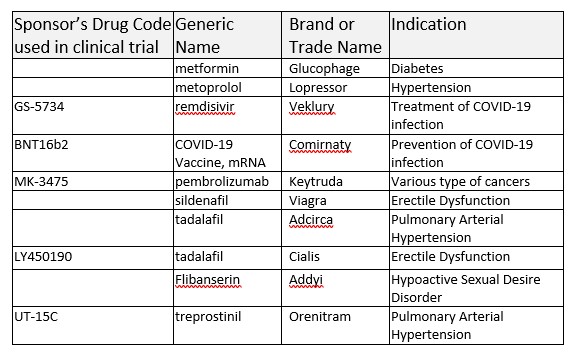
During the development stage, sponsors of the clinical trials may use their code for the compound or drug in the development. These drug codes will not be used when a drug is approved. For example, the famous drug from Merck 'pembrolizumab' has its own code MK-3475 that can be used in the clinical development stage and registered in clinicaltrials.gov, but will not be used as the name once the product is approved or marketed. Sponsor's drug code: MK-3475 - > generic name: pembrolizumab -> brand name: Keytruda. Similarly, Gilead's COVID-19 treatment drug has sponsor's drug code GS-5734 -> generic name: remdesivir -> Veklery. Pfizer/BioNTech's COVID-19 vaccine has sponsor's drug code: BNT16b2 -> generic name: COVID-19 Vaccine, mRNA -> brand name (proprietary name): COMIRNATY.

Here are some examples of the sponsor's drug code, generic drug name, brand drug name, and the corresponding indications.

When recording the drug name in clinical trials, either brand name or generic name can be recorded, but not the drug code used by the sponsors. 

Before the statistical analyses of the concomitant medication data, the data management group will perform appropriate medical coding activities to map the recorded brand name or generic name to the corresponding ATC classifications according to WHODrug-Global dictionary. 

Retire Statistical Significance and p-value? - Revisited

In 2019, there was a public debate about the use or misuse of statistical significance and p-values. I wrote a post about it "Retire Statistical Significance and p-value?"

Obviously, the hypothesis testing, statistical significance, and p-value are still the cornerstone of our clinical trials, the basis for judging if a clinical trial is a success, and the basis for the decision-making for regulatory approvals by the FDA and other regulatory authorities. 

In the latest issue of AMSTATNews and also the Annals of Applied Statistics, there is an article "The ASA President’s Task Force Statement on Statistical Significance and Replicability". The statements confirmed that the significance and p-values are here to stay. 
"P-values are valid statistical measures that provide convenient conventions for communicating the uncertainty inherent in quantitative results. Indeed, p-values and significance tests are among the most studied and best understood statistical procedures in the statistical literature. They are important tools that have advanced science through their proper application."

"p-values and significance tests, when properly applied and interpreted, increase the rigor of the conclusions drawn from data. Analyzing data and summarizing results are often more complex than is sometimes popularly conveyed. Although all scientific methods have limitations, the proper application of statistical methods is essential for interpreting the results of data analyses and enhancing the applicability of scientific results."

I would say the following about the significant tests and p-values:

  • We embrace it, not abandon it. 
  • We focus on the appropriate use and interpretation
  • We should not become the slave of the p-values

A quote from  Alfred Marshall, 1885:

"The most reckless and treacherous of all theorists is he who professes to let facts and figures speak for themselves, who keeps in the background the part he has played, perhaps unconsciously, in selecting and grouping them."

Monday, August 09, 2021

Randomized Withdrawal Design in Practice - Story of the HARMONY Trial

In previous posts, we discussed the "Randomized Withdrawal Design and Randomized Discontinuation Trial" and "Randomized Withdrawal Design - Examples for Defining the Criteria for Run-in and Randomized Withdrawal Periods".

Randomized Withdrawal Design (RWD) was discussed in FDA guidance "Enrichment Strategies for Clinical Trials to Support Determination of Effectiveness of Human Drugs and Biological Products" as one of the enrichment strategies and enable us to minimize the sample size of the study while demonstrating the efficacy of the experimental drug. 
"In a randomized withdrawal study, patients who have an apparent response to treatment in an open-label period or in the treatment arm of a randomized trial are randomized to continued drug treatment or to placebo treatment. Because such trials generally involve only patients who appear to have responded, this is a study enriched with apparent responders, an empiric strategy. The study evaluation can be based on signs or symptoms during a specified interval (e.g., BP, angina rate), on recurrence of a condition that had been controlled by the drug (e.g., depression), or on the fraction of patients developing a rate or severity of symptoms that exceeds some specified limit (i.e., a failure criterion). "

Even though the FDA encourages the use of the randomized withdrawal design in clinical trials, the use of RWD is still very limited, especially in pivotal, confirmatory studies. The reluctance in using the RWD is usually due to the safety concern - it will be perceived as unethical to discontinue the experimental treatment in the Placebo group when the experimental treatment has just been shown to be effective. Another concern is the size of the safety database - there is usually a sufficient number of patients exposed to the experimental drug so that the safety can be adequately assessed (see a previous post "The Size of Safety Database In Drug Development Program")

In the recent issue of the New England Journal of Medicine, the results of the HARMONY study (sponsored by Acadia Pharmaceuticals) were published: Tariot et al "Trial of Pimavanserin in Dementia-Related Psychosis". While the term 'randomized withdrawal' was not explicitly used in the study, the HARMONY study was a randomized withdrawal study and was described as the following:  
"a phase 3, double-blind, randomized, placebo-controlled discontinuation trial involving patients with psychosis related to Alzheimer’s disease, Parkinson’s disease dementia, dementia with Lewy bodies, frontotemporal dementia, or vascular dementia. Patients received open-label pimavanserin for 12 weeks. Those who had a reduction from baseline of at least 30% in the score on the Scale for the Assessment of Positive Symptoms–Hallucinations and Delusions (SAPS–H+D, with higher scores indicating greater psychosis) and a Clinical Global Impression–Improvement (CGI-I) score of 1 (very much improved) or 2 (much improved) at weeks 8 and 12 were randomly assigned in a 1:1 ratio to continue receiving pimavanserin or to receive placebo for up to 26 weeks. "
As we can see from the study design diagram below, all patients received pimavanserin during the open-label period. Those subjects who had responses to the pimavanserin (i.e., reduction in SAPS-H+D) were randomized to continue the treatment of pimavanserin or withdraw the treatment of pimavanserin (i.e., receiving the placebo). 


HARMONY Study protocol and SAP were posted on clinicaltrials.gov.  

Study Protocol  [PDF] July 16, 2010
Statistical Analysis Plan  [PDF] August 5, 2014

With the HARMONY study using a randomized withdrawal design, the sponsor was able to demonstrate the efficacy of pimavanserin in treating patients with dementia-related psychosis. The reduced sample size due to the use of the randomized withdrawal design was further reduced after the sponsor stopped the study early for positive efficacy. The sponsor subsequently submitted the sNDA for pimavanserin in treating patients with dementia-related psychosis. Unfortunately, they received a complete response letter from FDA citing the reasons not related to the study design but related to the insufficient sample size for certain sub-groups. 

Wednesday, July 28, 2021

FDA Regulatory Education for Industry (REdI) - Learning about FDA and Regulatory Science

FDA had their annual conference “FDA Regulatory Education for Industry (REdI)” last week. The REdI conference features three medical product center tracks: Drugs (CDER), Devices (CDRH), and Biologics (CBER). 

The recorded presentations by different tracks (drug, device, biological,...) are available on FDA's website and the conference agenda for this 5-day event is listed here. 

REdI presentations provide opportunities to learn directly from the FDA’s regulatory experts in medical product centers: drugs, devices, and biologics. This course is designed to provide participants with a strong, basic foundation in the FDA’s regulatory requirements.

The recording of the REdI conference are also posted on Youtube and separated by days 1 - 5.

Day 1: 


Day 2:


Day 3:


Day 4: 

Day 5: 


In Day 1 presentation by Dr. Bugin, the reorganized structure for various divisions under the Office of New Drug (OND) is revealed.