Showing posts with label data management. Show all posts

Sunday, June 26, 2022

Adverse event / serious adverse event data entry when death event occurs

If the death event is an efficacy endpoint in the study, should the death event still be reported as AE/SAE? 

If the death (or mortality) is an efficacy endpoint, the death event will ordinarily not be reported as AE/SAE. Only in some special situation, for example, a death due to anaphylactic reaction, car accident,... that are not related to the underlying disease, will the death be reported as AE/SAE. 

FDA's guidance Safety Reporting Requirements for INDs and BA/BE Studies clearly stated this: 

Generally, study endpoints refer to outcomes that sponsors are measuring to evaluate efficacy. For trials designed to evaluate the effect of a drug on disease-related mortality or major morbidity, endpoint information should be collected, tracked, and monitored, usually by a Data Monitoring Committee (DMC), during the course of the study. The protocol would prespecify a monitoring plan for determining whether subjects receiving the drug treatment are at higher risk for the outcome (e.g., all-cause mortality), and such results would be reported according to the protocol. The study endpoints must be reported to FDA by the sponsor according to the protocol, and ordinarily would not be reported as IND safety reports, except when there is evidence suggesting a causal relationship between the drug and the event (21 CFR 312.32(c)(5)). For example, a death ordinarily would not be reported as an individual case in an expedited report from a trial designed to compare all-cause mortality in subjects receiving either drug treatment or a placebo. On the other hand, in the same trial with an all-cause mortality endpoint, if the death occurred as a result of an anaphylactic reaction that coincided with initial exposure to the drug, or as a result of fatal hepatic necrosis, the death must be reported as an individual case in an IND safety report because there would then be evidence suggesting a causal relationship between the drug and the event (21 CFR 312.32(c)(5)).  
In our clinical trial "Dinutuximab and Irinotecan Versus Irinotecan to Treat Subjects With Relapsed or Refractory Small Cell Lung Cancer", the overall survival (time to death) was the primary efficacy endpoint. The death event would not be reported as AE/SAE and not recorded on AE/SAE case report form. It would be odd and inappropriate to record the AEs like "Death due to disease progression', 'death due to small cell lung cancer', 'death due to the underlying disease'. With Death being an efficacy endpoint, the death information should be recorded on separate case report form - Death Details form according to CDASH

Should death be reported as an event or an outcome of an AE/SAE?

Usually, when death event occurred, there were the adverse events leading to the death. The adverse event leading to the death will need to be reported as series adverse event with fatal outcome. The death is the outcome of a SAE and is not entered as an adverse event on its own. 

There are situations that the death is instantaneous or within very short period (for example one hour) of onset of symptoms or an unobserved cessation of life that cannot be attributed to a specific AE term. The death in this situation will be reported as Sudden Death or Sudden Death NOS on the AE case report form. 

If there are multiple ongoing AEs at the time of trial participant's death, should all these ongoing AEs be considered as SAEs with fatal outcome? 

This issue was discussed in a previous post "Recording the outcome for AE/SAE when multiple events contribute to Death". It is preferred in my opinion that a single AE/SAE should be identified as the primary cause for the death. This AE/SAE will have the fatal outcome recorded on the AE case report form. Other ongoing AEs at the time of death will have the AE outcome recorded as 'not recovered/not resolved"

How to fill out other fields on AE forms when death event occurs? 

As discussed above, for AE outcome, 'Fatal' should be selected for the AE/SAE that directly or primarily contribute to the study participant's death. 

For other ongoing AEs at the time of death, the AE outcome 'Not recovered or Not Resolved' should be selected.  


'Action Taken with Study Treatment' is another field on AE form and it is difficult to decide which choice should be selected when a death event occurs. 


At the time of death, there are two appropriate choices for 'Action Taken with Study Treatment": Dose Not Changed or Drug Withdrawn. Which choice to select depends on the sequence of the events: the last dose date/time in relevance to the death date/time. Assuming a study treatment with QD dose frequency, if the last dose date is the same as the death date or if the last dose date is one day prior to the death date, it is reasonable to assume that there is no dose withdrawn. Therefore, it is appropriate to select 'Dose Not Changed' for 'Action Taken with Study Treatment' field. On the other hand, if the last dose date is two days or earlier than the death date, it is appropriate to select 'Dose Withdrawn' for 'Action Taken with Study Treatment' field. 


Sunday, August 29, 2021

Drug names: brand name, proprietary name, trade name, generic name, and sponsor's drug code

Every Saturday, my favorite radio show is "Wait Wait... Don't Tell Me! | WUNC". In yesterday's episode, the host made fun of the brand name ('Comirnaty') of Pfizer/BioNTech Covid (Listen: 46.17 minutes).

Covid vaccines from Pfizer/BioNTech, Moderna, and J&J have become the household name in just about a year or so and have been administered to millions and millions of people under FDA's Emergency Use Authorization (EUA). Under the EUA, these vaccines are just called and differentiated by the company's name: Pfizer vaccine, Moderna vaccine, and J&J vaccine. However, when the vaccine (or any drug) is formally approved, according to the regulation, it must have a brand name - in the case of Pfizer/BioNTech Covid vaccine, the brand name is now 'Comirnaty'.

The meaning behind the name 'Comirnaty': Comirnaty is an agglomeration of the words “Covid-19 immunity” and “mRNA,” the latter indicating the technology that makes the vaccine work. As a whole, the word is intended to evoke “community,”

This brings a question about the drug names: the difference between the brand name and the generic name and how to record the drug names in clinical trials. According to the CDASH, the case report form will include a form for concomitant medication including the questions like

"What was the term for the medication/therapy taken?

or

"What was the term for the medication taken?"

Concomitant medications used by the study participants prior to the trial or during the trial period should all be recorded. Usually, there is no restriction on the medication term to be recorded. Either brand name or generic name can be recorded. 

The brand name of a medication is the name given by the company that makes the drug and is usually easy to say for sales and marketing purposes. The brand name may also be called the trade name. In FDA's guidance, the brand name is called proprietary name. The proprietary name of a drug product is its brand name. 

The generic name, on the other hand, is the name of the active ingredient. Generic drugs are copies of brand-name drugs that have exactly the same dosage, intended use, effects, side effects, route of administration, risks, safety, and strength as the original drug. In other words, their pharmacological effects are exactly the same as those of their brand-name counterparts. In FDA's guidance, the generic name may be called 'nonproprietary name' or 'proper name' for biological products. For biological products, the term proper name means the nonproprietary name designated by FDA in the license for a biological product licensed under the PHS Act. See also 105 21 CFR 600.3(k).

For drugs that make it all the way through development, testing, and regulatory acceptance, the pharmaceutical company then gives the drug a trade name, which is a standard term in the pharmaceutical industry for a brand name, trademark name, or proprietary name. The proprietary name must be approved by the FDA and included in the product label. FDA has its guidance for industry to govern the brand name approval process "Best Practices in DevelopingProprietary Names for HumanPrescription Drug Products".

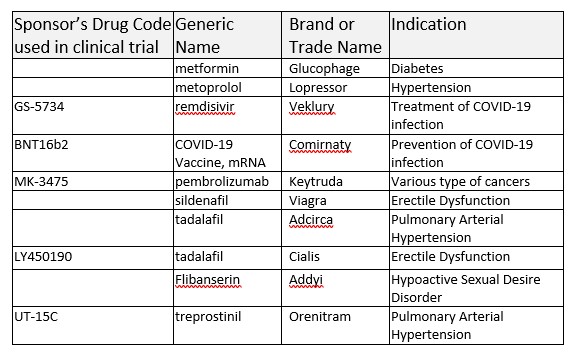
During the development stage, sponsors of the clinical trials may use their code for the compound or drug in the development. These drug codes will not be used when a drug is approved. For example, the famous drug from Merck 'pembrolizumab' has its own code MK-3475 that can be used in the clinical development stage and registered in clinicaltrials.gov, but will not be used as the name once the product is approved or marketed. Sponsor's drug code: MK-3475 - > generic name: pembrolizumab -> brand name: Keytruda. Similarly, Gilead's COVID-19 treatment drug has sponsor's drug code GS-5734 -> generic name: remdesivir -> Veklery. Pfizer/BioNTech's COVID-19 vaccine has sponsor's drug code: BNT16b2 -> generic name: COVID-19 Vaccine, mRNA -> brand name (proprietary name): COMIRNATY.

Here are some examples of the sponsor's drug code, generic drug name, brand drug name, and the corresponding indications.

When recording the drug name in clinical trials, either brand name or generic name can be recorded, but not the drug code used by the sponsors. 

Before the statistical analyses of the concomitant medication data, the data management group will perform appropriate medical coding activities to map the recorded brand name or generic name to the corresponding ATC classifications according to WHODrug-Global dictionary

Saturday, October 15, 2011

Will Electronic Data Capture be always better than Paper-CRF?

The traditional way to do the clinical trial data management is to use the paper based case report forms (CRFs). The blank paper CRFs are distributed to the investigator sites. The investigator or study coordinator fills out the CRFs. CRFs will then be monitored and collected from the investigator sites. CRFs will subsequently be handled by a centralized group - data management group where the activities include the clinical database building, data entry, data cleaning, data clarification,...

The industry trend has been gradually moving away from the paper-based CRFs and moving toward to the electronic data capture (EDC). In EDC world, the database was built prior to the study start (significant longer leading time prior to the study study is needed) . The data will be directly entered into the database by the investigator site (investigator or study coordinator). EDC has been touted by many vendors as the preferred way for conducting clinical trials: getting the data fast, saving timeline, saving cost, minimizing data transcription errors... While this is generally true, it is not universal.


In some situations, the trial using the traditional paper-based CRFs is a better way than EDC. For example, in a clinical trial for a rare disease, there are many investigator sites and each site may only enroll very few subjects or not enroll any subject. The EDC will not be an efficient way in data collection. Many site staff will be trained on EDC and never have chance to enroll any patient into the study and never have a chance to use EDC. When a site finally has a chance to enroll a subject, the initial training on using EDC may be a distant memory.

The EDC trial is not always cheap. With EDC trial, significant cost could be spent on the EDC system hosting and EDC system help desk support. Imagining a slow enrollment trial running for 7-8 years, the cost for hosting EDC system and providing the help desk support will be too much comparing to a paper-based study.

While EDC is a trend, the adoption of EDC is not universal. In some situations, the traditional paper CRFs may be better.