Showing posts with label RPSFTM. Show all posts

Tuesday, February 21, 2023

Analysis of Data from Open-Label Extension (OLE) Study

In the previous article, the open-label extension (OLE) study was discussed. The OLE study is usually designed as a separate study from the RCT (the parent study) with its own study protocol and a separate electronic data capture (EDC) system even though all participants in the OLE are rollovers from the parent study. 

When analyzing the data from the OLE study, the data from the parent study often needs to be considered or combined for the analysis. The data can be analyzed with three different baselines:

  • Baseline at the beginning of the OLE study - the data from the OLE study will be analyzed separately from the parent study
  • Baseline at the beginning of the parent study (at the randomization of the parent study (RCT)) – the data from the OLE study and the parent study are combined and delayed start analysis can be performed to look at the delayed effect or never catch up effect
  • Baseline at the first dose of the active drug – to look at the long-term trajectory of safety and efficacy variables for the experimental drug. For participants who were in the active arm of the parent study, the baseline would be at the randomization; for participants who were in the placebo arm of the parent study, the baseline would be at the beginning of the OLE study
If the efficacy outcome is a continuous variable, the delayed start analysis can be performed with the combined data from the parent and the OLE studies. See previous discussions: 

Here are some articles discussing the application of the delayed start analysis in this setting. One of the delayed start analysis approaches is to perform the non-inferiority test to see if the treatment difference observed at the end of the RCT is preserved at the end of the OLE. A non-inferiority margin is pre-defined, the Mixed Models for Repeated Measures (MMRM) method is used to analyze the combined data from the parent study (RCT) and the OLE study, and the results from MMRM analysis are compared to the non-inferiority margin.  

Two potential outcomes from the delayed start analyses are meaningful: 

Never catch up:
the placebo group (or delayed start group) will never catch up with the experimental treatment group after switching to the experimental treatment in the OLE study - suggesting the importance of the early treatment with the experimental drug and potential disease-modifying effect. For example, Chapman et al (2015) performed the delayed start analysis using the data from the double-blind trial and the subsequent open-label extension study. The results depicted below indicated the 'never catch up' scenario where the patients in the placebo group were never able to catch up with the AIPI (an enzyme augmentation treatment) group in terms of lung density change from baseline. 


Placebo group catch-up after treatment switching:

The placebo group (or delayed start group) catch up with the experimental treatment group after switching to the experimental treatment in the OLE study - emphasizing the treatment effects observed in the RCT. For example, Rosich et al (2022) performed the delayed start analysis using the data from a double-blind trial and its OLE study for the drug galcanezumab in patients with chronic migraine. After switching to galcanezumab doses at the start of OLE study (at month 3), the previous placebo group experienced a rapid mean reduction of 6.8 migraine headache days within the first month, catching up with the previous double-blind galcanezumab groups by month 4, and then maintaining that reduction over time.

If the efficacy outcome is overall survival (time to death), there is usually an insufficient number of death events from the randomized, controlled parent study for running the log-rank test or Cox regression. However, combining the data from the RCT and the OLE study, there may be enough death events for performing meaningful survival analyses. When performing the survival analysis using the data from the RCT and the OLE study, the start of the OLE study can be considered as treatment crossover or treatment switching - a situation often occurs in oncology clinical trials. Different approaches have been proposed to handle the treatment crossover or treatment switching due to the transition from the RCT to OLE study. These approaches were summarized in EMA's documet "Question and answer on adjustment for cross-over in estimating effects in oncology trials" and in a presentation by Norbert Hollaender (2014) "Methods to estimate survival time after treatment switching in oncology – overview and practical considerations".

Compared to the traditional intention-to-treat approach, it is better to perform the overall survival analyses using more sophisticated methods (such as the rank preserving structural failure time (RPSFT) method and The Inverse Probability of Censoring Weighting (IPCW) to adjust for treatment crossover or treatment switching due to the transition from the RCT to OLE study.  

Sunday, January 15, 2023

Rank Preserving Structural Failure Time Model (RPSFTM) to account for treatment crossover

In a previous post "Treatment crossover in parallel-group, randomized, controlled clinical trials", treatment crossover was discussed. Treatment crossover (or treatment switching) occurs when patients switch from their randomized arm to the other treatment during the study. In handling the treatment crossover, the naïve approaches (such as ITT analysis, exclusion of the treatment crossover subjects, and censoring at the time of the crossover) can cause a biased estimate of the treatment difference. More sophisticated approaches are needed to handle the treatment crossover. One of these approaches is called 'Rank Preserving Structure Failure Time Model (RPSFTM)". 

RPSFTM method was proposed by Robins and Tsiatis (1991) in their paper "Correcting for Non-Compliance in Randomized Trials Using Rank Preserving Structure Failure Time Models". The RPSFTM is a method used to adjust for treatment switching in trials with survival outcomes. The method is randomization based and uses only the randomized treatment group, observed event times and treatment history in order to estimate a causal treatment effect. The treatment effect is estimated by balancing counter-factual event times (i.e. the time that would be observed if no treatment were received) between treatment groups. 

We are seeing examples of RPSFTM application in oncology trials (especially open-label randomized trials) and in rare disease clinical trials. 

Hussain et al (2022) published a paper on NEJM "Survival with Olaparib in Metastatic Castration-Resistant Prostate Cancer". The results were from an open-label, phase 3 trial where patients were randomly assigned in 2:1 ratio to receive olaparib or physician's choice of enzalutamide or abiraterone plus prednisone as the control therapy. Patients in the control therapy group were allowed to be crossed over to olaparib after imaging-based disease progression criteria were met. Overall survival was analyzed using the naïve approach (intention-to-treat approach). Sensitivity analysis using the RPSFTM method was then performed to adjust for control patient crossover to olaparib.  Kaplan-Meier plots for the observed data and for crossover-adjusted analysis were depicted below: 


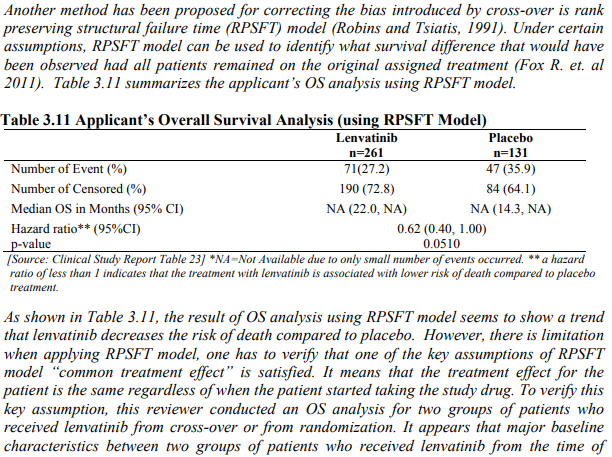
EISAI's Lenvatinib was approved for the treatment of patients with progressive, radioiodinerefractory differentiated thyroid cancer. The NDA approval was based on a pivotal study (Study 303). Study 303 is an international, double-blind, randomized 2:1, placebo-controlled, parallel-group, 2-arm trial. Patients would receive lenvatinib or placebo daily and could be treated until disease progression confirmd by IIR (RECIST v1.1) or unacceptable toxicity. The primary endpoint was progression-free survival with secondary endpoints of ORR and overall survival. Patients randomized to the placebo arm who had confirmed progression could choose to cross over and receive open-label lenvatinib. Overall survival was analyzed with the pooled data from the randomized portion of the study and the optional open-label extension phase. The effect of lenvatinib on overall survival was potentially confounded by the crossover of 83% of patients on the placebo arm to receive lenvatinib in the optional open-label (OOL) extension Phase.

The rank preserving structural failure time (RPSFT) model was then used in OS analysis to correct the bias introduced by cross-over and estimate the true treatment effect on OS. Here is the reference of RPSFT in the FDA's statistical review:


Amylyx's RELYVRIO was approved by FDA for the treatment of ALS. The approval was based on a pivotal study (CENTAUR) and its open-label extension study (CENTAUR-OLE). The pivotal CENTAUR study was a randomized, placebo-controlled, double-blind, 24-weeks study in patients with ALS. Patients who completed 24-week randomized treatment were rolled over to an open-label extension study where all patients received the active drug. Patients in the active drug group in the randomized trial would continue with the active drug in the open-label extension study; patients in the placebo group in the randomized trial would switch or cross over to the active drug. To provide substantial evidence of the effectiveness of the active drug, the sponsor performed the analyses for long-term overall survival with the combined data from the randomized study and the open-label extension study. RPSFTM method was employed to handle the switch or crossover of the placebo patients in the randomized study to active drug in the OLE. Here is the description of the RPSFTM analysis from the briefing book for FDA Adcom


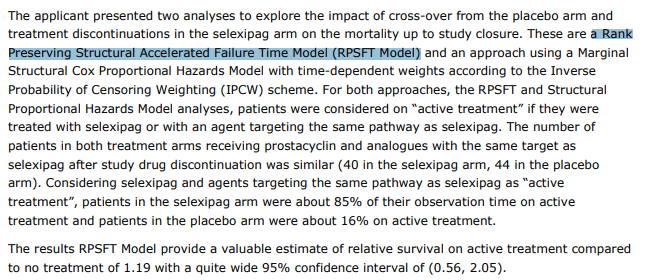
The drug Uptravi was approved for the treatment of pulmonary arterial hypertension. The efficacy and safety were based on a pivotal study followed by an open-label extension study. The pivotal study was designed as an event-driven study where patients who had clinical worsening events would be rolled over to the open-label extension study. The placebo patients in the randomized study would switch or cross over the active drug in the open-label extension study. While the randomized study showed the treatment benefit in reducing the risk of clinical worsening events, there was an imbalance in the number of deaths (more death events in active drug group than the placebo group).  The analyses for long-term overall survival with the combined data from the randomized study and the open-label extension study became necessary to mitigate the concern about the imbalance in the number of deaths observed in the randomized trial. RPSFTM method was employed to handle the switch or crossover of the placebo patients in the randomized study to the active drug in the OLE. EMA's assessment report described the RPSFTM analyses. 


An add-on package (RPSFTM) publically available for fitting rank preserving structural failure time models is available for R (Bond and Allison, 2017), and can be installed from the CRAN web portal. A SAS program was written by Bradford J. Danner and Indrani Sarkarto to perform RPSFTM analysis
 

 Additional References: