Showing posts with label Interim analysis. Show all posts

Monday, February 16, 2026

The Statistical Magic Trick: How Trials Share Results While Staying Blind


In the world of clinical research, "breaking the blind" is typically a cardinal sin. Yet, high-stakes Phase 3 trials like ORIGIN 3 (atacicept), PROTECT (sparsentan), and ATTRIBUTE-CM (acoramidis) have all successfully navigated the complex path of publishing interim results in the New England Journal of Medicine while keeping their long-term studies scientifically intact.

How do they pull off this statistical magic trick? It comes down to a rigorous architectural separation of data and people including statistical analysis team. Here is a look at the techniques used to maintain the "blind" during interim disclosures.

1. The "Firewall" Strategy: Independent Reporting Teams

The most critical technique used across all three studies is the creation of a "Firewall."

While a trial is ongoing, the people running the study (Sponsor clinical teams, investigators at hospitals, and the patients) must remain blinded. To perform an interim analysis, the Sponsor appoints an Independent Reporting Team (IRT) or an Independent Statistical Center.

  • How it works: This group has no contact with the study sites. They receive the raw "unblinded" data, perform the calculations for the primary endpoint (like the 36-week proteinuria reduction in PROTECT or ORIGIN 3), and prepare the manuscript for publication.
  • The Result: The people actually treating the patients remain in the dark, ensuring their medical decisions aren't influenced by knowing who is on the "winning" drug.

2. Safeguarding Against "Functional Unblinding"

In some trials, the drug’s effect is so obvious it could accidentally reveal the treatment.

  • In ORIGIN 3: Atacicept significantly lowers serum IgA and IgG levels. If a doctor saw these lab results, they would immediately know the patient was on the active drug. To prevent this, these specific lab values are suppressed. The results are sent to the Independent Reporting Team but are hidden from the investigators and the Sponsor’s site monitors.
  • In PROTECT: This study compared two active drugs (sparsentan vs. irbesartan). To ensure the difference in pill appearance didn't tip anyone off, they used a Double-Dummy design. Every patient took two sets of pills—one active and one placebo—so the physical routine remained identical for everyone.

3. Aggregate vs. Individual Disclosure

A common misconception is that "publishing the results" means everyone knows who got what. In reality, the NEJM publications for these trials only disclose aggregate data (group averages), not the individual patient level data.

  • In ATTRIBUTE-CM: When the Part A results (12-month 6-minute walk distance) were disclosed, the public learned how the group performed. However, the individual treatment assignments for each patient remained locked in the secure database.
  • The Benefit: Even if an investigator reads the NEJM article and sees that acoramidis is effective, they still do not know if the specific patient sitting in their office is receiving acoramidis or the placebo.

4. Prespecified Alpha Spending and "The Gatekeeper"

To maintain the statistical integrity of the final results (like the 104-week kidney function in ORIGIN 3 or the 30-month clinical outcomes in ATTRIBUTE-CM), the Statistical Analysis Plan (SAP) dictates exactly how much "statistical credit" is used during the interim look.

  • The Independent Data Monitoring Committee (iDMC) acts as the gatekeeper. They review the unblinded data behind closed doors and only allow the trial to proceed if the interim disclosure doesn't compromise the "power" of the final analysis.

Why go through all this trouble?

The goal is Accelerated Approval. By using these techniques, sponsors can show the FDA (and the medical community) that a drug works on a "surrogate marker" (like proteinuria) at an interim stage. This allows life-saving drugs to reach patients years earlier, while the "blinded" portion of the trial continues to gather the long-term data needed for full, traditional approval.

By combining physical dummies, suppressed lab data, and strict "firewalls" between statistical teams, researchers prove that you can indeed share the news of a trial's success without ruining the science that supports it.

Some Extra Words on ATTRIBUTE-CM Study

ATTRIBUTE-CM study is a phase 3, double-blind trial, 632 patients with transthyretin amyloid cardiomyopathy were randomly assigned in a 2:1 ratio to receive acoramidis hydrochloride at a dose of 800 mg twice daily or matching placebo for 30 months. The study contained two parts: Part A with primary endpoint of change from baseline to Month 12 of treatment in distance walked during the 6MWT, Part B with primary endpoint of a hierarchical combination of All-Cause mortality and CV-related hospitalization over a 30month period.

There were two readouts for the study and the Part A readouts were based on an interim analyses by the independent DMC. 

In December 2021, BridgeBio Pharma experienced a major setback when its Phase 3 ATTRibute-CM trial for acoramidis (a treatment for transthyretin amyloid cardiomyopathy - ATTR-CM) failed to meet its primary endpoint of improving the 6-minute walk distance (6MWD) at Month 12 (Part A primary efficacy endpoint). In the initial 12-month data, patients taking acoramidis did not show a statistically significant improvement in their 6MWD compared to those on a placebo.

Despite the failure of the 6MWD endpoint at 12 months, the study continued because the independent data monitoring committee noted encouraging trends in other areas. By July 2023, BridgeBio reported positive top-line results from the full study (Month 30), where acoramidis demonstrated a highly statistically significant improvement in a hierarchical analysis that included mortality, hospitalization, and 6MWD (Part B primary efficacy endpoint). 

Following the successful long-term data (Part B), which showed a 25% reduction in all-cause mortality and 50% reduction in cardiovascular hospitalization frequency (known as Attruby), the drug was approved by the FDA, with 3,751 prescriptions filled as of August 2025.

The study included an embedded Part A readouts that required the unblinding for interim analysis. The sponsor specified the following for maintaining the blinding for the overall study while the Part A results were analyzed and disclosed.


Friday, March 03, 2023

Risk of Stopping Trial Early for Treatment Benefit - Story of Veru's Sabizabulin for Treatment of Covid

Today, we learned that FDA declined to approve the emergency use authorization (EUA) for Veru's sabizabulin for the treatment of Covid. The decision is not surprising given that in Nov 9, 2022, the FDA advisory committee voted 8-5 against the sabizabulin treatment aimed at hospitalized patients with moderate to severe infection who are at high risk for acute respiratory distress syndrome.

However, this case is a perfect example demonstrating the risk of stopping a clinical trial early for treatment benefit (or for overwhelming efficacy). 

The pivotal study was an international, multicenter, randomized, double-blind, placebo-controlled, parallel group study of 60 days duration that evaluated the efficacy and safety of VERU-111 (sabizabulin) in hospitalized adult subjects with COVID-19 infection described as being at “high risk for ARDS”. Subjects were included if they met criteria for World Health Organization (WHO) ordinal scale category 5 (non-invasive ventilation or high-flow oxygen) or category 6 (mechanical ventilation); or category 4 (oxygen by mask or nasal prongs) with the following comorbidities: asthma, chronic lung disease, diabetes, hypertension, severe obesity (BMI ≥40), 65 years of age or older, primarily residing in a nursing home or long-term care facility, immunocompromised. The primary efficacy endpoint is all-cause mortality at Day 60. 

According to the study protocol, approximately, 300 subjects were planned to be randomized at a 2:1 ratio into two treatment arms (200 subjects in the VERU-111 treated group and 100 subjects in the Placebo treated group). The protocol also pre-specified a formal interim analysis conducted by an independent data monitoring committee:

An efficacy interim analysis of the primary endpoint, all-cause mortality at Day 60, will be conducted when approximately 67% of the subjects (~200 subjects) have completed day 60, died or withdrawn for other reasons. The interim and final analyses will follow an O'Brien-Fleming group sequential design, with a plan of stopping the trial at the interim analysis if the results are statistically significant in favor of VERU-111. The criterion for efficacy at the interim analysis will be a two-sided 0.0121 p-value (a one-sided p-value <=0.0061 in favor of VERU-111). If the criterion is not met, the trial will continue, and the final analysis will have a criterion for efficacy of a two-sided p-value <=0.0463 (one-sided 0.0232 in favor of VERU111).

The formal interim analysis was conducted after 204 patients were randomized into the study and followed up to 21 days (134 patients in Sabizabulin group and 70 patients in Placebo group). Sabizabulin treatment resulted in a 24.9 percentage point absolute reduction and a 55.2% relative reduction in deaths compared with placebo (odds ratio, 3.23; 95% CI confidence interval, 1.45 to 7.22; P=0.0042). The mortality rate was 20.2% (19 of 94) for sabizabulin versus 45.1% (23 of 51) for placebo.

Given that the p-value 0.0042 is less than the criterion for stopping the trial for efficacy (0.0121), the sponsor (Veru) stopped the study and declared the overwhelming efficacy in the hope of FDA's approval for emergency use authorization. 

The interim analysis results were then published in the top medical journal - New England Journal of Medicine "Oral Sabizabulin for High-Risk Hospitalized Adults with Covid-19: Interim Analysis".

The original sample size of 300 patients was already pretty small in trials for the treatment of COVID-19. The sample size was further decreased due to the early stop for 'overwhelming' efficacy. During the FDA's review, the small sample size was one of the big issues. FDA expressed their concern about the evidence for supporting the benefit outweighing the risk in their briefing document provided for the advisory committee:  

The FDA Review team acknowledges that Study 902 met its prespecified primary endpoint of all-cause mortality at Day 60. We also note that the VERU-111 program is quite small in size compared to other therapeutic programs for patients hospitalized with COVID-19. As detailed in the briefing document, our review has identified a number of uncertainties with the data, which we raise in the context of this small trial in critically ill patients. These include:
  • High placebo group mortality rate
  • Potential for unblinding events with enteral tube administration
  • Baseline imbalances in standard of care therapies
  • Differences in hospitalization duration prior to trial enrollment
  • Uncertain effects of goals of care decisions on all-cause mortality
  • Negative studies with other microtubule disruptors in COVID-19 
  • Uncertainty in identification of a clinically relevant patient population 

Based on our review, none of these uncertainties or imbalances alone invalidate the mortality benefit observed in Study 902, but all of these issues together in a small trial which is more vulnerable to imbalances raise questions about the results. We conducted sensitivity analyses to investigate the potential impact of the noted imbalances. However, these analyses cannot eliminate the concern that certain baseline imbalances across treatment groups may have impacted study outcomes, due to the small study size. In addition, these issues raise concern that, even when using an objective endpoint such as mortality, observed results can be subject to biases in a small trial of short duration in critically ill patients. We ask the AC panel to consider these uncertainties together and how they affect the interpretation of the mortality data. 

When considering whether to authorize the emergency use of a product under EUA, the Agency must determine, among other requirements (see section 2.1.3), whether “the known and potential benefits of the product when used to diagnose, prevent, or treat the identified serious or life-threatening disease or condition, outweigh the known and potential risks of the product”. Evaluation of the potential risks in the VERU-111 development program is limited by the atypically small safety database, comprising a total of 149 subjects who received VERU-111 for the proposed use in COVID-19. While the small safety database limits our ability to identify clinically significant safety signals, potential safety signals identified in our review are urinary tract infections (including serious infections), ......

There is no guarantee that Veru's EUA application would be approved had the study not been stopped early. But I think that the chance of EUA approval would be much higher if the study was allowed to be completed according to the protocol and 100 additional patients were randomized into the study. To decide whether a study should be stopped early for efficacy, the stopping criterion is not the only factor to consider. I wished that the sponsor had consulted with the regulatory authorities before the decision to stop the study early for efficacy. 

On a separate note, FDA's "Good Review Practice: Clinical Review of Investigational New Drug Applications" spelled out their concerns about early stopping for efficacy:


Sunday, January 09, 2022

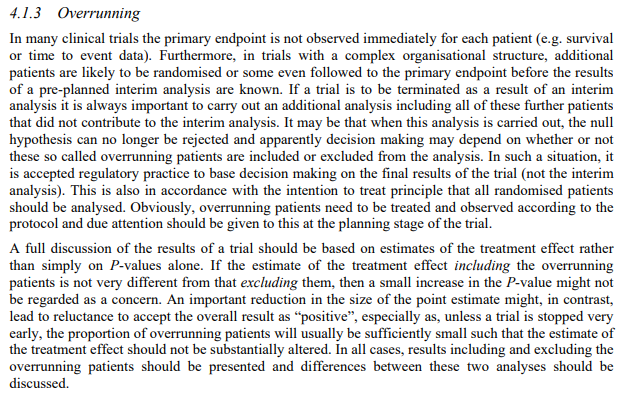
Overrunning issue at the interim analysis for group sequential design

It is pretty common these days that clinical trials (especially the late phase, adequate, and well-controlled studies) employ interim analyses to determine if the efficacy results are too good so that the study should be stopped early for overwhelming efficacy, or if the efficacy results are not good so that the study should be stopped early for futility, or both. A study with formal interim analyses to look at the comparative efficacy is called 'group sequential design' even though the 'group sequential design' may not be formally used in the study protocol. Group sequential design is the most common type of adaptive design as described in the FDA guidance "adaptive designs for clinical trials". 

As mentioned in an early post "overrunning issues in adaptive design clinical trials", one of the issues with interim analyses in group sequential design is the overrunning issue. Overrunning consists of extra data, collected by investigators while awaiting results of the interim analysis (IA). Overrunning is the 
phenomenon that data will continue to accumulate after it is decided to stop a trial (Whitehead, 1992). In many cases there will be patients who have already been admitted to the trial but whose responses are not yet known. Also some extra patients will enter the trial because of the delay between the moment the data for the final interim analysis were retrieved, and the moment participating clinical centers receive instruction to stop recruitment.

EMA guidances "reflection paper on methodological issues in confirmatory clinical trials planned with an adaptive design" had a full paragraph discussing the overrunning issue: 


When planning for an interim analysis, the decision needs to be made about the timing of the interim analysis and what data is to be included in the interim analysis. For an event-driven study where the number of events is the endpoint, the timing of the interim analysis can be based on the percentage of the events, for example, the interim analysis can be performed when 50% of the total number of events are accrued. In other words, once 50% of the total number of events is achieved. For a longitudinal design, the endpoint is measured at various intervals. At any time during the study, there will be patients at different stages of the study (reaching the end of the study, reaching a specific duration of the study, or just being randomized into the study). It is more difficult to determine a good timing for interim analysis. Suppose that an interim analysis is planned when 50% of subjects reach the end of the study, by that time, there will be plenty of subjects in the various stage of the study already, just having not reached the end of study yet. If the study enrollment is pretty fast and the study endpoint is pretty long (for example 52 weeks), by the time 50% of subjects reach the study endpoint, the majority of subjects (if not all) have already been randomized into the study. 

If the interim analysis results trigger the recommendation of discontinuing the study early (either for efficacy or futility), the debate is whether the interim analysis needs to be re-run by including the overrunning subjects before adopting the recommendation to discontinue the study early. 

This exact issue about the handling of the overrunning subjects was discussed in Biogen's aducanumab clinical trials in Alzheimer's disease. As I discussed in a previous post "Futility Analysis and Conditional Power When Two Phase 3 Studies are Simultaneously Conducted", Biogen made the wrong decision and discontinued its pivotal studies (EMERGE and ENGAGE) where one of the studies was later found to have statistically significant treatment effects. The wrong decision was driven by two issues: 

  • they calculated the conditional powers based on the pooled data from both studies (instead of calculating the conditional powers separately based on the data from individual studies) - this was discussed in the previous post
  • they stopped the study early without re-running the interim analysis by including the overrunning subjects. 

The overrunning issue was mentioned in a recent article in the Wall Street Journal (Jan 4, 2022) "How Biogen Fumbled Its Alzheimer's Drug ---Once-promising Aduhelm is pricey and without proven efficacy"

"By evaluating data midstream in approval-seeking trials, companies can try to predict whether a drug will succeed if the trial continues. Stopping trials early for "futility," in industry parlance, can save millions of dollars and prevent patients from investing hope on an ineffective drug.

In a March 2019 meeting, Biogen executives on a small "senior decision team," as the company called it, concluded that the trials were doomed. Biogen pulled the plug and asked researchers around the world to shut down trials. It told more than 3,000 Alzheimer's patients who had volunteered that they would no longer receive treatment.

Biogen stock fell by nearly 30% the day of the announcement.

Biogen executives made errors in shutting down the trials. The trial plan called for analyzing data after half of patients completed the study treatment in late December 2018. By the time Biogen completed the analysis in March 2019, three more months of additional data were available -- but the decision team didn't scrutinize the additional data before the company halted the trials, Biogen has said.

A Biogen consultant in the summer of 2018 recommended to senior Biogen statisticians that they consider all available trial data, according to a person involved in the process. The consultant cautioned them that a plan to leave out consideration of additional trial data after the cutoff date -- and to leave out certain data from patients in the trial before the cutoff -- would open up Biogen to criticism and scrutiny, the person said. The statisticians didn't heed the consultant's advice, and it isn't clear whether the decision team or management considered the recommendation, the person said.

Biogen declined to comment on past discussions with its consultants but said it followed its pre-established statistical-analysis plan.

The decision not to consider the three months of additional data was a misstep, said some clinical-trial experts and statisticians. "Additional data after a study stops is called 'overrunning.' We plan for it," said Scott Emerson, a professor emeritus of biostatistics at the University of Washington who served on an FDA advisory committee that recommended against approving Aduhelm in November 2020. "In this case, the overrunning data was large."

The Biogen spokeswoman said: "Our decision to stop the trials, though clearly incorrect in hindsight, was based on putting patients at the forefront -- as it always should be. Cost was not considered in determining futility."

Only in the weeks after the trials stopped did Biogen scientists complete a preliminary analysis of the overrunning data and recognize their mistake, the Biogen spokeswoman said. The data seemed to show that one of the trials would have produced positive results, despite the likelihood of a negative outcome in the second trial. Initially, Biogen had analyzed combined data from both trials."

Even though the aducanumab was finally approved by FDA through the accelerated approval pathway, the approval was very controversial - the first drug and the only drug so far that was approved based on studies that had been stopped early for futility. There are strong pushback from academic about the use of aducanumab because of its unapproved efficacy and perhaps also because of the drama of resurrecting a drug that was declared failed. 

We all wonder: had these two pivotal studies not been stopped for futility by the sponsor, what would be the situation now for aducanumab? 

Saturday, January 01, 2022

Futility Analysis and Conditional Power When Two Phase 3 Studies are Simultaneously Conducted

In late-phase clinical trials, an independent Data Monitoring Committee (DMC) is usually set up. If the clinical program includes multiple late-phase studies, the same DMC will be responsible for the entire program. With DMC, the interim analyses can be performed for different purposes:
  • The interim analysis for safety
    • with pre-specified stopping rule (for example stop the trial if the significant imbalance in # of Serious Adverse Events or in # of deaths)
    • without pre-specified stopping rule (rely on DMC members to review the overall safety)
  • The interim analysis for efficacy: To see if the new treatment is overwhelmingly better than the control group  - then stop the trial for efficacy
  • The interim analysis for futility (futility analysis): To see if the new treatment is unlikely to be better than the control group or the study will be unlikely to achieve its objective given the data at the interim – then stop the trial for futility.
There seem to be more studies with built-in futility analysis without interim analysis for overwhelming efficacy, mainly because of the concerns about the alpha-spending for efficacy. The futility analysis will have an impact on the beta-spending and the statistical power, but not on the alpha-spending. For the decision-making, regulatory agencies are usually more concerned about the alpha level (incorrectly approves a drug that does not work) or the alpha level inflation. The sponsors are more concerned about the statistical power (incorrectly concludes a drug not working while the drug is actually working).

Futility analysis usually requires calculating the Conditional Power (CP) that is defined as the probability that the final study result will be statistically significant, given the data observed thus far at the time of the interim data cut and a specific assumption about the pattern of the data to be observed in the remainder of the study, such as assuming the original design effect (alternative hypothesis) or the effect estimated from the interim data.  

If there is one single pivotal trial, the stopping rule and the CP are relatively straightforward. However, it is uncommon that the sponsor may need to conduct two pivotal (phase 3) studies (two adequate and well-controlled (A&WC) trials in FDA's term) to demonstrate substantial evidence of effectiveness as outlined in FDA guidance for industry "Demonstrating Substantial Evidence of Effectiveness for Human Drug and Biological Products Guidance for Industry".

For a clinical program with two independent A&WC trials (usually with identical design), the futility analysis and CP calculation are a little bit more complicated. Two independent A&WC trials may have an identical design but be executed differently (i.e., may not be started at the same time; may be conducted in different geographic regions/countries; and may have different enrollment speeds,...). 

When futility analysis is performed for two A&WC trials, should the conditional powers be calculated for individual studies separately or should the conditional powers be calculated for both studies together (i.e. pooled data from both studies)? 

When there are two identical A&WC trials, the interim analysis for safety should be based on the pooled data sets from both studies because it will give a more definitive answer to the safety issues, the interim analysis for efficacy should be based on the individual study data because the decision about the overwhelming efficacy should be based on the individual study, not the integrated data from two studies; the interim analysis for futility is a little bit more complicated and the decision to use the data from an individual study or to use the data from the pooled data seems to be dependent on how close the observed results from two A&WC trials are at the time of the interim analysis. 

For futility analysis using stochastic curtailment procedure, While CPs can be calculated for each individual study assuming that the treatment effect in the remaining subjects in the same study will follow the treatment effect estimated from the data of this same study at the time of the interim data cut, 

There is an alternative way to calculate the CP, i.e., to calculate the CP for each individual study, but use the observed treatment effect from the pooled data at the interim from both studies to project the trend and pattern for the remaining subjects. 

According to the paper by Lan and Wittes (1988) "The B-Value: A Tool for Monitoring Data", the CP calculation involves the decomposition of overall critical value (B-value or B1 for example) into the sum of two statistically independent interval B-values: 
  • Bt, the value of B that accumulated up through time t when interim analysis is conducted; and 
  • (B1 - Bt), the incremental value of B that accumulates from time t through the end of the study. The legitimacy of the decomposition follows from the independence of distributions of the outcomes for successive study subjects
At the time t when the interim analysis is conducted, Bt is known and is estimated from the observed data up to the time t. (B1 - Bt) is a random variable that needs to be estimated. The conditional power is derived by fixing Bt and calculating the probability that Bt + (B1 - Bt) will exceed Z1-a/2.

To calculate the CPs when there are two identical A&WC studies, t, as a measure of the information fraction, will be different for different studies. At the time t, maybe 60% of subjects have been enrolled in study #1 while 50% of subjects are enrolled in study #2. In CP calculations, the Bt part will be obtained from the individual study. The (B1-Bt) part is estimated assuming the remaining data following the observed effect up to the interim time t, should the observed effect up to the interim time t be based on the data from the individual study or from the pooled data?

It turns out both approaches can be used: 
  • estimate the treatment differences for each individual study and calculate the CP assuming that the reminding data follows the trend and pattern based on the observed data from individual study
  • estimate the treatment difference from both studies and calculate the CP assuming that the remaining data follow the trend and pattern based on the observed data from the pooled data of two studies.           
For both of these approaches, the CPs will be calculated for each individual study (therefore one CP for each study). The difference between these two approaches is in the calculation of the (B1-Bt) part - based on the individual study itself or based on the pooled data from both studies. 

We can take a look at the famous and controversial case in Biogen's aducanumab program in Alzheimer's disease. Aducanumab program in Alzheimer's diseases consisted of two pivotal, phase 3 studies (EMERGE (study 301) and ENGAGE (study 302)), and both studies were designed the same and conducted simultaneously globally. Each study had two active arms (low dose and high dose of aducanumab) versus placebo - therefore two hypothesis tests (low dose vs. placebo and high dose vs. placebo). There was a total of four hypothesis tests (two for each study).  The protocol and SAP specified the interim analysis for futility. 

An interim analysis was performed after approximately 50% of the subjects had the opportunity to complete the Week 78 visit for both EMERGE and ENGAGE studies. An interim analysis for the futility of the primary endpoint was performed to allow early termination of the studies if it was evident that the efficacy of aducanumab was unlikely to be achieved. The futility criteria were based on conditional power, which was the chance that the primary efficacy endpoint analysis would be statistically significant in favor of aducanumab at the planned final analysis, given the data at the interim analysis. The CP was calculated assuming that the future unobserved effect was equal to the maximum likelihood estimate of what is observed in the interim data. 

For each study, two CPs were calculated. The pre-specified CP calculation was to use the pooled interim data from both EMERGE and ENGAGE studies for the (B1-Bt) part and assume that the treatment effect for the remaining of the study would follow the observed treatment effect at the interim analysis. At the interim analysis, the CPs were calculated to be 13% for low dose vs placebo and 0% for high dose vs. placebo in EMERGE study, and 11% for low dose vs placebo and 12% for high dose vs. placebo in ENGAGE study. Given all four CPs were lower than the threshold of 20% (a criterion for futility), the DMC recommended stopping both studies for futility.  Biogen followed the DMC recommendation and stopped both EMERGE and ENGAGE studies for futility
.

Only after two terminated studies were wrapped up, the reanalyses of the final data indicated that there were statistically significant treatment differences in one of the studies (the ENGAGE study). With the help of the FDA, Biogen was able to submit the BLA and obtain approval for aducanumab for Alzheimer's disease. Leading to the FDA approval, there was an advisory committee meeting to review the aducanumab data. In FDA's presentation, the conditional powers were retrospectively re-calculated - this time, the conditional powers were calculated for each individual study and assumed future unobserved effect would be similar to the interim data for each individual study (not the pooled interim data). FDA claimed that CPs using this approach were more appropriate and would have one of the four CPs above the threshold of 20% (CP=59% for high-dose vs placebo in ENGAGE study) - the studies would not be recommended for stopping for futility. 


Retrospectively, CPs calculated for each study independently (not using the pooled interim data to project the trend and pattern for the remaining data) seemed to be better in Biogen aducanumab program consisting of two A&WC trials. 

However, in a paper by Deng et al "Superiority of combining two independent trials in interim futility analysis", CP calculation using the observed treatment effects from the pooled interim data from two studies was considered a better approach. It concluded, "it is demonstrated that by leveraging data from the other study, the probability of making correct interim decision is increased if the treatment effects are similar between the two studies, and such benefit remains even if there is small to moderate between-study difference."

It is probably true that CP calculation using the pooled data at the interim to project the trend and pattern for the remainder data is a better approach if two studies are conducted in the same way and the results at the time of the interim analysis are similar. However, the CP calculation and the statistical analysis plan for interim analysis are usually pre-specified before seeing the unblinded data. At the time of the interim analysis, it is usually unknown whether or not the results (treatment effects) observed from two identical studies will be similar. Even though two A&WC studies are designed the same, the operation and execution of the trial can still be different: two studies may be conducted in different countries, enrollment speed may be different,... As evidenced by Biogen's EMERGE and ENGAGE trials, two identical designed studies may have different results - therefore calculating the CP entirely independently for each study may be more appropriate when two identical A&WC trials are conducted.