Tuesday, August 15, 2023

Platform trials in action beyond oncology trials

One of the complex innovative designs is the study with 'Master protocol' that has been getting popularity in recent years. Master protocol simply refers to the study of more than one drug with a single protocol. In clinical trials with Master protocol, the protocol document stands alone, without reference to specific drugs. Protocol amendments (or study-specific protocol) are used to provide details of each drug. Master protocols establish a trial network with infrastructure in place to streamline trial logistics and improve data quality, and facilitate data sharing and new data collection. Master protocols develop a common protocol for the network that incorporates innovative statistical approaches to study design and data analysis.


Platform trial is one type of Master protocol and refers to establishing the trial infrastructure and master protocol as a perpetuating effort, with drugs entering and leaving the platform.

Two prominent references for master protocols and platform trials are the following: 

 "Master Protocols to Study Multiple Therapies, Multiple Diseases, or Both" in 2017 by Woodcock and LaVange defines Master protocols include three type of trials: Umbrella, basket, and platform trials. 
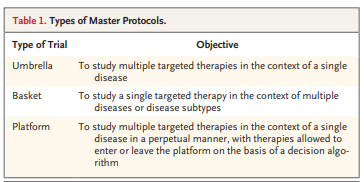


FDA procedural guidance in 2022 "Master Protocols: Efficient Clinical Trial Design Strategies to Expedite Development of Oncology Drugs and Biologics Guidance for Industry" provided the definition for Master protocols:
a master protocol is defined as a protocol designed with multiple substudies, which may have different objectives and involve coordinated efforts to evaluate one or more investigational drugs in one or more disease subtypes within the overall trial structure.
A master protocol may be used to conduct the trial or trials for exploratory purposes or to support a marketing application and can be structured to evaluate, in parallel, different drugs compared with their respective controls or to a single common control. The sponsor can design the master protocol with a fixed or adaptive design with the intent to modify the protocol to incorporate or terminate individual substudies within the master protocol. 

Master protocols can include basket trial, umbrella trial, and platform trial and these trials can be schematically displayed as the following: 

Basket trial

Umbrella Trial
Platform Trial:


In  a paper by Berry et al, "The Platform Trial An Efficient Strategy for Evaluating Multiple Treatments", the platform trial was compared to the traditional trial: 


While platform trial has its challenges, we see the implementation trials in action, beyond the oncology trials. Here are examples of platform trials in areas other than the oncology trials. 

HEALEY ALS Platform Trial
The HEALEY ALS Platform Trial is a perpetual multi-center, multi-regimen clinical trial evaluating the safety and efficacy of investigational products for the treatment of ALS. This trial is designed as a perpetual platform trial. This means that there is a single Master Protocol dictating the conduct of the trial.

In this trial, multiple investigational products for ALS will be tested simultaneously or sequentially. Each investigational product will be tested in a regimen. Each regimen consists of a placebo-controlled trial, meaning that the active investigational product and matching placebo will be tested in each regimen.

The study website is here: https://www.massgeneral.org/neurology/als/research/platform-trial

The study master protocol can be accessed here

Several testing drugs have been completed or graduated from the platform, please see the news releases

PrecISE (Precision Interventions for Severe and/or Exacerbation-Prone Asthma) Network Study
PrecISE is an adaptive platform trial under master protocol with common biomarker screening where drugs enter when available and discontinue based on futility analysis. According to clinicaltrials.gov, 5 novel interventions are currently listed as the testing drug for study: Medium Chain Triglycerides (MCT), Clazakizumab, Broncho-Vaxom, Imatinib Mesylate, Cavosonstat; each active will be tested against its own control.
the study design was described in the paper by Israel et al "PrecISE: Precision Medicine in Severe Asthma: An adaptive platform trial with biomarker ascertainment"
REMAP-CAP: A Randomised, Embedded, Multi-factorial, Adaptive Platform Trial for Community-Acquired Pneumonia

REMAP-CAP platform trial was originally designed for identifying the treatments for community-acquired pneumonia. After the Covid pandemic in 2020, REMAP-CAP has quickly implemented the Pandemic Appendix to the Core Protocol so that the platform can respond rapidly in the event of widespread disease resulting from the novel 2019 coronavirus (COVID-19).

ACTIV (NIH) Accelerating Covid-19 Therapeutic Interventions and Vaccines
Working in an unprecedented time frame, the Accelerating COVID-19 Therapeutic Interventions and Vaccines (ACTIV) public–private partnership developed and launched 9 master protocols between 14 April 2020 and 31 May 2021 to allow for the coordinated and efficient evaluation of multiple investigational therapeutic agents for COVID-19. The ACTIV master protocols were designed with a portfolio approach to serve the following patient populations with COVID-19: mild to moderately ill outpatients, moderately ill inpatients, and critically ill inpatients.

The study design was described in the paper by LaVange et al "Accelerating COVID-19 Therapeutic Interventions and Vaccines (ACTIV): Designing Master Protocols for Evaluation of Candidate COVID-19 Therapeutics"

RECOVER Clinical Trials - for Long Covid
Long COVID is defined as "a multifaceted disease that can affect nearly every organ system" and can manifest as new or worsening chronic health problems, including but not limited to heart disease, diabetes, kidney disease, hematologic issues, and mental and neurologic conditions. The signs, symptoms, and conditions continue or arise anew 4 weeks or more after the initial symptomatic or asymptomatic infection and may be relapsing and remitting.
NIH RECOVER trial is also using platform protocols/clinical trials to investigate treatments for long covid and master protocol is posted on the study website: https://trials.recovercovid.org/design. There will be multiple master protocols: RECOVER-VITAL, RECOVER-NEURO, RECOVER-AUTONOMIC (coming soon), RECOVER-SLEEP (coming soon) to investigate different
It is ironic that the RECOVER trial is started after NIH spent 2.5 years and $1 billion on long Covid research and failed to test meaningful long Covid treatments. See the article "Underwhelming’: NIH trials fail to test meaningful long Covid treatments — after 2.5 years and $1 billion "

Clinicaltrialsarena.com has an featured article "Platform trials: an opportunity for rare dystrophies or gene therapies?". The article discussed the possibility of platform trials in rare diseases and gene therapies. PaVeGT platform trial was listed: 

PaVe-GT: Paving the Way for Rare Disease Gene Therapies

PaVe-GT will develop and test AAV-9, with a different gene for each indication, using a single master protocol. The NCATS-led Platform Vector Gene Therapy (PaVe-GT) pilot project seeks to increase the efficiency of clinical trial startup by using the same gene delivery system and manufacturing methods for multiple rare disease gene therapies. We will make program results and regulatory documents publicly available, with the intention of benefiting future gene therapy clinical trials for very rare diseases.

 In a paper by Collignon (2022) "An Economic Perspective on Platform Trials—The Gift and the Curse", the following conclusion was made about the platform trial: 

"...sharing a common control group in a platform trial can be viewed as a gift and a curse, and choosing whether to implement a platform trial or a more standard development program is complex since it is contingent on numerous factors that are disease and context dependent. To make such a decision, a clear framework needs to be implemented. Decision-making in the pharmaceutical industry is becoming increasingly more quantitative, and in practice, both development approaches would be compared according to a series of standard metrics, including
(1) duration of the clinical program;
(2) cost and expected reward of the clinical program;
(3) flexibility of the clinical program (eg, reporting of the analyses corresponding to the different treatments while maintaining data and trial integrity, ability to add sites, and so forth); (4) probability of success for each treatment, for all treatments, or for at least 1 treatment, assuming all or some of the treatments have a certain efficacy;
(5) probability of (multiple) false-positive findings (eg, achieving statistical significance) for each treatment or for at least 1 treatment, assuming all or some of the treatments are comparator-like; and
(6) the extent to which a positive readout informs the success of potential subsequent trials and the ability to de-risk the next phase of development.
Using these metrics, governance boards would then make their decisions on whether to progress developing a treatment according to a range of diverse considerations, such as portfolio opportunities and investment priorities."

Tuesday, August 01, 2023

Mediation Analysis vs. Landmark Analysis for Clinical Trial Data

Mediation analysis and Landmark analysis are two valuable statistical tools in different contexts, providing insights into different aspects of data analysis. Both methods can be utilized to investigate if a surrogate endpoint or short-term measure can predict the long-term clinical endpoint or to investigate if short-term measures can be mediators for the long-term clinical endpoint. Both mediation analysis and landmark analysis are useful tools for post-hoc, exploratory analyses, but not the primary analysis method for the primary efficacy endpoint. 

Mediation analysis is a statistical method used to explore and understand the mechanism or process through which an independent variable influences a dependent variable. It helps to determine whether the effect of an independent variable on a dependent variable is mediated (i.e., transmitted through) one or more intermediate variables, often referred to as mediators.

In mediation analysis, the main focus is on understanding the causal chain of relationships between variables. It involves three key components:
  • Independent variable (X): The variable that is hypothesized to influence the dependent variable directly or indirectly through one or more mediators.
  • Mediator (M): The variable(s) that mediates the relationship between the independent variable and the dependent variable. It explains how and why the independent variable affects the dependent variable.
  • Dependent variable (Y): The variable that is influenced by the independent variable either directly or indirectly through the mediators.
The analysis aims to estimate the direct effect of the independent variable on the dependent variable and the indirect effect mediated through the mediator(s). Several statistical techniques can be used for mediation analysis, such as regression-based methods (e.g., ordinary least squares regression) or more advanced methods like structural equation modeling.

In our published paper "Contemporary risk scores predict clinicalworsening in pulmonary arterial hypertension - Ananalysis of FREEDOM-EV",  mediation analysis was used to test the hypothesis that improvements in risk score (a surrogate endpoint) contributed to reduced likelihood for clinical worsening (a long-term clinical endpoint). 
 
In a paper by Blette et al, "Is low-risk status a surrogate outcome in pulmonary arterialhypertension? An analysis of three randomised trials ", the mediation analysis was used to investigate surrogacy. The author stated:
"we performed a mediation analysis considering each candidate surrogate as an intermediate outcome. To avoid inconsistent mediation (ie, when direct and indirect effects cancel each other out, the direct effect is even larger than the total effect, or other situations that can result in a negative proportion mediated), we first empirically tested four criteria to justify the mediation analysis. Next, Cox proportional hazards models were fit for the clinical worsening and survival outcomes conditional on each candidate surrogate separately, as well as treatment, corresponding baseline risk score, and a fixed effect variable with three levels for trial membership (to allow for similarity within each trial). Results from these models were combined with parallel models that did not condition on the candidate surrogates, but otherwise conditioned on the same set of variables to perform the difference method for mediation, estimating the total effect and direct effects of treatment on clinical worsening and survival, as well as the indirect effects through each candidate surrogate. The proportion of the effect mediated through each surrogate risk score was estimated, along with 95% CIs via a bootstrap procedure."
In a previous post, the mediation analysis was discussed. "Mediation analysis and SAS CAUSALMED procedure"

Landmark analysis, also known as landmark survival analysis, is a statistical method commonly used in survival analysis to investigate the impact of time-dependent variables on the occurrence of an event of interest. It allows for the assessment of time-varying effects in longitudinal studies or clinical trials where the values of variables may change over time.

In landmark analysis, the follow-up time is divided into predefined intervals or "landmarks," and the analysis is performed separately for each landmark. The key steps in landmark analysis are as follows:

  • Define landmarks: Choose specific time points of interest during the follow-up period.
  • Create landmark cohorts: At each landmark, divide the study population into subgroups based on the status of the time-dependent variable(s) of interest.
  • Analyze survival outcomes: Estimate survival probabilities or hazard rates for each subgroup defined by the landmark cohorts.
  • Compare survival outcomes: Compare the survival outcomes between the different subgroups to assess the impact of the time-dependent variable(s) on the event occurrence.

Landmark analysis allows researchers to capture time-varying effects and observe how the relationship between variables changes over the course of a study. It is particularly useful when analyzing data with time-dependent covariates, treatment interventions, or changes in exposure levels over time.

In a paper by McLaughlin et al "Pulmonary Arterial Hypertension-Related Morbidity Is Prognostic for Mortality", the landmark analysis was used to assess the impact of morbidity events on the risk of subsequent mortality.

In a paper by Eisenstein et al "Clopidogrel use and long-term clinical outcomes after drug-eluting stent implantation" , landmark analyses were performed to explore the association of extended clopidogrel use and long-term clinical outcomes of patients receiving drug eluting stents (DES) and bare-metal stents (BMS) for treatment of coronary artery disease.

The tutorial paper "Landmark Analysis at the 25-Year Landmark Point" by Dr Dafni is a good reference for Landmark analysis. 

Mediation analysis and Landmark analysis differ in their goals, focus, and types of data they analyze:

Goals: Mediation analysis aims to understand the mechanism or process through which an independent variable influences a dependent variable, exploring direct and indirect effects. Landmark analysis, on the other hand, focuses on assessing time-varying effects and understanding how the occurrence of an event is influenced by time-dependent variables.

Focus: Mediation analysis emphasizes identifying mediators that explain the relationship between an independent variable and a dependent variable. Landmark analysis focuses on investigating the impact of time-dependent variables on survival outcomes or event occurrences.


Data: Mediation analysis typically requires cross-sectional or longitudinal data with variables measured at different time points. It is applicable to both continuous and categorical variables. Landmark analysis is commonly used in survival analysis, analyzing time-to-event data, and requires longitudinal data with time-dependent variables.

Both mediation analysis and landmark analysis are valuable statistical tools in different contexts, providing insights into different aspects of data analysis. Here is a table to compare the mediation analysis and the landmark analysis generated by ChatGPT, but I added the last row for implementing the mediation and landmark analyses. 

Aspect

Mediation Analysis

Landmark Analysis

Statistical Method

Investigates relationships and effects between variables

Analyzes time-varying effects and event occurrences

Time Dependency

Considers temporal aspect of data

Accounts for time-varying effects and changing values over time

Causal Inference

Aims to understand causal chain of relationships

Examines impact of time-dependent variables on event outcomes

Focus

Identifying mediators that explain relationships

Assessing time-dependent variables and event occurrences

Variables

Independent, mediator, and dependent variables

Time-dependent variables influencing event occurrences

Data Type

Cross-sectional or longitudinal with measured variables

Longitudinal data with time-dependent variables

Analytical Steps

Estimating direct and indirect effects using regression

Dividing follow-up into landmarks, comparing survival outcomes

Research Questions

Mechanisms and processes of variable influence

Impact of time-dependent variables on events or survival

Implementation


In SAS, Procedure CASUALMED allows you to estimate direct and indirect effects using different mediation models. It supports various regression-based mediation approaches, including Sobel, bootstrapping, and Bayesian estimation.

In R, to conduct mediation analysis, the most commonly used package is "mediation." This package provides a comprehensive set of functions to estimate direct and indirect effects in mediation models. It supports various mediation methods, including the causal steps approach, bootstrapping, and structural equation modeling (SEM).

In SAS, Procedures LIFETEST, PHREG, and LIFEREG can all be used. You can divide the follow-up time into landmark intervals and analyze survival outcomes for different subgroups defined by the landmarks

In R, you can utilize the "survival" package, which is widely used for survival analysis. The "survival" package provides functions to handle time-to-event data, perform survival analysis, and estimate survival probabilities. You can divide the follow-up time into landmarks and analyze survival outcomes for different landmark cohorts.


Personally, I prefer the mediation analysis to the landmark analysis. In the landmark analysis, the subjects who did not reach the landmark timepoint were excluded from the analysis and the analyses are performed on a subset of the overall population - sort of principle stratum. The endpoint measure at the landmark timepoint and whether or not the subjects reach the landmark timepoint itself is meaningful. Excluding it from the analysis is against the intention-to-treatment principle and may cause biases. 

Monday, July 24, 2023

Win Ratio and its application in clinical trials

The win ratio is a method for examining composite endpoints in clinical trials. It was introduced in 2012 by Dr Pocock and has since been widely adopted in cardiovascular trials. The win ratio accounts for relative priorities of the components and allows the components to be different types of outcomes. The win ratio is calculated by dividing the total number of winners by the total number of losers.

The win ratio was motivated by the Finkelstein–Schoenfeld (FS) test, with the aim of providing an estimate of the treatment effect (the win ratio) and confidence interval, in addition to a P-value. The general principle behind both the Finkelstein-Schoenfeld test and the win ratio is that they are both methods for examining composite endpoints in clinical trials. Win ratio can be considered as a popular name for the Finkelstein-Schoenfeld test. See my previous post "Finkelstein-Schoenfeld Method, Win Ratio, and Hodges-Lehman Estimates - Statistical Methods Based on All Paired Comparisons". In practice, we may see the terms "Win Ratio test" and "Finkelstein-Schoenfeld test" interchangeably. 

Win Ratio is defined differently than hazard ratio in survival analysis, however, both Win Ratio and Hazard Ratio are important statistical measures used in clinical trials to assess treatment outcomes and compare different treatments. However, they have distinct interpretations and applications, making them suitable for different types of clinical trial data and research questions. Here are comparison table for Win Ratio and Hazard Ratio:

Metric

Win Ratio

Hazard Ratio

Definition

Ratio of treatment success in the experimental group to the control group

Compares the risk of an event occurring in the treatment group to the control group over time

Clinical trial design

Usually fixed-duration studies

Both fixed-duration studies and event-driven studies

Endpoint

Composite endpoint, all events are considered

Composite endpoint, usually time to the first event

Interpretation

Great than 1: Experimental treatment has higher success rate than control group

Equal to 1: Both groups have the same success rate<br>

Less than 1: Experimental treatment has lower success rate than control group

Greater than 1: Higher risk of event in treatment group<br>

Equal to 1: Equal risk of event in both groups<br>

Less than 1: Lower risk of event in treatment group

Application

Non-inferiority or superiority trials to assess treatment efficacy

Survival analysis with time-to-event outcomes (e.g., overall survival, progression-free survival)

Focus

Treatment success rates

Risk of an event over time

Type of Data

Binary or categorical data

Time-to-event data


For win-ratio and hazard ratio comparison, please see the article by Ferreira et al "Use of the Win Ratio in Cardiovascular Trials".

Win Ratio approach has been used to re-analyze the clinical trials with a composite endpoint (either the primary efficacy or secondary efficacy endpoint). There is a table in Redfors et al 2020 paper that summarized the re-analysis results using the Win Ratio approach. We recently published a paper in Annals of American Thoracic Society "A Novel Approach to Clinical Change Endpoints: A Win Ratio Analysis of the INCREASE Trial" where the Win Ratio approach was used to analyze the secondary efficacy endpoint of clinical worsening events.

Win Ratio approach has also been prespecified as the primary analysis method to analyze the clinical trials with composite endpoints. A table in Redfors et al 2020 paper summarized seven different trials including ATTR-ACT, Chart-1, and TAVR-UNLOAD trials where the Win Ratio approach was listed as the primary analysis method.

This past week, Biotech company, Bridgebio Pharma announced their phase III study of acoramidis in transthyretin amyloid cardiomyopathy, or ATTR-CM. One of the primary efficacy endpoint is a composite endpoint - a hierarchical combination of 1) all-cause mortality, 2) cumulative frequency of cardiovascular-related hospitalization, 3) change from baseline in NT-proBNP, and 4) change from baseline in 6MWT over a 30-month fixed treatment duration. According to clinicaltrials.gov, the composite endpoint is analyzed using the following approach: 
Each subject will be compared to every other subject within a stratum over outcomes of all-cause mortality (death due to any cause), cumulative frequency of cardiovascular-related hospitalizations (number of times a subject is hospitalized for cardiovascular-related causes), change from baseline in NT-proBNP, and change from baseline in the total distance walked in 6 minutes (distance in meters).

The hierarchical approach with the Finkelstein-Schoenfeld test will be applied and the test recognizes the greater importance of the mortality endpoint. Scores are transformed to -1, 0, +1. The alternative hypothesis is a subject in the acoramidis treatment group will have a greater score than a subject in the placebo group.
In the company's presentation slides, results for the primary endpoint and secondary endpoints are listed. The win ratio is listed as 1.8, which indicates 80% more wins in acoramidis treatment group than in the placebo group.


The win ratio test requires a pairwise comparison (each subject in the treatment group is compared with each subject in the placebo (control) group). The number of pairs is the sample size (n) for the treatment group times the sample size (m) for the placebo group, i.e., n x m pairs. The win ratio test results are largely dependent on the rules or algorithms in determining the win/loss/tie for each individual pair. Therefore, the rules and algorithm need to be pre-specified. For the prospective clinical trials, these rules and algorithms need to be pre-specified in the statistical analysis plan (SAP) and the SAP needs to be submitted to FDA for review to avoid the potential biases or potential impression of biases. 
 

Friday, July 07, 2023

GCP violation and tampering with evidence

Last week, biotech company BioXcel reported positive efficacy results of their investigational product Igalmi in the treatment of Alzheimer's Agitation, but the supposed good news was shadowed by data integrity issues. On the same day, the company revealed allegations that an investigator had failed to adhere to trial protocol and was alleged to have fabricated emails to cover their tracks.

See the article "Missed trial protocols, fabricated emails and failed endpoint mar BioXcel's Alzheimer's agitation readout".

The company filed Form 8-K and revealed the GCP violation issues. Here are the excerpts from the SEC filing

          Important Information Regarding TRANQUILITY II Phase 3 Clinical Trial 

In December 2022, the U.S. Food and Drug Administration (“FDA”) conducted an inspection of one of the clinical trial sites in the Phase 3 TRANQUILITY II clinical trial, where the principal investigator enrolled approximately 40% of the subjects participating in the trial. At the conclusion of this inspection, the FDA issued an FDA Form 483 identifying three inspectional observations. These observations related to the principal investigator’s failure to adhere to the informed consent form approved by the Institutional Review Board for a limited number of subjects whose records the FDA reviewed, maintain adequate case histories for certain patients whose records the FDA reviewed, and adhere to the investigational plan in certain instances. For example, the FDA cited the principal investigator’s delay in informing the sponsor’s medical monitor or pharmacovigilance safety vendor of a serious adverse event (“SAE”) for one of the subjects, which report was made to the Company’s vendor outside of the 24 hour time period prescribed by the clinical trial protocol. The principal investigator for this clinical site responded to the FDA observations within the time period requested. The FDA inspection remains open, however, as the FDA has not issued an Establishment Inspection Report. 

In May 2023, it came to the Company’s attention that this same principal investigator in the TRANQUILITY II clinical trial may have fabricated email correspondence purporting to demonstrate that the investigator timely submitted to the Company’s pharmacovigilance safety vendor a report of an SAE from a different subject than the one cited in the FDA Form 483, and purporting to show that the vendor had confirmed receipt. Upon receipt of this information, the Company promptly initiated an investigation and recently received confirmation that the principal investigator fabricated the email correspondence related to the timing of the reporting of this SAE to the Company’s pharmacovigilance vendor to make it appear as though this SAE had been timely reported to the pharmacovigilance vendor as required by the clinical trial protocol. The Company also confirmed that this SAE had been timely entered into the electronic data capture system, even though the SAE had not been separately reported to the Company’s pharmacovigilance safety vendor within the 24 hour timeframe required under the protocol. 

In connection with this ongoing investigation, the Company was made aware that the fabricated email correspondence was provided to the FDA by the principal investigator’s employer during the on-site inspection in December 2022. After unblinding of the data, the Company determined that the SAE that was the subject of this fabricated correspondence between the principal investigator and the Company’s pharmacovigilance vendor occurred in a subject in the placebo arm. This principal investigator has not participated in any other clinical trial sponsored or conducted by the Company. Moreover, the study was designed such that trained study staff other than principal investigators were to conduct assessments of the primary efficacy measure.

In this case, the fabrication of evidence to hide the late reporting of the SAE to the sponsor is far more serious than the late reporting of the SAE itself. The situation is similar to tampering with evidence and obstruction of justice in the criminal law. 

ICH E6 Good Clinical Practice requires the investigational site to report the serious adverse events (SAEs) to the sponsor in a timely manner usually within 24 hours when the site staff become aware of the occurrence of an SAE. Failure to do so will be recorded as a major protocol deviation. 

However, fabricating the evidence to conceal the protocol deviation (late reporting of the SAE) is no longer a GCP compliance issue, it is a scientific misconduct issue. 

Monday, June 26, 2023

Placebo Effect versus Nocebo Effect

In placebo-controlled clinical trials, a placebo refers to an inactive or inert substance or treatment that has no specific therapeutic effect on a person's health condition but is given or administered with the intention of maintaining the blinding of the study (i.e., the participants and/or investigators do not know if the active treatment or placebo is given). Placebo can be in the form of a pill (sugar pill), injection, or any other treatment method that resembles a real medical intervention. However, during the clinical trial, the placebo may have a therapeutic effect and have an impact on the outcome measures. 

The placebo effect is defined as a beneficial effect experienced by a clinical trial participant due to receiving a placebo (inactive substance) believing it to be an active treatment. The placebo effect has been discussed quite extensively in the literature. The Placebo Effect can come from psychological factors (the act of physically taking a pill may elicit a positive response) and neurobiological factors. (increased levels of “feel-good” neurotransmitters, like endorphins and dopamine). 

I posted several articles to discuss the placebo effect in placebo-controlled clinical trials. 
Now there is a term 'nocebo effect' (it is not a typo). In a newly released draft guidance by FDA "Psychedelic Drugs: Considerations for Clinical Investigations", the 'nocebo effect' is specifically mentioned: 
An AWC study uses a design that permits a valid comparison with a control to provide a quantitative assessment of a drug’s effect. In the context of psychedelic drug development, the use of a traditional placebo as a control can be problematic for assessing efficacy. Subjects receiving an active drug experience functional unblinding because of the intense perceptual disturbances that can develop; those who receive a placebo in the context of high expectancy may experience a nocebo effect (i.e., worsening symptoms as a result of knowing they did not get active treatment). However, an inactive control allows for better contextualization of any safety findings. Alternatives to an inert placebo (e.g., subperceptual doses of a psychedelic drug, other psychoactive drugs that mimic some aspects of the psychedelic experience) may be considered as well. 
The nocebo effect is defined as a negative effect experienced by a clinical trial participant due to receiving a placebo (inactive substance) believing it to be a harmful treatment. With the help of the ChatGPT, the following table compared the differences between the placebo effect and the nocebo effect. 

Aspect

Placebo Effect                                                

Nocebo Effect

Definition             

A positive response to an inactive treatment, often due to the person's belief in the treatment's effectiveness.

A negative response to a treatment, often due to the person's belief that the treatment will cause harm or have adverse effects.

Psychological Mechanisms

Expectation of improvement, conditioning, and the power of suggestion.

Expectation of harm, conditioning, and the power of suggestion.

Potential Chemical Mechanisms

Belief and expectation trigger the release of endorphins, dopamine, and other neurochemicals, leading to perceived improvement in symptoms.

Belief and expectation trigger the release of stress hormones (e.g., cortisol) and activate the brain’s pain pathways, leading to perceived worsening of symptoms.

Common Occurrences

In clinical trials, as a control group receiving an inactive treatment (e.g., sugar pill).

In clinical trials, when participants experience side effects despite receiving an inactive treatment, or when they're informed about potential side effects

Impact on Treatment

Can lead to an actual improvement in symptoms or a perceived improvement in well-being

Can cause or exacerbate symptoms, leading to a perceived worsening of health

Importance in Research

Helps determine the true efficacy of a treatment by comparing it to the placebo group

Highlights the importance of considering participants' expectations and beliefs when designing and interpreting clinical trials.

Clinical Use

Utilized in clinical trials as a control to assess the effectiveness of new treatments.

Considered a challenge in clinical trials as it can lead to false negative outcomes or increased reports of adverse effects.

Impact on Clinical Trial Outcome

Making the outcome measures in placebo group artificially better than what they should be.

Underestimating the treatment difference. Lowering the statistical power.

Making the outcome measures in placebo group artificially worse than what they should be.

On the efficacy side, overestimate the treatment difference. Increasing the statistical power.

Ethical Considerations

May be considered deceptive if participants are not informed about the possibility of receiving a placebo

Raises questions about the balance between informing participants of potential side effects and avoiding the creation of negative expectations

Examples

- Feeling relief from pain after taking a sugar pill, believing it to be a painkiller.

- Experiencing reduced anxiety after receiving a fake treatment, thinking it is an anti-anxiety medication.

- Developing side effects (e.g., nausea, dizziness) after taking a harmless sugar pill, convinced it is a potent medication.

- Perceiving worsening of symptoms despite receiving an inert substance, assuming it is a harmful treatment.

References: 


Wednesday, June 21, 2023

SAE reporting - from non-serious AE to serious AE - one event or two events?

An adverse event is any undesirable experience associated with the use of a medical product in a patient. The event is serious (therefore serious adverse event (SAE)) and should be reported when the patient outcome is:

Death

Report if you suspect that the death was an outcome of the adverse event, and include the date if known. 

Life-threatening

Report if suspected that the patient was at substantial risk of dying at the time of the adverse event, or use or continued use of the device or other medical product might have resulted in the death of the patient.

Hospitalization (initial or prolonged)

Report if admission to the hospital or prolongation of hospitalization was a result of the adverse event.

Emergency room visits that do not result in admission to the hospital should be evaluated for one of the other serious outcomes (e.g., life-threatening; required intervention to prevent permanent impairment or damage; other serious medically important event).

Disability or Permanent Damage

Report if the adverse event resulted in a substantial disruption of a person's ability to conduct normal life functions, i.e., the adverse event resulted in a significant, persistent or permanent change, impairment, damage or disruption in the patient's body function/structure, physical activities and/or quality of life.

Congenital Anomaly/Birth Defect

Report if you suspect that exposure to a medical product prior to conception or during pregnancy may have resulted in an adverse outcome in the child.

Required Intervention to Prevent Permanent Impairment or Damage (Devices)

Report if you believe that medical or surgical intervention was necessary to preclude permanent impairment of a body function, or prevent permanent damage to a body structure, either situation suspected to be due to the use of a medical product.

Other Serious (Important Medical Events)

Report when the event does not fit the other outcomes, but the event may jeopardize the patient and may require medical or surgical intervention (treatment) to prevent one of the other outcomes. Examples include allergic brochospasm (a serious problem with breathing) requiring treatment in an emergency room, serious blood dyscrasias (blood disorders) or seizures/convulsions that do not result in hospitalization. The development of drug dependence or drug abuse would also be examples of important medical events.

In clinical trial setting, there are two layers of SAE reporting:

The investigational site reports the SAE to the trial sponsor:

According to ICH E6 (Good Clinical Practice), the SAEs should be reported immediately to the sponsor when the site staff become aware of the occurrence of a SAE. 'Reported immediately' is generally interpreted as 'reported within 24 hours'. The clinical trial protocol typically includes a statement "Sites must report SAE information regardless of causality or expectedness to the Sponsor within 24 hours of awareness of an SAE." 


The sponsor or designee reports the SAEs and SUSAR to the regulatory authorities (FDA):

SAEs need to be reported to regulatory agencies and IRBs/ECs in narrative format (so called SAE narratives). According to 21CRF part 312.32 Safety Reporting, here are the requirements:


SUSUR stands for serious and unexpected suspected adverse reaction. FDA guidance "Safety Reporting Requirements for INDs and BA/BE Studies" provided the definition for SUSAR and specified the reporting requirement. 


SUSAR determination and subsequent reporting are typically handled by the drug safety or pharmacovigilance group, which has access to treatment assignment information. When a SUSAR event is reported, the drug safety or pharmacovigilance group may unblind the individual subject to determine if they are in the active drug group or the placebo group. If the subject is in the placebo group, it will not be considered a SUSAR.

SUSAR events that involve unexpected fatal or life-threatening suspected adverse reactions must be reported to the FDA within 7 days through the submission of a "7-day IND safety report." Here is what is said in 21CFR part 312.32 IND Safety Reporting:


In practice, it is common for adverse events to initially present as non-serious (not meeting the criteria for defining a serious adverse event), but with the event worsening, they may evolve into a serious adverse event. For example, a subject may experience an adverse event that eventually requires hospitalization, meeting the criteria for a serious adverse event.

There is a common (but inappropriate) approach to handling this situation by splitting the event into two separate entries: one for the initial non-serious adverse event and another for the subsequent serious adverse event. Some sponsors provide instructions to record the non-serious adverse event with a stop date, mark the outcome as 'Not recovered/not resolved,' and create a new entry for the serious adverse event with the start date when the seriousness criteria are met. The stop date of the non-serious adverse event should be the same date or the day prior to the start date of the serious adverse event. While this approach aligns with SAE reporting and is considered conservative, it artificially divides the same episode into two separate events, which will cause the problem when writing the SAE narratives. We can not just write a SAE narrative without including the non-serious part - they are essentially the same event. 

In general, when an adverse event initially presents with non-serious symptoms and later progresses to meet the criteria for a serious adverse event (SAE), it is typically reported once as an SAE. This is because the serious adverse event designation takes precedence over the non-serious symptoms.

It's important to note that the onset date of the SAE should be the date when the symptoms started, not the date when the SAE criteria are met. Reporting of SAEs should be based on the date when the SAE criteria are met and when the site staff becomes aware of the SAE.

In situations where an adverse event starts as non-serious and progresses to serious, it is appropriate to report the event as an SAE.

When an adverse event evolves into a serious condition, such as requiring hospitalization or meeting other predefined criteria for seriousness, it is considered a new phase or stage of the same event. Reporting it as an SAE captures the escalated severity and ensures appropriate attention, monitoring, and reporting to regulatory authorities.


When an adverse event (AE) starts as non-serious and progresses to a serious state, it should be reported solely as a serious adverse event (SAE). In this situation, there are three potentially relevant dates: the "serious adverse event start date," "adverse event becomes serious," and "the site staff became aware of the serious adverse event." These terms are associated with the reporting and monitoring of adverse events in clinical trials or medical research. Here's a comparison of these terms:

Serious Adverse Event Start Date: The serious adverse event start date refers to the specific date when an adverse event initially occurred or began in a participant during a clinical trial or medical research study. It marks the beginning of the event's timeline and is often recorded to establish the temporal relationship between the event and the study procedures.

Adverse Event Becomes Serious: An adverse event refers to any unfavorable or undesirable medical occurrence experienced by a participant during a clinical trial or medical research study, regardless of its seriousness. When an adverse event becomes serious, it means that the event has worsened in intensity, severity, or clinical impact. The criteria for determining whether an adverse event is considered serious may vary, but they generally include outcomes such as death, life-threatening situations, hospitalization or prolonged hospital stay, significant disability, congenital anomalies, or other important medical events.

The Site Staff Became Aware of the Serious Adverse Event: This phrase signifies the point at which the staff at the clinical trial site or research facility becomes aware of the occurrence of a serious adverse event in a participant. It is crucial to promptly report and document the event to ensure participant safety and adhere to regulatory requirements. The site staff's awareness triggers subsequent actions such as assessment, documentation, reporting to the appropriate authorities, and potential modifications to the study protocol or participant management.

In summary, when an adverse event starts as non-serious and progresses to a serious state, it should be reported solely as a serious adverse event (SAE). The serious adverse event start date marks the initial occurrence of the event, while the "adverse event becomes serious" indicates the worsening of its intensity or impact. The "site staff became aware of the serious adverse event" signifies the point when the research facility staff acknowledges the occurrence and initiates the necessary actions for reporting and participant safety.