Thursday, October 20, 2022

Multiple Endpoints in Clinical Trials (Final) - FDA Guidance for Industry

Today, the FDA finalized its guidance for industry "Multiple Endpoints in Clinical Trials". The draft version of this guidance was issued in 2017. The guidance is intended to help sponsors better understand FDA's current thinking about the issues related to the multiple endpoints and multiplicity issues for multiple endpoints, and different approaches in handling multiplicity issues. The guidance also discussed composite endpoints and multi-component endpoints. 

Typically, an adequate and well-controlled study will include only one primary efficacy endpoint and then multiple secondary efficacy endpoints, and additional exploratory endpoints. Exploratory endpoints are those endpoints for research purposes or for new hypotheses generation and not for the purpose of the product label. Primary and secondary efficacy endpoints can potentially be included on the product label. However, the testing hierarchy and sound approach for multiplicity adjustment must be pre-specified. The Fixed-Sequence Method in the appendix of this guidance seems to be commonly used. With Fixed-Sequence Method, the secondary efficacy endpoints will be tested only if the primary efficacy endpoint is statistically significant. The secondary efficacy endpoints are ranked or ordered based on the importance of the endpoints and the likelihood of getting statistically significant results. The next secondary efficacy endpoint will be tested only if the previous secondary endpoint is statistically significant. The testing hierarchy will stop once the hypothesis test for one of the secondary endpoints is not statistically significant.  

If the sponsor wants to include secondary endpoints in the product label, multiplicity adjustment for secondary endpoints must be included in the statistical analysis plan. 

In the section discussing the co-primary endpoints, "When Demonstration of Treatment Effects on Two or More Distinct Endpoints Is Recommended to Establish Clinical Benefit (Co-Primary Endpoints)", the examples of clinical trials with co-primary endpoints included in the draft version of this guidance were removed from the final guidance. For example, the draft guidance mentioned the following example and the final guidance did not:


Presumably, this is due to the revised FDA guidance "Early Alzheimer's Disease: Developing Drugs for Treatment" and the availability of the integrated scale - Clinical Dementia Rating Sum of Boxes (CDR-SB) Score:

"An integrated scale that adequately and meaningfully assesses both daily function and cognitive effects in early AD patients is acceptable as a single primary efficacy outcome measure. " 

"Common Statistical Methods for Addressing Multiple Endpoint-Related Multiplicity Problems" was included in the body of the guidance in the draft guidance and is now moved to the Appendix: Statistical Methods. The list of methods remains the same and includes the Bonferroni method; the Holm procedure; the Hochberg procedure; prospective alpha allocation scheme; the fixed-sequence method; resampling-based, multiple-testing procedures; gatekeeping testing strategies; and graphical approaches based on sequentially rejective tests. 

As a regulatory agency, FDA is conservative and tries to avoid false conclusions. Without adequate adjustment for multiplicity, the alpha level (type I error rate) can be inflated, and statistically, significant differences may be wrongly declared for an ineffective drug. In the summary of this guidance, FDA concludes: 

Previous Posts:

Sunday, October 16, 2022

Risk difference and confidence interval for Analyses of AEs and Clinical Laboratory Data

Several years ago, I posted an article "Should hypothesis tests be performed and p-values be provided for safety variables in efficacy evaluation clinical trials?". There are some new development on this topic. 

Recently, FDA in collaboration with the Duke-Margolis Center for Health Policy hosted a one-day virtual meeting focused on advancing pre-market safety analytics. At this workshop, it was revealed that FDA Biomedical Informatics and Regulatory Review Science (BIRRS) Team was working on a document called "Standard Safety Tables and Figures: Integrated Guide". The document is currently posted on regulations.gov for public comments. The integrated guide proposed the mockup shells how the safety data analyses (adverse events and clinical laboratory data) should be displayed. Throughout all the proposed shells, we can see that a column for "'Risk Difference (%) (95% CI)" are included. Here are a couple of examples. 


If this integrated guide become official and is implemented, the future analyses for safety data (adverse events and clinical laboratory parameters) will be shifted from the pure summary statistics to summary statistics + point estimate and 95% confidence interval for risk differences. p-values and hypothesis testing should not be provided. 

Risk difference and its 95% confidence interval are provided for the descriptive purpose, not for inferential purpose. As stated in the integrated guide "These safety analyses are exploratory in nature and confidence intervals (CIs) for the risk difference presented here are not adjusted for multiplicity."

In AE tables, the sort order will be by the risk difference (from the highest to the lowest). In this way, the reviewers can easily identify the AEs with largest risk difference between two treatment groups. 

There are several ways in calculating the confidence interval for risk difference. The commonly used approach is Wilson score method - a method of estimating the population probability from a sample probability when the probability follows the binomial distribution.

There seems to be some differences between the regulatory requirement and the requirement by the medical journals. We continue to see the requests from journals like New England Journal of Medicine for providing the p-values for AE summary tables. In our published article, "Inhaled Treprostinil in Pulmonary Hypertension Due to Interstitial Lung Disease", we had to provide the p values for AEs and other safety endpoints for treatment group comparison per NEJM's editor's request. 

Saturday, October 08, 2022

PDUFA, GDUFA, BSUFA, and MDUFA - FDA's User Fee Programs

For professionals who are working in drug development areas, the term PDUFA should be a very familiar term. As a matter of fact, FDA's action date or decision date to approve a new drug application (NDA) or biological license application (BLA) is called 'PDUFA date'. There are several trackers to track FDA's calendar for NDA/BLA approvals based on the PSUFA dates. 

PDUFA stands for 'Prescription Drug User Fee Amendments' and it is a program allowing FDA to collect the application fees from the sponsor. The PDUFA was created by Congress in 1992 and authorizes FDA to collect fees from companies that produce certain human drug and biological products. Since the passage of PDUFA, user fees have played an important role in expediting the drug approval process. In "Regulatory Education for Industry (REdI) Annual Conference 2022", Dr. Kevin Bugin from FDA presented "PDUFA Overview and Reauthorization".
"Timely review of the safety and effectiveness of the new drug applications and biologics license applications is essential to FDA mission to protect and promote public health. PDUFA is essential to these efforts. In fact, before PSDUFA is enacted in 1992, American's access to innovative new medicines lacked behind other countries. FDA’s premarket review process was unstaffed and unpredictable, and frankly slow. Agency lacks sufficient staff to perform a timely review and lacks in procedures and standards to ensure a rigorous, consistent, and predictable process.

So to tackle these challenges Congress passed PDUFA and this authorized FDA to collect industry user fees to hire additional staff and upgrade its information technology systems, processes, and so on, in return, it committed the agency to timelines for the application review process for new drugs without compromising its high standards for new drug safety efficacy and quality and, over the years as the PDUFA program has been reauthorized now six times going into its seventh time here hopefully there have been additional enhancements."

PDUFA must be reauthorized or renewed by congress every five years. Since its inception in 1992, it has been amended six times and we are now waiting for congress to authorize the 7th amendment (PDUFA VII). Notice that each PDUFA amendment may have its own name associated with it. 

PDUFA I - Original 

PDUFA II - FDAMA (Food and Drug Administration Modernization Act) 

PDUFA III - Public Health Security and Bioterrorism Preparedness and Response Act of 2002

PDUFA IV - FDAAA (Food and Drug Administration Amendments Act of 2007)

PDUFA V - FDASIA (Food and Drug Administration Safety and Innovation Act)


There are several sister programs designed with the same purpose as PDUFA, but for different approval pathways: GDUFA (Generic Drug User Fee Amendment), BSUFA (Biosimilar User Fee Amendment), and MDUFA (Medical Device User Fee Amendment). Recently, PDUFA VII was authorized by congress, and so were these sister programs. 

Along with the approval of PDUFA, GDUFA, BSUFA, and MDUFA, the user fee rates for various types of applications are updated and released by the FDA:

PDUFA: Prescription Drug User Fee Amendments

Prescription Drug User Fee Rates for Fiscal Year 2023


GDUFA: Generic Drug User Fee Amendment

Generic Drug User Fee Rates for Fiscal Year 2023


BSUFA: Biosimilar User Fee Amendment

Biosimilar User Fee Rates for Fiscal Year 2023


MDUFA: Medical Device User Fee Amendment

Medical Device User Fee Rates for Fiscal Year 2023


For companies that are well-funded and have steady revenues, these user fees are affordable. However, these user fees could be a burden for small companies. 

For drug development in diseases with orphan drug designation, the application fees for NDAs or BLAs are waived - this is an approach to encourage the companies to develop the drugs in orphan diseases. 

FDA's guidance "User Fee Waivers, Reductions,and Refunds for Drug andBiological Products" listed the situations where the user fees can be waived.  

Monday, September 19, 2022

FMQ (FDA Medical Query) and SMQ (Standardized MedDRA Query)

For clinical trials, the safety analyses are mainly based on the analyses of the adverse events including serious adverse events. The adverse events are recorded in CRFs/eCRFs with investigators' verbatim terms (text field). Before the adverse event data can be summarized and analyzed, the verbatim terms need to be coded and standardized. The common practice is to code the adverse events based on the MedDRA dictionary and the coded terms are then summarized and analyzed by system organ class and preferred term. For a while, this approach seems to work very well. However, there are issues with this approach, mainly because different preferred terms may point to the same disease/condition. 

Last Wednesday, The FDA in collaboration with the Duke-Margolis Center for Health Policy hosted a one-day virtual meeting focused on advancing premarket safety analytics. In the morning session, FDA officers discussed the FMQ (FDA Medical Query). In the afternoon session, FDA discussed the standardized presentation of the safety data including the tables and figures for adverse event data and laboratory data. 

The FDA Medical Queries (FMQs) is a standardized approach to group preferred terms. Recognizing the limitation of the current analysis of adverse event data by preferred term, using FMQs can consolidate a medical condition with scattered preferred terms and be more likely to identify any signal of safety issues. The rationales for FDA's efforts in developing various FMQs are described in the slide below: 


FMQs were defined as the following: 

FMQs can be used to identify the safety signals that may be missed by using the conventional preferred term approach. When FMQs are adopted by the regulatory agency and the industry, FMQs (grouped term information) can be included in the ADVERSE REACTIONS Section of the Prescribing Information (or product label). The slide below illustrates a fictitious example of using FMQ term in the ADVERSE REACTIONS section of the product label. The AE table in the product label will include the mixture of the FMQ term (grouped term) and the MedDRA preferred terms. 


A real example of FMQs in the product label can be the drug called Injectafer. The tables for adverse reactions included the mixture of the preferred terms and the grouped terms (based on FDA's FMQs). 

FMQ is exactly the same concept as the SMQ (standardized MedDRA query). The SMQ was defined as the following: 

With each version of the MedDRA dictionary, a set of available SMQs will be included. Included is also the document "Introductory Guide for Standardised MedDRAQueries (SMQs)". 

Both FMQ and SMQs included narrow terms and broad terms. However, the narrow terms are more commonly used in practice. 

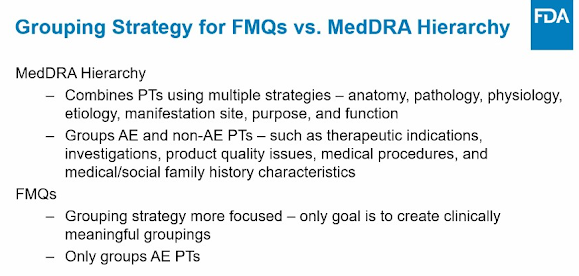
One natural question is: what is the difference between FMQ and SMQ? why can't we just use the SMQ? Here are a couple of slides indicating the differences between FMQ and SMQ. There are almost equal numbers of FMQs (104 FMQs for now) to SMQs (110 SMQs).


It is true that SMQs have primarily been used in pharmacovigilance, not in premarket safety assessment. I have previously written a couple of articles about the SMQs: 
One drawback of FMQ is that it is developed by the US FDA and its use and application may be limited for market authorization applications in countries outside the US. 

One thing for sure is that we will hear the term FMQ more often in the future and may see the request from FDA to present the grouped terms according to FMQs in the summary and analysis tables for AEs. 

Further reading:

Friday, September 02, 2022

Communicating with FDA: Type A, B, C, D meetings, and INTERACT meeting,

For any drug development program, the early and sometimes frequent communications are critical. However, the formal communications between the sponsor and the FDA are a cumbersome process. The sponsor representatives can not directly reach out to FDA reviewers (such as medical reviewer, statistical reviewer, clinical pharmacology reviewer, CMC reviewer,...). On the sponsor side, the communications with FDA is always through the regulatory affairs group. On the FDA side, the communication with the sponsor is through the regulatory project manager (RPM) - each review division at FDA has its own RPM. Direct communications between the sponsor representatives and the FDA reviewers/officers are not good practice and can cause the trouble down the road. We all knew how badly the situation was with Biogen's Aduhelm approval where Biogen executives met with FDA officials outside the normal communication channel. See "FDA chief asks for independent investigation into approval of Biogen's Alzheimer's drug Aduhelm".

The FDA RPM: The review division regulatory project manager (RPM) is the primary point of contact for communications between IND sponsors and FDA during the life cycle of drug development, and has comprehensive knowledge of the drug and its regulatory history. The RPM is also the primary contact for facilitating the timely resolution of technical, scientific, and regulatory questions, conflicts, or communication challenges between the sponsor and the review team. If sponsors encounter challenges in obtaining timely feedback to inquiries to the review division RPM, they should contact the RPM’s next level supervisor for timely resolution of the issue. 

Communications with FDA are usually through the formal meetings. There are different type of meetings for different purpose. The processes for requesting the formal meetings are described in FDA's guidance below:

In Regulatory Education for Industry (REdI) Annual Conference 2022 - Day 1, Dr Kevin Bugin gave a PSUFA overview where additional type of meetings with FDA were discussed and FDA officer, Jeannie Roule presented "Guidance for Industry: Formal Meetings Between the FDA and Sponsors or Applicants of PDUFA Products".

Different type of Meetings with FDA and the Comparisons:


The Prescription Drug User Fee Act (PDUFA) was created by Congress in 1992 and authorizes FDA to collect fees from companies that produce certain human drug and biological products. Since the passage of PDUFA, user fees have played an important role in expediting the drug approval process. PDUFA needs to be reauthorized by Congress every five years. PDUFA VII for fiscal years 2023 through 2027 is being discussed by Congress and is expected to be reauthorized before the end of the current fiscal year. 

To-be-reauthorized PDUFA VII will create some additional meetings with FDA, specifically, Type D meeting. Once the PDUFA is reauthorized by Congress, the sponsor can request for Type D meeting. 
According to PDUFA REAUTHORIZATION PERFORMANCE GOALS AND PROCEDURES FISCAL YEARS 2023 THROUGH 2027, the Type D meeting is described as the following: 


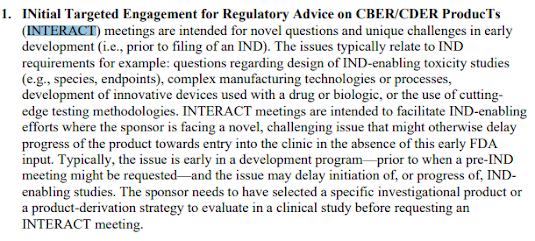
FDA also had a meeting called INTERACT. INTERACT stands for INitial Targeted Engagement for Regulatory Advice on CBER/CDER ProducTs. It is like the pre-pre-IND meeting and is especially useful in CAR-T, Gene therapy, xenotransplantation development programs. 

Monday, August 22, 2022

Story of BrainStorm's Stem Cell Treatment for ALS - Criticality of the Statistical Analyses

This past week, the biotech company BrainStorm announced the decision to submit a BLA to the FDA for NurOwn® (a stem cell treatment) for the treatment of ALS (Amyotrophic Lateral Sclerosis). The news stirred quite some discussions. The decision to submit the BLA is driven by the reanalysis or the corrected analysis of the previously announced negative results from their pivotal study. In their news announcement, they stated the following: 
New clinical analyses strengthen the conclusions from NurOwn's® Phase 3 clinical trial

A correction was made to the Muscle and Nerve publication from December 2021 describing the results of NurOwn's® Phase 3 clinical trial in ALS following new clinical analyses which strengthen the Company's original conclusions from the trial. The correction results in a statistically significant treatment difference (p=0.050) of more than 2 points for an important secondary endpoint, average change from baseline in ALSFRS-R, in the pre-specified efficacy subgroup of participants with a baseline score of at least 35. Analyses reported in the original publication utilized an efficacy model that unintentionally deviated from the trial's pre-specified statistical analysis plan by erroneously incorporating interaction terms between the subgroup and treatment. The newly published results, which includes supporting information to the publication, employ the efficacy model as pre-specified in the trial's statistical analysis plan, correcting the analyses. The correction also relates to the other subgroup analyses published for this endpoint, demonstrating that all subgroups with ALSFRS-R baseline scores of at least 26 to 35 showed a statistically significant benefit following treatment with NurOwn® (p≤0.050) on this secondary endpoint.

The reanalysis (or as they called it 'correction') was only on the pre-specified subgroup analyses for the secondary endpoint of ALSFRS-R total score (as highlighted in yellow below from the original publication). 


An erratum was issued to present the 'corrected' results for this endpoint: 


The original publication reported results for ALSFRS-R total score subgroup endpoint using a model that unintentionally deviated from the pre-specified statistical analysis plan by erroneously incorporating interaction terms between the subgroup and treatment. The error was made by the CRO who performed the statistical analyses. Applying the correct statistical model for that outcome resulted in the average difference between NurOwn- and placebo-treated patients going from 2.01 points to 2.09 points, but importantly this difference became statistically significant with a P-value of 0.05 (from a p-value of 0.20 in the original analysis). 

While the trial did not reach statistical significance on the primary or secondary endpoints, the company believes these corrected analyses support the conclusion that NurOwn has a positive treatment effect for patients with ALS. 

A year and a half ago, FDA put out a statement (unusual) to advise the BrainStorm not to file the BLA based on the announced results after unblinding of their phase 3 study. FDA specifically stated the following: 
With the recent completion of a randomized phase 3 controlled clinical trial comparing NurOwn to placebo, it has become clear that data do not support the proposed clinical benefit of this therapy. Data indicated that none of the primary or secondary endpoints were met in the group of patients who were randomized. For the main (primary) endpoint, 27.7% of people given the placebo were scored as responding compared to 32.6% of people given NurOwn. The 4.9% absolute difference in responders was not at all statistically significant, and the small difference between the two groups was most likely due to chance. In addition, there was a modest excess in deaths in those treated with NurOwn, the significance of which is unclear at this time. If BrainStorm plans further studies of NurOwn to determine if the product can provide clinical benefit to individuals with ALS, FDA will continue to provide advice to the company on their development program.
Now, A year after FDA slammed on the breaks, BrainStorm is hitting the gas with updated data, approval plans, we will see how the FDA will react to BrainStorm's plan and if FDA will accept the BLA filing by BrainStorm. 

No matter what the fate is for BrainStorm's BLA, one thing is clear: the statistical analyses are critical to the clinical trials and to the overall drug development. It is so important to avoid errors/mistakes in the statistical analyses. This important point has been discussed in previous posts such as "Statistician's nightmare - mistakes in statistical analyses of clinical trials" and "Futility Analysis and Conditional Power When Two Phase 3 Studies are Simultaneously Conducted" where the inappropriate method for futility analysis was implemented. 

It is surprising that the p-value and the statistical significance are still playing a critical role in regulatory decision-making after all of these discussions about retiring statistical significance and p-value

Sunday, August 21, 2022

Mediation analysis and SAS CAUSALMED procedure

In a recent publication (Benza et al "Contemporary Risk Scores Predict Clinical Worsening in Pulmonary Arterial Hypertension - An Analysis of FREEDOM-EV"), we conducted an analysis called 'Mediation analysis'. In the statistical analysis section, the 'mediation analysis' was stated as the following: 

"To determine whether the change in Week 12 REVEAL Lite 2 risk score ‘mediated’ the treatment effect in delaying clinical worsening, we used SAS (v14.3) CAUSALMED procedure which operationalizes the work of Valeri and VanderWeele.
This analysis attempts to determine what fraction of the total treatment effect appears to be attributable to the treatment effect on the REVEAL Lite 2 score. The analysis was adjusted for baseline REVEAL Lite 2 score; we did the analysis both with and without assuming that there is a treatment and mediator (REVEAL Lite 2 score) interaction on the outcome model (clinical worsening). The definition ‘net clinical benefit’ has been previously proposed as the achievement of all three French non-invasive low risk factors without a clinical worsening event; we retrospectively used the present database to model the performance of this definition."
According to Wikipedia, the mediation model and mediation analysis are defined as the following: 
In statistics, a mediation model seeks to identify and explain the mechanism or process that underlies an observed relationship between an independent variable and a dependent variable via the inclusion of a third hypothetical variable, known as a mediator variable (also a mediating variable, intermediary variable, or intervening variable). Rather than a direct causal relationship between the independent variable and the dependent variable, a mediation model proposes that the independent variable influences the mediator variable, which in turn influences the dependent variable. Thus, the mediator variable serves to clarify the nature of the relationship between the independent and dependent variables.

Mediation analyses are employed to understand a known relationship by exploring the underlying mechanism or process by which one variable influences another variable through a mediator variable. In particular, mediation analysis can contribute to better understanding the relationship between an independent variable and a dependent variable when these variables do not have an obvious direct connection.

A mediator variable can either account for all or some of the observed relationship between two variables. 

Full Mediation

Maximum evidence for mediation, also called full mediation, would occur if the inclusion of the mediation variable drops the relationship between the independent variable and dependent variable to zero. In other words, the effect of the independent variable on the dependent variable is all through the mediator variable. 

Partial mediation

Partial mediation maintains that the mediating variable accounts for some, but not all, of the relationship between the independent variable and dependent variable. Partial mediation implies that there is no only a significant relationship between the mediator and the dependent variable, but also some direct relationship between the independent and dependent variable - the line from independent variable to dependent variable is solid and c is not equal to zero. 


The mediation analysis has been used in the data analysis for observational data, clinical trial data, survey data, and epidemiology study data. 

In an article by Eyre et al "Effect of Covid-19 Vaccination on Transmission of Alpha and Delta Variants", the mediation analysis was used to assess whether the effect of the vaccination status of the index patient was explained by Ct values at diagnosis.  Ct values are cycle-threshold values (indicative of viral load21) in the index patient.

In an article by Reaven et al "Intensive Glucose Control in Patients with Type 2 Diabetes — 15-Year Follow-up", mediation analyses were performed:

In prespecified mediation analyses, Cox proportional-hazards models were used to examine the effects of the glycated hemoglobin level on the primary cardiovascular disease outcome and on the observed treatment effects. Specifically, the log-linear association of the cumulative glycated hemoglobin level (modeled as a time-varying covariate) with the primary cardiovascular disease outcome was assessed during the period of separation of the glycated hemoglobin curves and after convergence. Models examined the effect of treatment group (intensive therapy or standard therapy) on the primary outcome in an unadjusted analysis (model 1) or while accounting for baseline, most recent, or cumulative mean glycated hemoglobin level (models 2, 3, and 4, respectively).

A paper by Vo et al summarized "the conduct and reporting of mediation analysis in recently published randomized controlled trials: results from a methodological systematic review"

Mediation analysis can be performed using SAS procedure CAUSALMED. CAUSALMED procedure was developed for estimating causal mediation effects from observational data, but can definitely be used for estimating mediation effects from the randomized controlled clinical trial data. Please see the references below:

Mediation analysis can be performed using other software. This is very well summarized in a paper by Valente et al "Causal Mediation Programs in R, Mplus, SAS, SPSS, and Stata".

Thursday, August 18, 2022

Handling of values below or above a threshold (Below the Low Limit of Quantification or Above the Upper Limit of Quantification)?

In clinical trials, the samples are often collected and sent to the central laboratory or specialty laboratory for measuring certain parameters (drug concentrations, metabolite concentrations, biomarkers,...). It is not uncommon that the results may be reported as "<xxx" or ">xxx" indicating that the measurement is below or above a threshold, outside the range, or the quality control curves. We call them below the low limit of quantification or above the upper limit of quantification.

How to handle them in the data set and in the analyses?

In the data set, the laboratory results should be reported as it is in character variable. The data listings should use the character variable so that the signs of '<' or '>' will be kept and displayed.

For the purpose of the statistical summaries and analyses, a separate numeric variable should be derived and appropriate rules will be applied to these values below the low limit of quantification or above the upper limit of quantification.
 
Most of the discussions were about the handling of the values below the low limit of quantification (BLQs). See a previous post "BLQs (below limit of quantification) and LLOQ (Lower Limit of Quantification): how to handle them in analyses?" and the researchgate.net discussion board "How should one treat data with <LOQ values during statistical analysis?".

The options for handling the BLQs are:

  • Treat BLQs as missing
  • Treat BLQs as 0
  • Treat BLQs as 1/2 of the LLQ (lower limit of qualification). For example, if the result was reported as "<10" Âµg, take 5 Âµg as the measure - this approach is pretty common in handling pharmacokinetic concentration data. 
  •  Simply remove the sign of  '<' and take the face value (i.e. LLQ value). For example, if the result was reported as "<10" Âµg, take 10 Âµg as the measure. 
  • More complicated methods using statistical (regression, maximum likelihood,...) approaches 
There are fewer discussions about handling the values above the upper limit of quantification (ULQ). Usually, these values above the upper threshold will be handled by:

  • Treat values above ULQ as missing
  • Simply remove the sign of  '>' and take the face value (i.e. ULQ value). For example, if the result was reported as ">100" mg, take 100 mg as the numeric value
In an SAP developed by Astellas, the simple rule was specified for handling the values below or above a threshold:

"For continuous variables that are recorded as “< X” or “> X”, the value of “X” will be used in the calculation of summary statistics. The original values will be used for the listings."

In an SAP developed by Galapagos for their phase 3 study of GLPG1690 in subjects with idiopathic pulmonary fibrosis, the following rules were proposed to handle values below or above a threshold. Their approach of adding or deducting a small number from the face value is unconventional.

7.3. Handling of Values Below (or Above) a Threshold 

Values below (above) the detection limit will be imputed by the value one unit smaller or larger than the detection limit itself. In listings, the original value will be presented. Example: if the database contains the value “<0.04”, then for the descriptive statistics the value “0.03” will be used. The value “>1000” will be imputed by “1001”. 

Monday, August 01, 2022

Placebo effect and its impact on the overall treatment effect

RCTs (randomized, controlled clinical trials) are still the golden standard in clinical research. In RCTs, the most common control group is the Placebo. According to Wikipedia, a placebo is a sham substance or treatment which is designed to have no known therapeutic value. Common placebos include inert tablets (like sugar pills), inert injections (like saline), sham surgery, and other procedures. In order to maintain the blinding (masking), the placebo group may include additional excipients similar to the experimental drug so that the placebo group will have the same characteristics as the experimental drug in shape, size, color, texture, weight, taste, smell,......

Placebo is assumed to have no therapeutic effect or detrimental effect. However, the assumption may not be true especially when the composition of the placebo is in consideration. 

In previous article "Placebo Effect, Honest Placebo, Open-label Placebo", we discussed the placebo effect in diseases in the CNS and psychological area or in diseases with subjective symptom measures. In the post "Placebo effect and the choice of placebo", we discussed the composition of the placebo and some 'placebo' may actually have therapeutic effect. For example, in clinical trials to test the therapeutic effects of IGIV, the  low concentration of albumin may be selected as the placebo control - the low concentration of albumin may actually have the therapeutic effect. In both of these cases, the placebo effect or potential therapeutic effect from the 'placebo' can cause the unexpected higher response rate in Placebo arm, therefore decrease the difference between the experimental drug and the placebo groups, result in the failed trials. 

On the flip side, the placebo can have detrimental effect. There are quite some recent discussions about the placebo having the detrimental effect - consequently, the overall treatment effect observed in the clinical trials may not be due to the therapeutic effect of the experimental drug, but due to the detrimental effect of the placebo group. In other words, the overall treatment effect can be  overestimated due to the detrimental effect of the placebo.

Here are some articles discussing the potential detrimental effects of the placebo in clinical trials to study the effects of fish oil in the prevention of the cardiovascular events. The REDUCT-IT trial was published in NEJM and was the pivotal trial resulting in the FDA and EMA's approval. According to the study protocol, "the matching placebo capsule is filled with light liquid paraffin and contains 0 mg of AMR101 (icosapent ethyl [ethyl-EPA])." The detrimental effect of the placebo may come from the paraffin. 

When we conduct the placebo-controlled clinical trials, the composition of the placebo needs to be carefully considered and the potential therapeutic effect from the placebo needs to be minimized. 

Friday, July 29, 2022

CRO, ARO, and VRO - All types of clinical research organizations

CRO (Contract Research Organization or Clinical Research Organization)

A CRO is a company that provides clinical trial management services for the pharmaceutical, biotech, and medical device industries.

Although there are different types of CROs and diverse levels of specialization (distinct therapeutic areas for instance), typical CRO services include regulatory affairs, site selection and activation, recruitment support, clinical monitoring, data management, trial logistics, pharmacovigilance, biostatistics, medical writing, and project management, among others. Given that the clinical trials are going global, the large CROs usually have foot prints in all of these countries that are the usual spots for doing clinical trials.

In a clinical trial, CROs are hired by sponsors to perform a set of tasks, taking various technical and administrative responsibilities on the sponsor’s behalf.

The main role of the CRO is to plan, coordinate, execute, and supervise the processes involved in the development of a clinical trial, being a central contact point between the sponsor and other trial actors (e.g. ethics committees, regulatory agencies, vendors, and hospitals).

CROs are key players in clinical research, since they have the knowledge and the capabilities needed for the proper development of a clinical study. They help sponsors by reducing their workload, while ensuring trial quality and compliance with national and international standards.

At the same time, many CROs supply innovative technological tools to increase efficiency in the study processes, which translates into cost reductions.

Without doubt, CROs play a crucial role in the success of a clinical trial. Sponsors should carefully assess the particular needs of their projects, and look for the CRO that best meets their technical requirements and budget.

The website https://www.proclinical.com/blogs/2022-3/top-10-cros-to-watch-in-2022 listed the top ten CROs in 2022 which are:

I would also add WCG as one of the top CROs.


ARO (Academic Research Organization)

An ARO is an academic or non-profit organization that provides support mainly to the academic principal investigators in the form of research services: biopharmaceutical development, biologic assay development, commercialization, preclinical research, clinical research, clinical trials management, and pharmacovigilance.

Comparing to the CRO, AROs are non-profit; are usually cheaper, are usually strictly related to their main center; are mainly focused on studies oriented to improve the standard clinical practice, thus they are majorly involved in observational studies, phase IV studies, pragmatic clinical trials,...

ARO can also be good to take on the role of the central reader and clinical event adjudications. 

This book chapter discussed the role of ARO in clinical research:
Chapter 3. The Role of Academic Research Organizations in Clinical Research

The most prominent ARO is perhaps the Duke Clinical Research Institute (DCRI)

VRO (Virtual Research Organization)

With the recent rapid development in conducting the virtual clinical trials or decentralized clinical trials, the new term VRO is appearing. VRO is specialized in helping the sponsors to do virtual clinical trials. A paper by Hong et al "Virtual Research Organization: Nature and Forms" discussed the roles of the VROs. 

An example of a VRO is ObvioHealth - they claim to be the VRO who are specialized in doing decentralized clinical trials. 

Sunday, June 26, 2022

Adverse event / serious adverse event data entry when death event occurs

If the death event is an efficacy endpoint in the study, should the death event still be reported as AE/SAE? 

If the death (or mortality) is an efficacy endpoint, the death event will ordinarily not be reported as AE/SAE. Only in some special situation, for example, a death due to anaphylactic reaction, car accident,... that are not related to the underlying disease, will the death be reported as AE/SAE. 

FDA's guidance Safety Reporting Requirements for INDs and BA/BE Studies clearly stated this: 

Generally, study endpoints refer to outcomes that sponsors are measuring to evaluate efficacy. For trials designed to evaluate the effect of a drug on disease-related mortality or major morbidity, endpoint information should be collected, tracked, and monitored, usually by a Data Monitoring Committee (DMC), during the course of the study. The protocol would prespecify a monitoring plan for determining whether subjects receiving the drug treatment are at higher risk for the outcome (e.g., all-cause mortality), and such results would be reported according to the protocol. The study endpoints must be reported to FDA by the sponsor according to the protocol, and ordinarily would not be reported as IND safety reports, except when there is evidence suggesting a causal relationship between the drug and the event (21 CFR 312.32(c)(5)). For example, a death ordinarily would not be reported as an individual case in an expedited report from a trial designed to compare all-cause mortality in subjects receiving either drug treatment or a placebo. On the other hand, in the same trial with an all-cause mortality endpoint, if the death occurred as a result of an anaphylactic reaction that coincided with initial exposure to the drug, or as a result of fatal hepatic necrosis, the death must be reported as an individual case in an IND safety report because there would then be evidence suggesting a causal relationship between the drug and the event (21 CFR 312.32(c)(5)).  
In our clinical trial "Dinutuximab and Irinotecan Versus Irinotecan to Treat Subjects With Relapsed or Refractory Small Cell Lung Cancer", the overall survival (time to death) was the primary efficacy endpoint. The death event would not be reported as AE/SAE and not recorded on AE/SAE case report form. It would be odd and inappropriate to record the AEs like "Death due to disease progression', 'death due to small cell lung cancer', 'death due to the underlying disease'. With Death being an efficacy endpoint, the death information should be recorded on separate case report form - Death Details form according to CDASH

Should death be reported as an event or an outcome of an AE/SAE?

Usually, when death event occurred, there were the adverse events leading to the death. The adverse event leading to the death will need to be reported as series adverse event with fatal outcome. The death is the outcome of a SAE and is not entered as an adverse event on its own. 

There are situations that the death is instantaneous or within very short period (for example one hour) of onset of symptoms or an unobserved cessation of life that cannot be attributed to a specific AE term. The death in this situation will be reported as Sudden Death or Sudden Death NOS on the AE case report form. 

If there are multiple ongoing AEs at the time of trial participant's death, should all these ongoing AEs be considered as SAEs with fatal outcome? 

This issue was discussed in a previous post "Recording the outcome for AE/SAE when multiple events contribute to Death". It is preferred in my opinion that a single AE/SAE should be identified as the primary cause for the death. This AE/SAE will have the fatal outcome recorded on the AE case report form. Other ongoing AEs at the time of death will have the AE outcome recorded as 'not recovered/not resolved"

How to fill out other fields on AE forms when death event occurs? 

As discussed above, for AE outcome, 'Fatal' should be selected for the AE/SAE that directly or primarily contribute to the study participant's death. 

For other ongoing AEs at the time of death, the AE outcome 'Not recovered or Not Resolved' should be selected.  


'Action Taken with Study Treatment' is another field on AE form and it is difficult to decide which choice should be selected when a death event occurs. 


At the time of death, there are two appropriate choices for 'Action Taken with Study Treatment": Dose Not Changed or Drug Withdrawn. Which choice to select depends on the sequence of the events: the last dose date/time in relevance to the death date/time. Assuming a study treatment with QD dose frequency, if the last dose date is the same as the death date or if the last dose date is one day prior to the death date, it is reasonable to assume that there is no dose withdrawn. Therefore, it is appropriate to select 'Dose Not Changed' for 'Action Taken with Study Treatment' field. On the other hand, if the last dose date is two days or earlier than the death date, it is appropriate to select 'Dose Withdrawn' for 'Action Taken with Study Treatment' field. 


Sunday, June 19, 2022

Sentinel Dosing (Sentinel Subject) and Staggering Enrollment in First-in-Human (FIH) Clinical Trials

First-in-human (FIH) study is a type of clinical trial in which a new drug, procedure, or treatment is tested in humans for the first time. FIH studies take place after the new treatment has been tested in laboratory and animal studies and are usually conducted as phase I clinical trials. 

FIH study can be conducted in healthy volunteers (usually the case) or in patients.(in some special situations). Even though the new drug, procedure, or treatment has been thoroughly tested in pre-clinical studies before initiating the FIH study, the conservative approaches may still needed to be taken to ensure the safety of the study participants when designing the FIH study . 

FIH study can also be designed as phase 0 study or exploratory IND study as discussed in a previous post. 

FIH study may be designed as a single ascending dose (SAD) study where the healthy volunteers are enrolled and dosed in cohorts in dose-escalation fashion, i.e., the next dose cohort will only be enrolled after the safety data from the previous cohorts has been reviewed. FIH study may also be designed as dose-escalation study to identify the maximum tolerable dose (MTD) - such as the "3+3 design". 

Even with the SAD or dose escalation study designs, if it is uncertain there are still potential risks to the participants, additional precautions may be taken: sentinel dosing (sentinel subject) and staggering enrollment. 

Sentinel Dosing (Sentinel Subject): 

For the FIH study in healthy volunteers, the subjects are recruited to the clinical research unit (CRU, also called Phase I clinic). A cohort of subjects will be confined in the CRU to be dosed, observed, and evaluated. All subjects in the same dose cohort will be dosed at the same time. The study starts with the lowest dose cohort and then moves to higher dose cohorts. 

While dosing by cohort approach is usually safe, unexpected incidences can still occur. If the unexpected adverse events cause the harm to the study participants, it affects all participants in the entire cohort. Below are two examples where the phase I trial participants died or severely injured after receiving the experiment treatment in FIH Phase I studies. 

To prevent this from happening, a strategy called sentinel dosing is often practiced so that one person in the first cohort of participants is dosed in advance of the full study or in advance of any full cohort. The very first subject who receive the sentinel dose is called 'sentinel subject'. 

Sentinel dosing was mentioned in EMA guidance "Guideline on strategies to identify and mitigate risks for first-in-human and early clinical trials with investigational medicinal products":

It is considered appropriate to design the administration of the first dose in any cohort so that a single subject receives a single dose of the active IMP (often known as sentinel dosing). Flexibility in this approach is allowed but should be on a risk-proportionate basis with a clear scientific rationale for any proposals not to use this strategy.

When the study design includes the use of placebo it would be appropriate to allow for one subject on active and one on placebo to be dosed simultaneously prior to dosing the remaining subjects in the cohort. This approach is expected for all single and multiple dosing cohorts, in order to reduce the risks associated with exposing all subjects in a cohort simultaneously. This sentinel approach may continue or also start to be appropriate at later stages of study design, e.g. on the steep part of the dose response curve, when approaching target saturation levels or the maximum clinical exposure levels defined in the protocol (see sections 7.5 and 8.2.9), in case of non-linear PK, or in light of emerging clinical signs or adverse events that do not meet stopping criteria. There should be an adequate period of time between the administration of treatment to these first subjects in a cohort and the remaining subjects in the cohort to observe for any reactions and adverse events. The duration of the interval of observation will depend on the PK and PD characteristics and the level of uncertainty associated with the product (see section 4). At the end of the observation period, there should be a clearly defined review of all available data for the sentinel subjects before dosing of further subjects in the cohort, with dose stopping rules in place to prevent further dosing if any rule is met (see also section 8.2.10).

Staggering Enrollment

Majority of phase I studies are conducted in healthy volunteers where the same cohort of subjects are recruited and confined at the clinical research unit (a single center) for dosing and post-dose measures and observations. In some situations (such as oncology studies, gene therapy trials, studies using human-plasma derived products), phase I studies are conducted in patients and are not ethical to be conducted in healthy volunteers. The patients will usually be recruited from multiple sites - so called multi-center phase I clinical trials. 

In multi-center phase I clinical trials, before multiple sites can start to recruit patients, a 'staggering enrollment' approach may be employed to minimize the potential harms caused by the innovative therapies. With the 'staggering enrollment' approach, after the first patient is enrolled, the second patient will only be enrolled after the first patient has been followed-up for a period of time and thoroughly evaluated for the safety measures. The third patient or the parallel enrollment will only be started after the second patient has been followed-up and thoroughly evaluated. 

The 'staggering enrollment' approach was used in the first-in-human trials in CAR-T trial and in gene therapy trials.  

The first CAR-T approval was for Novartis’s Kymriah (tisagenlecleucel) for the treatment of Acute lymphocytic leukemia (ALL). The tisagenlecleucel was originally developed by UPENN and FIH study was conducted by the UPENN. In their FIH study for CAR-T, the enrollment was staggering: 

“Staggered enrollment on the CNS3 cohort: infusion of any subsequent patient on the CNS3 cohort will be delayed until 21 days after the prior CNS3 patient’s infusion to allow for toxicity monitoring.”

For Bluebird’s Beti-cel in treatment of β-thalassemia patients requiring regular red blood cell (RBC) transfusions, their FIH trial also employed a staggering enrollment strategy:

“Initially, subjects with β-thalassemia major of the βE/β0 genotype will be enrolled in this study, and treatment will be staggered. The second subject will begin myeloablative conditioning only after the first subject 1) engrafts (defined as an absolute neutrophil count [ANC] ≥0.5 × 10⁹/L for 3 consecutive days); and 2) has no LentiGlobin® BB305 Drug Product treatment-related serious adverse event (SAE) unexpected to occur with autologous HSCT. After Subject 2 meets these same criteria, parallel enrollment will be opened to additional subjects with the βE/β0 genotype.” 

'Staggering enrollment' may also be employed for the logistic reason. For a specific investigational site, the investigator and the study coordinator may not have the resource to enroll multiple patients all at once. They just don't have the manpower to do that. 'Staggering enrollment' approach allows the site to enroll one patient at a time. 

Thursday, June 09, 2022

Drug Development for Rare Diseases - Public Workshops

Drug development for rare diseases is challenging, complex, but absolutely necessary. FDA has special programs to manage and encourage the drug development for rare diseases. 

According to "Rare Diseases at FDA" website, all three divisions (CDER, CBER, and CDRH) have special programs to support the drug development in rare diseases areas:

At "Regulatory Education for Industry (REdl)" meeting this week, there was a session "Partnering Across FDA to Advance Therapies for Rare Diseases" featuring three prosentations by FDA officers:

FDA/CDER has an ARC program (Accelerating Rare disease Cures) aiming to drive scientific and regulatory innovation and engagement to accelerate the availability of treatments for patients with rare diseases. In year 1 of the ARC program, two important public workshops had been organized (webcasts can be watched following the links below):
CDER’s Rare Diseases Team and National Center for Advancing Translational Sciences
Focus on academic investigators and those looking to learn how to bridge the gap between academic investigation and the regulatory aspects of drug development
Focus on translational science and the development of surrogate endpoints

Monday, May 30, 2022

Clinical trials with external control, historical control, concurrent control, contemporaneous control, and synthetic control

Three critical features for modern clinical trials are control, randomization, blinding. For the golden standard of RCTs (randomized controlled clinical trials), a concurrent control group is critical. With recent advances in clinical trial designs, non RCTs such as real-world data (RWD)/real-world evidence (RWE), single arm trial, registry studies have been much discussed. The control group is now expanded to include concurrent control, external control, historical control, contemporaneous control. 

Concurrent Control: ICH E10 "Choice of Control Group in Clinical Trials" defined the concurrent control as the following: 
A concurrent control group is one chosen from the same population as the test group and treated in a defined way as part of the same trial that studies the test treatment, and over the same period of time. The test and control groups should be similar with regard to all baseline and on-treatment variables that could influence outcome, except for the study treatment. Failure to achieve this similarity can introduce a bias into the study. Bias here (and as used in ICH E9) means the systematic tendency of any aspects of the design, conduct, analysis, and interpretation of the results of clinical trials to make the estimate of a treatment effect deviate from its true value. Randomization and blinding are the two techniques usually used to minimize the chance of such bias and to ensure that the test treatment and control groups are similar at the start of the study and are treated similarly in the course of the study (see ICH E9). Whether a trial design includes these features is a critical determinant of its quality and persuasiveness.
Concurrent control is the feature of the RCTs and involves the randomization. The subjects are randomized into the test group or control group over the same period of time. 

External Control and Historical Control: ICH E10 "Choice of Control Group in Clinical Trials" defined the external control (including historical control) as the following:
External Control (Including Historical Control)

An externally controlled trial compares a group of subjects receiving the test treatment with a group of patients external to the study, rather than to an internal control group consisting of patients from the same population assigned to a different treatment. The external control can be a group of patients treated at an earlier time (historical control) or a group treated during the same time period but in another setting. The external control may be defined (a specific group of patients) or non defined (a comparator group based on general medical knowledge of outcome). Use of this latter comparator is particularly treacherous (such trials are usually considered uncontrolled) because general impressions are so often inaccurate. So-called baseline controlled studies, in which subjects' status on therapy is compared with status before therapy (e.g., blood pressure, tumor size), have no internal control and are thus uncontrolled or externally controlled (see section 2.5).
 Historical control is also external control. External control may or may not be historical control 

Contemporaneous Control may also be called contemporaneous cohort. In clinical trials with contemporaneous control group, subjects are recruited (not randomized) into the test group and the control group over the same period of time. The key idea is to compare subjects in the same time frame. For example, in a comparison of surgery versus chemotherapy for breast cancer, you wouldn't want to use surgery patients from 20 years ago as a control group to compare against a current chemo group. 

An great example of a clinical trial with a contemporaneous control group is a study assess the EVLP (ex-vivo lung perfusion) lung versus traditional (normal) lung in lung transplantations. In a non-randomized study "Extending Preservation and Assessment Time of Donor Lungs Using the Toronto EVLP System™ at a Dedicated EVLP Facility", according to the the study protocol, a contemporaneous control group was included to provide context for EVLP results and to inform control measures for future research. For every EVLP lung transplantation, a contemporaneous control lung transplantation with matched study center, single and double lung transplantation, lung allocation score. It is possible that for some EVLP lung transplants, the contemporaneous controls may not be identified which results in the large sample size in EVLP group than the contemporaneous control group. 
Once the donor lung is accepted following EVLP, the eligible recipient, who has provided written informed consent, and receives the lung transplant, is enrolled into the study. Patients who consent for the current EVLP , but receive a conventional (i.e., non-EVLP) lung transplant will be considered for a contemporaneous control group matched to the EVLP treatment group (66 subjects each). This matching will take place on a patient-by-patient basis and only after an EVLP subject has been enrolled at that Study Center. Investigators and their team will be notified by the Sponsor on a real-time basis of the specific matching criteria required for a control subject as EVLP subjects are enrolled. In order to be considered for eligibility, the control patient must “match” a priori to at least one EVLP subject who has already been enrolled at that Study Center based on the following criteria: SLT versus DLT and Lung Allocation Score Disease Diagnosis Group (LASDDG).
Contemporaneous control group is external, but concurrent control. Contemporaneous control group is similar to the matched control group in epidemiological case-control and cohort studies - similar statistical analysis approaches (such as conditional logistic regression) may be used for analyses.

Synthetic Controlsynthetic control was discussed in a previous post "Synthetic Control Arm (SCA), External Control, Historical Control". Synthetic control includes subjects who are selected from historical clinical trials and who are on standard of case, and whose baseline characteristics match the current-day experiment group. Synthetic control is historical control, not concurrent control, but with matched baseline characteristics with the concurrent experiment treatment group. 

One Extra Point: 
One interesting discussion is about the control group in platform trial where multiple treatment arms are compared to the common control group. Since the different treatment arms may be added to or removed from the platform at different times, for a specific treatment - control group comparison, the control group may be not recruited over the same period of time. This issue was discussed in a NEJM paper "
Platform Trials — Beware the Noncomparable Control Group" and a JAMA paper "How to Use and Interpret the Results of a Platform Trial".
In platform trial, control group from a randomized trial may not be concurrent control.