Showing posts with label safety. Show all posts

Saturday, February 15, 2025

Sponsor’s Response to DMC Recommendation: A Case Study from a Phase 2b/3 Trial

 The DMC or DSMB is now commonly used in the clinical trials, especially the late phase clinical trials. According to FDA guidance for industry "Use of Data Monitoring Committees in Clinical Trials", DMC Responsibilities include:

1.             1.    Monitoring of Trial Conduct

2.      Monitoring of Results of Interim Analysis of Trial Data

·         Safety – to determine if there is a credibly increased risk of a serious adverse outcome in subjects receiving the investigational product, indicating that enrollment should be stopped. To determine a safety risk, review of unblinded efficacy data should also be conducted by the DMC as they evaluate a benefit-risk assessment

·         Implementing a predefined adaptive feature

                                                              i.      Efficacy – to determine if there is statistically significant evidence of efficacy such that enrollment should be stopped

                                                            ii.      Futility – to determine if there is no longer a reasonable likelihood that the trial will reach a conclusion of effectiveness, so that enrollment should be stopped to protect subjects from further exposure to a potentially ineffective investigational product and to conserve resources

                                                          iii.      Other adaptations – a DMC or a separate adaptation committee should determine if a prespecified adaptive aspect of the trial design is to be implemented. This can include modifying the sample size, changing a randomization ratio, or restricting future enrollment to a prespecified subgroup (adaptive enrichment

3.    Consideration of External Data

4.    Recommendations and Documentation

When a DMC is established, a DMC charter will be established to describe DMC Obligations, Responsibilities, and Standard Operating Procedures. DMC charter may also specify if there is any stopping rules to implement, decision trees to be followed, and any adaptation rules to be implemented. 

DMC communicates with the sponsor through the DMC recommendations. The FDA guidance has the following about the DMC recommendations:

A fundamental responsibility of a DMC is to make recommendations to the sponsor concerning the continuation of the trial.  Most frequently, a DMC’s recommendation after an interim review is for the trial to continue as designed.  Other less frequent but possible recommendations, however, as discussed previously, include trial termination, trial continuation with major or minor modifications (such as implementation of prespecified adaptive elements), or temporary suspension of enrollment and/or trial intervention until an identified uncertainty is resolved. 

A DMC should express its recommendations clearly to the sponsor because a DMC’s actions potentially affect the safety of trial subjects.  Both a written recommendation and an oral communication, with opportunity for questions and discussion, can be valuable.  Recommendations for modifications are best accompanied by the minimum amount of data critical for the sponsor to make a reasonable decision about the recommendation, and the rationale for such recommendations should be as clear and precise as possible.  Sponsors may wish to develop internal procedures to limit the interim data released by a DMC after a recommendation and until a decision is made regarding acceptance or rejection of the recommendation in order to help maintain confidentiality of the interim results should the trial continue.  We recommend that a DMC document its recommendations and rationale in a manner that can be reviewed by the sponsor and then circulated, as appropriate, to IRBs, FDA, and/or other interested parties, when based on interim data.  Major trial changes—such as early trial termination, change in population or entry criteria, or change in trial endpoints—can have substantial impact on the validity of the trial and/or its ability to support the desired regulatory decision.  Sponsors should discuss with FDA any proposed protocol changes based on review of interim data that were not planned for, before implementation, and submit such changes to FDA in accordance with 21 CFR 312.30 and 812.35.  However, if the sponsor learns of information that presents an imminent safety hazard to trial participants, sponsors should implement the necessary changes as quickly as possible to ensure the safety and welfare of study subjects (see 21 CFR 312.30(b)(2)(ii) and 812.35(a)(2)). 

In most of situation, the study is as expected and it is easy for DMC to make a recommendation of no changes to the study. However, in complicated situation, the DMC needs to make tough decision and recommend the termination of the study. In a paper by Wittes et al "The Data Monitoring Committee: A Collective or a Collection?", the following suggestions of consensus operating were made:

In a typical DMC meeting, data emerge as expected. No worrisome safety concern arises; the efficacy data are not surprising; and the DMC deems that trial is progressing as planned with, perhaps, some lag in recruitment and a less than desirable rate of follow-up of participants and incomplete capture of important efficacy and safety data. These and other quality metrics affect decision-making and the DMC may discuss them with study leadership. When, however, evidence of an unexpected harm arises, or the study operations appear unacceptable, or efficacy appears much different from anticipated, the deliberations of the DMC may reveal initial, perhaps strong, differences of opinion. A requirement to vote may curtail discussion and may lead to the failure to produce a recommendation that all find acceptable. Instead, we agree with those who urge DMCs to operate by consensus . Operating by consensus means that a DMC can have an odd or even number of members. Prior to reaching consensus, the Chair may elicit the opinion of each member to gauge the general views of members of the DMC or even call an informal straw vote. Regardless of how the DMC reached consensus, all members should agree to the language summarizing its recommendations....

This week, we saw an interesting example how the DMC recommendation was received and handled by the sponsor. Apparently, the sponsor did not trust the DMC's recommendation of stopping the study. The sponsor is now assembling an expert panel to review the unblinded data to determine how the DMC's recommendation is made and what are the rationales for DMC's recommendation.

Pliant Therapeutics announcedthat their phase 2b/3 study in IPF was suspended per DMC’s recommendation.  

          Pliant Brings in Outside Experts to Review IPF Study Pause 

          Pliant Therapeutics  has initiated assembly of outside panel of world-renowned experts to review 

          BEACON-IPF trial dataAnnounces Next Steps Following DSMB

SOUTH SAN FRANCISCO, Calif., Feb. 13, 2025 (GLOBE NEWSWIRE) -- Pliant Therapeutics, Inc. (Nasdaq: PLRX) today announced that, per the charter of the trial’s independent Data Safety Monitoring Board (DSMB), the Company has initiated the assembly of an outside expert panel to review unblinded data from the ongoing BEACON-IPF Phase 2b trial of bexotegrast in patients with idiopathic pulmonary fibrosis (IPF). The panel, consisting of world-renowned experts in pulmonary diseases and biostatistics, will provide an independent recommendation to Pliant regarding the BEACON-IPF trial. Subsequently, the panel will serve as part of an expanded DSMB with the goal to reach a consensus recommendation regarding BEACON-IPF. The decision to assemble the outside panel was taken as the Company has not been able, through review of blinded data, to determine the rationale for the DSMB’s recommendation to pause enrollment and dosing in the trial. The Company expects this process to conclude in two to four weeks.

Following the DSMB’s previously announced recommendation, Pliant voluntarily paused enrollment and dosing in the BEACON-IPF clinical trial. Pliant is committed to remaining blinded ensuring the data integrity of the BEACON-IPF 2b clinical trial with the goal of maintaining its potential to serve as a registrational trial.

It is very likely that the DMC focuses on the safety review and follows the FDA guidance which says:

Safety – to determine if there is a credibly increased risk of a serious adverse outcome in subjects receiving the investigational product, indicating that enrollment should be stopped. To determine a safety risk, review of unblinded efficacy data should also be conducted by the DMC as they evaluate a benefit-risk assessment

There may be an imbalance in the number of deaths or serious adverse events and there may no clear indication of efficacy. In such cases, the DMC's recommendation to stop the trial is based on a careful benefit-risk assessment. 

Tuesday, November 15, 2022

Treatment Emergent AEs (TEAEs), On-Study AEs, On-Treatment AEs, Non-TEAEs

During the clinical trial, the adverse events (AEs) are collected from the signing of the informed consent to the last dose of the study drug plus some follow-time. For statistical analyses of adverse event data, the treatment-emergent AEs (TEAEs) are usually defined. AEs with an onset date at or after the first dose of the study drug will be defined as TEAEs. AEs with an onset date prior to the first dose of the study drug will then be defined as Non-TEAEs. 

For example, the TEAE can be defined as:

"TEAEs are defined as events that start within the day of the first dose of trial treatment until 28 days after the last dose of treatment" in an SAP for an EMD Serono study.

"Treatment-emergent AEs (TEAEs) are defined as AEs that are not present at baseline or represent an exacerbation of a preexisting condition during the treatment period. Therefore, referencing the protocol, TEAEs will be defined programmatically as any AE record with a start date/time on or after the first study treatment administration (greater than or equal to study day 1), inclusive to the end of the study (specifically the EOS visit or ET visit)." in an SAP for a Regeneron's study

The TEAEs can be further defined based on the comparison of the AE onset date with a cut-off date where the cut-off date may be the last dose date or 28 days after the last dose date. 

In FDA's clinical review document for AstraZeneca's asthma drug, the on-study AE and on-treatment AE were defined:

  • On-study AE: events with onset between the first-day dosing and the scheduled follow-up visit. 
  • On-treatment AE: events with onset between the first day of treatment and the scheduled end of treatment (EOT) or investigational product discontinuation (IPD) visit. 
  • Post-treatment AE: events with onset after the on-treatment period defined above

 On-study AEs include all TEAEs - all AEs recorded on or after the first dose date. 

On-treatment AEs are a subset of all TEAEs or on-study AEs. The AEs with an onset date after the cut-off date will be excluded from on-treatment AEs. 

There are some clinical trials with on-treatment AEs defined as the same as traditional TEAEs (i.e., any AEs with an onset date on or after the first dose of the study drug regardless of the cut-off date).

In a recent workshop "Advancing Premarket Safety Analysis" organized by FDA and Duke Margolis Center for Health Policy, the on-study and on-treatment AEs were specifically discussed. Here are the presentation slides for this topic:


The concept of on-treatment AEs has already been implemented in some clinical trials. For example, in a GSK-sponsored trial "A Phase 3a, Repeat Dose, Open-label, Long-term Safety Study of Mepolizumab in Asthmatic Subjects", the primary outcome measure is "Number of Participants With Any On-treatment Adverse Event (AE) or On-treatment Serious AE (SAE)" where On-treatment AEs and on-treatment SAEs are the events occurring on/after the first dose of open-label mepolizumab date and before/on last dose+28 days.

In a BMS trial "A randomized, open-label, phase 3 study of  BMS-936558 vs. Everolimus in Subjects with advanced or metastatic clear-cell renal cell carcinoma who have received prior anti-angiogenic therapy", the on-treatment AEs were defined as the following with a cut-off date of 100 days of the last dose of study treatment.
"On-treatment AEs will be defined as AEs with an onset date-time on or after the DateTime of the first dose of study treatment (or with an onset date on or after the day of first dose of study treatment if time is not collected or is missing). For subjects who are off study treatment, AEs will be counted as on-treatment if event occurred within 100 days of the last dose of study treatment. No “subtracting rule” will be applied when an AE occurs both pre-treatment and post-treatment with the same preferred term and grade."
Defining on-treatment AEs will require specifying a cut-off date and the cut-off date may be different depending on the potential impact of the study drug after the drug discontinuation and the half-life of the investigational products. 

Defining on-treatment AEs may be necessary for studies with the treatment policy estimand where the efficacy data and AE/SAEs are continued to be collected after the study participants have discontinued the study treatment. 

Previous discussions: 

Sunday, October 16, 2022

Risk difference and confidence interval for Analyses of AEs and Clinical Laboratory Data

Several years ago, I posted an article "Should hypothesis tests be performed and p-values be provided for safety variables in efficacy evaluation clinical trials?". There are some new development on this topic. 

Recently, FDA in collaboration with the Duke-Margolis Center for Health Policy hosted a one-day virtual meeting focused on advancing pre-market safety analytics. At this workshop, it was revealed that FDA Biomedical Informatics and Regulatory Review Science (BIRRS) Team was working on a document called "Standard Safety Tables and Figures: Integrated Guide". The document is currently posted on regulations.gov for public comments. The integrated guide proposed the mockup shells how the safety data analyses (adverse events and clinical laboratory data) should be displayed. Throughout all the proposed shells, we can see that a column for "'Risk Difference (%) (95% CI)" are included. Here are a couple of examples. 


If this integrated guide become official and is implemented, the future analyses for safety data (adverse events and clinical laboratory parameters) will be shifted from the pure summary statistics to summary statistics + point estimate and 95% confidence interval for risk differences. p-values and hypothesis testing should not be provided. 

Risk difference and its 95% confidence interval are provided for the descriptive purpose, not for inferential purpose. As stated in the integrated guide "These safety analyses are exploratory in nature and confidence intervals (CIs) for the risk difference presented here are not adjusted for multiplicity."

In AE tables, the sort order will be by the risk difference (from the highest to the lowest). In this way, the reviewers can easily identify the AEs with largest risk difference between two treatment groups. 

There are several ways in calculating the confidence interval for risk difference. The commonly used approach is Wilson score method - a method of estimating the population probability from a sample probability when the probability follows the binomial distribution.

There seems to be some differences between the regulatory requirement and the requirement by the medical journals. We continue to see the requests from journals like New England Journal of Medicine for providing the p-values for AE summary tables. In our published article, "Inhaled Treprostinil in Pulmonary Hypertension Due to Interstitial Lung Disease", we had to provide the p values for AEs and other safety endpoints for treatment group comparison per NEJM's editor's request. 

Monday, September 19, 2022

FMQ (FDA Medical Query) and SMQ (Standardized MedDRA Query)

For clinical trials, the safety analyses are mainly based on the analyses of the adverse events including serious adverse events. The adverse events are recorded in CRFs/eCRFs with investigators' verbatim terms (text field). Before the adverse event data can be summarized and analyzed, the verbatim terms need to be coded and standardized. The common practice is to code the adverse events based on the MedDRA dictionary and the coded terms are then summarized and analyzed by system organ class and preferred term. For a while, this approach seems to work very well. However, there are issues with this approach, mainly because different preferred terms may point to the same disease/condition. 

Last Wednesday, The FDA in collaboration with the Duke-Margolis Center for Health Policy hosted a one-day virtual meeting focused on advancing premarket safety analytics. In the morning session, FDA officers discussed the FMQ (FDA Medical Query). In the afternoon session, FDA discussed the standardized presentation of the safety data including the tables and figures for adverse event data and laboratory data. 

The FDA Medical Queries (FMQs) is a standardized approach to group preferred terms. Recognizing the limitation of the current analysis of adverse event data by preferred term, using FMQs can consolidate a medical condition with scattered preferred terms and be more likely to identify any signal of safety issues. The rationales for FDA's efforts in developing various FMQs are described in the slide below: 


FMQs were defined as the following: 

FMQs can be used to identify the safety signals that may be missed by using the conventional preferred term approach. When FMQs are adopted by the regulatory agency and the industry, FMQs (grouped term information) can be included in the ADVERSE REACTIONS Section of the Prescribing Information (or product label). The slide below illustrates a fictitious example of using FMQ term in the ADVERSE REACTIONS section of the product label. The AE table in the product label will include the mixture of the FMQ term (grouped term) and the MedDRA preferred terms. 


A real example of FMQs in the product label can be the drug called Injectafer. The tables for adverse reactions included the mixture of the preferred terms and the grouped terms (based on FDA's FMQs). 

FMQ is exactly the same concept as the SMQ (standardized MedDRA query). The SMQ was defined as the following: 

With each version of the MedDRA dictionary, a set of available SMQs will be included. Included is also the document "Introductory Guide for Standardised MedDRAQueries (SMQs)". 

Both FMQ and SMQs included narrow terms and broad terms. However, the narrow terms are more commonly used in practice. 

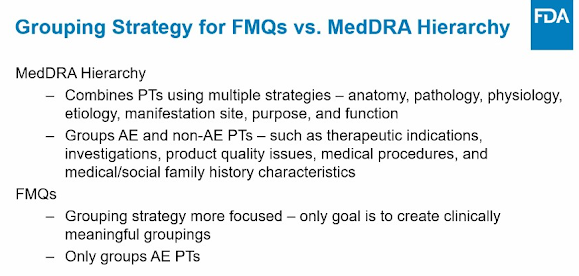
One natural question is: what is the difference between FMQ and SMQ? why can't we just use the SMQ? Here are a couple of slides indicating the differences between FMQ and SMQ. There are almost equal numbers of FMQs (104 FMQs for now) to SMQs (110 SMQs).


It is true that SMQs have primarily been used in pharmacovigilance, not in premarket safety assessment. I have previously written a couple of articles about the SMQs: 
One drawback of FMQ is that it is developed by the US FDA and its use and application may be limited for market authorization applications in countries outside the US. 

One thing for sure is that we will hear the term FMQ more often in the future and may see the request from FDA to present the grouped terms according to FMQs in the summary and analysis tables for AEs. 

Further reading:

Thursday, March 31, 2022

Safety Assessment Committee (SAC), Data Monitoring Committee (DMC), Steering Committee (SC), Clinical Event Committee (CEC)

In clinical trials, there are usually different committees established to ensure the study protocol is executable, to ensure the integrity of the study, to monitor the safety of the clinical trial participants. The most common one is the Data Monitoring Committee (DMC) - previously called Data Safety Monitoring Board (DSMB), which is critical for conducting the interim analysis for safety or for efficacy (whether the interim results are too good (overwhelming efficacy) or futility (unlikely to achieve the statistical significance if the trial continues)). In FDA's Guidance for Clinical Trial Sponsors "Establishment and Operation of Clinical Trial Data MonitoringCommittees", DMC was defined as the following: 

A clinical trial DMC is a group of individuals with pertinent expertise that reviews on a regular basis accumulating data from one or more ongoing clinical trials. The DMC advises the sponsor regarding the continuing safety of trial subjects and those yet to be recruited to the trial, as well as the continuing validity and scientific merit of the trial. When a single DMC is responsible for monitoring multiple trials, the considerations for establishment and operation of the DMC are generally similar to those for a DMC monitoring a single trial, but the logistics may be more complex. For example, multiple conflict of interest determinations may be needed for each DMC member.

In this same guidance, two other clinical trial committees were mentioned to be compared with the DMC: Steering Committee (SC) and Endpoint Adjudication Committee (EAC). EAC may be called Clinical Endpoint Committee (CEC). 

Clinical Trial Steering Committees In some clinical trials the sponsor may choose to appoint a steering committee; this committee may include investigators, other experts not otherwise involved in the trial, and, usually, representatives of the sponsor. A sponsor may delegate to a steering committee the primary responsibility for designing the study, maintaining the quality of Contains Nonbinding Recommendations 7 study conduct, ongoing monitoring of individual toxicities and adverse events, and, in many cases, writing study publications. When there is a steering committee, the sponsor may elect to have the DMC communicate with this committee rather than directly with the sponsor. Interactions between the steering committee and the DMC consist primarily of discussions during "open sessions" (see Section 4.3) of DMC meetings and the communication of recommendations following each DMC review of the trial. More extensive interactions might occur when early termination is being considered, or when external forces (e.g., announcement of results of related studies) impact the ongoing trial.

Endpoint Assessment/Adjudication Committees Sponsors may also choose to establish an endpoint assessment/adjudication committee (these may also be known as clinical events committees) in certain trials to review important endpoints reported by trial investigators to determine whether the endpoints meet protocol-specified criteria. Information reviewed on each presumptive endpoint may include laboratory, pathology and/or imaging data, autopsy reports, physical descriptions, and any other data deemed relevant. These committees are typically masked to the assigned study arm when performing their assessments regardless of whether the trial itself is conducted in a blinded manner. Such committees are particularly valuable when endpoints are subjective and/or require the application of a complex definition, and when the intervention is not delivered in a blinded fashion. Although such committees do not share responsibility with DMCs for evaluating interim comparisons, their assessments (if performed at frequent intervals throughout the trial with results incorporated into the database in a timely manner) help to ensure that the data reviewed by DMCs are as accurate and free of bias as possible.

In FDA guidance for Industry "Safety Assessment for IND Safety ReportingGuidance for Industry", a separate committee, Safety Assessment Committee or SAC, in short, was proposed. The SAC was defined as 

"... a group of individuals chosen by the sponsor to review safety information in a development program and tasked with making a recommendation to the sponsor regarding whether the safety information must be reported in an IND safety report"

In a separate Guidance for Industry, "Sponsor Responsibilities— Safety Reporting Requirements and Safety Assessment for IND and Bioavailability/Bioequivalence Studies", the term 'Safety Assessment Committee" was not used, but the responsibility of a 'safety assessment team' was discussed. 

All of these committees can be established to ensure patient safety and study integrity. The responsibilities across these committees are sometimes overlapped. The table below is created to compare these committees side by side:


Data Monitoring Committee (DMC)

Steering Committee (SC)

Clinical Event Committee (CEC)

Safety Assessment Committee (SAC)

Alternative names

Data Safety Monitoring Board (DSMB)

Data Safety Monitoring Committee (DSMC)


Event Assessment Committee (EAC)

Event Adjudication Committee (EAC)


Responsibilities

Monitoring for effectiveness, safety, study conduct; Executing the adaptation rules for adaptive designs; making recommendations for study modification, pause, termination

Designing the study, maintaining the quality of study conduct, ongoing monitoring of individual toxicities and adverse events, and, Helping the sponsor to execute the study (for example enrollment); Writing study publications.

Reviewing important endpoints reported by trial investigators to determine whether the endpoints meet protocol-specified criteria

Reviewing safety information in a development program; Performing aggregate safety analyses; and making recommendations regarding whether the safety information must be reported in an IND safety report

Participating in study design and protocol development

May provide the comments on the protocols

Yes

May provide inputs related to the clinical events to be adjudicated

Limited to the safety reporting section of the study protocol

External

Usually external

External

External

Usually internal within the sponsor

Independent

Usually independent

Usually not    independent

Independent

Independent of the study team

Review aggregate data

Safety and maybe also Efficacy

Secondary review

Usually not

Safety data only

Blinding

Unblinded to the treatment assignments. DMC can review fully unblinded data

Blinded

Usually blinded

Blinded

Participating in clinical trial result reporting/publication

Usually not

Yes

Usually not

Usually not

Documents

DMC Charter

DMC Statistical Analysis Plan

SC Charter is optional

CEC Charter, Operational Manual, May employ a computer system to facilitate the adjudication

Safety Surveillance Plan

Sunday, July 25, 2021

Maximum Tolerable Dose (MTD) and Dose-Limiting Toxicities (DLTs)

According to Wiley Encyclopedia of Clinical Trials, the maximum tolerable dose (MTD) is defined as: 

The “Maximum Tolerable Dose” (MTD), also known as the “Maximum Tolerated Dose” or the “Maximally Tolerated Dose”, is defined as the dose that produces an “acceptable” level of toxicity or that, if exceeded, would put animals or patients at “unacceptable” risk for toxicity. Besides determining animal toxicology, establishing the MTD is the main objective of Phase I clinical trials, mostly in cancer and HIV treatment in which relatively high doses of drugs are usually chosen to achieve the greatest possible beneficial antitumor effect. Definition of the MTD usually relies on the sample, as MTD is defined as the dose level at which more than two patients over six experienced dose-limiting toxicity (DLT). More recently, the MTD has been defined as the dose that produces a certain frequency of DLT within the treated patient population. In this framework, the MTD is estimated from the data using Bayes or maximum likelihood inference. In all these designs, the MTD is established for one initial administration or treatment course of a cytotoxic experimental agent, ignoring efficacy. To address these issues, the maximum tolerated schedule and the most successful dose have been proposed to be used rather than a conventional MTD. Finally, the concept of MTD that uses toxicity as a surrogate endpoint for efficacy in cytotoxic Phase I trials has been also controversial. Interests in alternatives to MTD have gained recently when dealing with new cytostatic agents that may produce relatively minimal organ toxicity, compared with standard cytotoxics. New optimal doses should be defined in the near future.

The clinical trials with the objective of determining the MTD are designed as dose-escalation studies with patients enrolled into the low dose group and then gradually into the high dose group. The patients who are enrolled under the same dose level below to the same dose cohort. The determination of the MTD relies on the identification of the dose-limiting toxicities (DLTs). Prior to escalating the dose cohort, the safety and tolerability in the previous cohort will be assessed and evaluated. 

According to NCI, DLTs are defined as side effects of a drug or other treatment that are serious enough to prevent an increase in dose or level of that treatment. In early-phase clinical trials, DTLs are defined so that the escalation of the dose cohort to the higher dose level can be determined based on the observed # of DTLs, which are subsequently used to determine the maximum tolerable dose (MTD). 

The dose-escalation study for determining the MTD is the most common first-in-human study design in oncology studies. The DTLs are usually defined as grade 3 or above drug-related adverse events defined by the common toxicity criteria for AEs (CTCAE) maintained by the National Cancer Institute (NCI). 

In non-oncology studies, the CTCAE criteria can still be used to define DTLs. But we also see some non-oncology studies with the customer-defined DLTs criteria.

Here are some examples of how the DTLs are described in oncology clinical trials with MTD as the purpose.  

A Multicenter Phase I Gene Therapy Clinical Trial Involving Intraperitoneal Administration of E1A-Lipid Complex in Patients with Recurrent Epithelial Ovarian Cancer Overexpressing HER-2/neu Oncogene

Toxicity during therapy was categorized as unrelated to, probably, possibly, or definitely related to E1A lipid complex. The dose-limiting toxicity was defined as the highest dose at which at least 2 of the 6 patients experienced National Cancer Institute Common Toxicity Criteria grade 3 or 4 drug-related toxicity during the course of therapy. Maximum tolerated dose was defined at one dose level below dose-limiting toxicity

Intra-arterial administration of a replication-selective adenovirus (dl1520) in patients with colorectal carcinoma metastatic to the liver: a phase I trial
Dose escalation proceeded from 2 × 10⁸ to 2 × 10¹² particles without occurrence of any dose-limiting toxicities. Specifically, no treatment-emergent clinical hepatotoxicity occurred during dose-escalation, despite pre-existing liver abnormalities due to intrahepatic metastases in over half of the patients at baseline. Transient low grade (1– 2) transaminitis was documented in three patients (following single agent virus) and was classified by the investigator as ‘possibly attributable’ to ONYX-015 (6 × 10¹¹ and 2 × 10¹² particles); the laboratory abnormalities resolved within 12 days and did not reoccur after subsequent treatments. Four patients had liver-related adverse events reported (hyperbilirubinemia) that were classified as ‘unrelated’ to ONYX-015 and were associated with intrahepatic tumor progression. The highest dose administered (2 × 10¹² particles) was shown to be well-tolerated in three patients. The 2 × 10¹² particle dose level therefore appears to be well-tolerated, and the maximum dose that could be administered based on manufacturing capabilities was the MTD for the study

Redefining Dose-Limiting Toxicity

Dose-limiting toxicities (DLTs) traditionally are defined by the occurrence of severe toxicities during the first cycle of systemic cancer therapy. Such toxicities are assessed according to the National Cancer Institute’s Common Terminology Criteria for Adverse Events (CTCAE) classification, and usually encompass all grade 3 or higher toxicities with the exception of grade 3 nonfebrile neutropenia and alopecia. This broad definition dates back to the development of conventional cytotoxic chemotherapeutic agents, and is not applicable to the toxicity profile of modern molecularly targeted therapies (MTTs), which now constitute the vast majority of drugs evaluated in phase 1 trials. Despite this shift in drug development, the old definition of DLT is still used for most clinical trials. However, a few clinical trials are beginning to update their definition of DLT, and now tend to add variations to that common DLT definition backbone. The most frequent changes include the addition of some a priori untreatable or irreversible grade 2 toxicities (eg, neurotoxicities, ocular toxicities, or cardiac toxicities), prolonged grade 2 toxicities (ie, grade 2 toxicities lasting longer than a certain period), or the prolongation of the DLT period. However, these changes are still rare and most phase 1 clinical trials still use the traditional DLT definition.

Lenalidomide in Treating Patients With AIDS-Associated Kaposi's Sarcoma
Toxicities will be graded according to the National Cancer Institute (NCI) Common Terminology Criteria for Adverse Events (CTCAE) Version 4.0. Using a 3+3 design, the MTD is defined as the level at which 0/6 or 1/6 patients experiences at dose-limiting toxicity in the first cycle.

Here are some examples of how the DTLs are described in non-oncology clinical trials with MTD as the purpose.  

The LIPid Intensive Drug Therapy for Sepsis - Pilot (LIPIDS-P) Phase I/II Trial
LIPid Intensive Drug therapy for SepsisPilot (LIPIDS-P): Phase I/II clinical trial protocol of lipid emulsion therapy for stabilising cholesterol levels in sepsis and septic shock

Safety and Tolerability Study of Allogeneic Mesenchymal Stem Cell Infusion in Adults With Cystic Fibrosis (CEASE-CF)

Dose limiting toxicity (DLT), triggered by occurrence in the first 24 hours after hMSC infusion of grade ≥3 infusion-related allergic toxicities [ Time Frame: 24 hours ]

 Phase 1b Study of PD-0332991 in Combination With T-DM1(Trastuzumab-DM1)

Toxicity will be assessed using the Common Terminology Criteria of Adverse Events (CTCAE) version 4.0 grading scale. Dose- limiting toxicity-DLT is defined as any drug-related grade 3 non-hematologic toxicity or grade 4 hematologic toxicity lasting >28 days after the last day of therapy. If two patients experience drug-related DLT, the maximal tolerated dose (MTD) for the combination in HER2-positive breast cancer patients has been exceeded, enrollment to that dose will stop, and the next lower dose will be designated the MTD. An additional 15 patients will be treated at the MTD or the maximal 200mg po daily PD-0332991 dose in combination with T-DM1 to confirm safety. Treatment cycles will continue until disease progression or withdrawal from study.
Histone Deacetylase Inhibitor LBH589 in Addition to Corticosteroids in Patients With Acute Graft Versus Host Disease (GVHD)
Dose limiting toxicity (DLT) is defined by the occurrence of Common Toxicity Criteria (CTC) grade 3 or greater toxicity that is unexpected with transplantation, except for hematological toxicity, where DLT is defined as absolute neutrophil count (ANC) <750, and for those participants who were platelet transfusion independent is defined as platelets <10 K.
We can identify the clinical trials on clinicaltrials.gov with the purpose of identifying the MTDs and DLTs. The vast majority of these studies are oncology studies or studies in serious conditions - these studies are usually conducted in patients (not healthy volunteers) and must be registered on clinicaltrials.gov even it is a phase I study - the phase I studies in healthy volunteers are exempted from the clinicaltrias.gov registration. 

Sunday, July 18, 2021

Imputation of partial dates for adverse events, concomitant medications, and disease diagnosis

Many date variables are collected in the clinical trial database. The date variables include date of birth, date of disease diagnosis, date of medical history onset, start and stop date of adverse events, start / stop date of concomitant medications, ......

It is not uncommon that the partial dates may be collected where the partial dates mean that at least one of the components (day, month, or year) is missing. 

Partial date for date of birth is not because the subjects don't remember their birth date, is because the data security law prevents the sponsors from collecting the date of birth information in certain countries (especially in Germany). 

In statistical analyses, the partial dates need to be handled or imputed for the purpose of allocating the event (adverse events, concomitant medication) into the appropriate categories (treatment-emergent adverse events, prior medications, concomitant medications added during the study,...) or calculating the duration of the events (duration from the disease diagnosis to the study start).

For clarity, the algorithm and rules for imputing the partial dates need to be specified in the statistical analysis plan (SAP). There is no regulatory guidance about which algorithm and rules will be appropriate when imputing the partial dates. Different companies may have different rules when imputing partial dates. In general, the rules will be adequate as long as it is on the conservative side, for example, if an adverse event has a partial or missing start date and can't be determined if it occurs before the first dose of the study drug, the adverse event will be classified as 'treatment-emergent adverse event'. 

Partial date imputation is always a single imputation - the missing day or missing month will be replaced with a fixed day or month based on the imputation algorithm. The candidates for replacing the missing day could be: the first day of the month, the last day of the month, the day of the first dose of the study drug. The candidates for replacing the missing day and month could be Jun 30 of the year or July 1 of the year. 

Usually, if all day, month, and year are missing, the missing date will not be imputed. The adverse events with missing onset date will be classified as 'treatment-emergent AEs' and the concomitant medication will be classified as 'on treatment medications' (i.e., to be included in summaries of concomitant medications during the study). 

Below are a list of algorithm and rules for imputing the partial dates for adverse events and concomitant medications:

In an SAP for a Pfizer phase I study, if the day of the month is missing, the 1st day of the month is used. 


In a Novartis study SAP, the rather complicated algorithm was proposed for imputing the partial dates for adverse events and concomitant medications:


In a study by Johnson & Johnson, the appended SAP specified the rules for imputing the partial dates for adverse events, concomitant medications, and for disease diagnosis as the following: 


In a study by ChemoCentryx in NEJM, the appended SAP described the imputation rules for partial dates for adverse events and concomitant medications as the following: 


In the paper "Partial Dates; decisions and implications of handling partially missing dates" by Bowman, the following rules were stated for imputing the partial dates for adverse events and concomitant medications. 

Missing Adverse Event Start and Stop Dates date:

There are two options available. The partial start date may be set to the first of the month or to equal the study medication start date. As previously discussed, the first option would indicate the adverse event began prior to the study medication. However, the second option, setting the start date of AE1 to the study medication start date will suggest the adverse event had a short duration, as the adverse event end date is also defined as June 2006, but began during the treatment period of the study drug. Although the second option is not ideal, as AE1 may have had a longer duration, it is more conservative to associate the adverse event start with a date during study medication. Another solution to consider is not to impute a date at all but merely to assign a study phase to the start of the adverse event. In this example, a phase of "treatment" could be allocated to the start of teh adverse event, which would ensure it was classed most conservatively, without defining an actual date to the start of the adverse event. 

Concomitant Medications:

Subject has a partial concomitant medication start date of “--Apr2006” (see figure 1). As discussed above, missing start dates may be set to the first of the month, which is shown under option 1. However, this then pushes the concomitant medication to starting before the first dose of the Study Medication (15Apr2006) and would suggest that the Study Medication had no involvement with the concomitant medication being taken. Is this really the most conservative approach? If not is there an alternative? The missing concomitant medication start date could be set to equal the first dose of Study Medication, options 2. This option allows the concomitant medication to be classed as an on-treatment medication, and is therefore the most conservative.  


Monday, April 26, 2021

Within Patient Benefit-Risk Evaluation? Using Outcomes to Analyze Patients versus Using Patients to Analyze Outcomes?

In our daily life, benefit-risk evaluation is something we always do whether we realize it or not. Benefit-risk evaluation is especially critical in drug development and in the regulator's decision process. We often hear that a drug is approved because the benefits outweigh the risks. In the recent decision of resuming the J&J Covid-19 vaccine, the CDC and the FDA cited that the benefits of rolling out the J&J Covid vaccine outweigh the risks of developing the rare blood clot (so-called CVST Cerebral Venous Sinus Thrombosis) in some young women who received the J&J Covid vaccine. 

In a recent New York Times article "Irrational Covid Fears", the benefit and risk of the Covid-19 vaccine are compared to a fable of our times and automobiles. 
A fable for our times
Guido Calabresi, a federal judge and Yale law professor, invented a little fable that he has been telling law students for more than three decades.
He tells the students to imagine a god coming forth to offer society a wondrous invention that would improve everyday life in almost every way. It would allow people to spend more time with friends and family, see new places and do jobs they otherwise could not do. But it would also come with a high cost. In exchange for bestowing this invention on society, the god would choose 1,000 young men and women and strike them dead.
Calabresi then asks: Would you take the deal? Almost invariably, the students say no. The professor then delivers the fable’s lesson: “What’s the difference between this and the automobile?”
In truth, automobiles kill many more than 1,000 young Americans each year; the total U.S. death toll hovers at about 40,000 annually. We accept this toll, almost unthinkingly, because vehicle crashes have always been part of our lives. We can’t fathom a world without them.
It’s a classic example of human irrationality about risk. We often underestimate large, chronic dangers, like car crashes or chemical pollution, and fixate on tiny but salient risks, like plane crashes or shark attacks.
One way for a risk to become salient is for it to be new. That’s a core idea behind Calabresi’s fable. He asks students to consider whether they would accept the cost of vehicle travel if it did not already exist. That they say no underscores the very different ways we treat new risks and enduring ones.
I have been thinking about the fable recently because of Covid-19. Covid certainly presents a salient risk: It’s a global pandemic that has upended daily life for more than a year. It has changed how we live, where we work, even what we wear on our faces. Covid feels ubiquitous.
Fortunately, it is also curable. The vaccines have nearly eliminated death, hospitalization and other serious Covid illness among people who have received shots. The vaccines have also radically reduced the chances that people contract even a mild version of Covid or can pass it on to others.
Yet many vaccinated people continue to obsess over the risks from Covid — because they are so new and salient.
This article reminds me of the seminars presented by Scott Evans. In his seminars, for example, the one posted on youtube, he started with a hypothetical question:
If you are given a choice to choose drug A or drug B, Drug A increases your intelligence, but decreases your good looks; Drug B increases your good looks, but decreases your intelligence; which drug will you choose? 
This is a typical question about the benefit-risk evaluation or benefit-risk tradeoff. With this question, he brought up a topic about an alternative (supposed to be optimal) way to perform the benefit-risk evaluation (i.e., the benefit-risk assessment on each individual patient level before aggregating the data on the group level).  
Currently, in clinical trials, the benefit (efficacy) evaluation and risk (safety) evaluation are performed independently. The study protocol was designed for showing the benefit (efficacy) - selecting the sensitive and clinically meaningful efficacy endpoint, ensuring sufficient large sample size for statistical power, sound statistical analysis methods are all for ensuring that the efficacy results can be used to demonstrate the benefit of the new drug. FDA has issued specific guidance only for efficacy "Demonstrating Substantial Evidence of Effectiveness for Human Drug and Biological Products".

Risk (safety) evaluation is usually assessed separately from the efficacy. While we collect the data for risk (safety) analysis (adverse events, serious adverse events, death, clinical laboratory results, ECG results, vital signs,...), the analyses of safety data are usually based on the summaries (no hypothesis testing) to assess the nature/pattern of the serious adverse events, related to the investigational new drug, if there is elevated levels in certain laboratory parameters,... Safety analyses contain a lot of subjective judgment. Different reviewers may come to different conclusions. 

There is no separate guidance from FDA specifically about the risk (safety assessment). Instead, the safety assessment is included in FDA's Good Review Practice: Clinical Review Template - a checklist for FDA reviewers in evaluating the safety. 

Only after the efficacy and safety are separately analyzed and evaluated, are a benefit-risk section written as a formal evaluation of the benefit-risk - this is usually in CTD module 1 and 2. 

This approach of assessing the efficacy and safety separately evaluates the average effect (efficacy or safety) in the entire study population. The benefit or risk can not be easily translated into the individual patient level. In clinical trials, it is almost impossible to decide if a drug is good (the benefit outweighs the risk) for a specific patient. We have to wait for the aggregate data to determine the benefit and risk on a group level. 

With advances in precision medicine and pharmacogenomics, we hope that in the future, within-patient benefit-risk evaluation can be performed. In the present days (perhaps the foreseeable future), the benefit-risk evaluation (or efficacy-safety evaluation) will still be primarily based on the population level to assess the average group effect. 
  • Average effect (Using Patients to Analyze Outcomes)
  • Subgroup analyses to identify the prognostic factors (phenotypes) to help identify the patients who will more likely to respond to the therapy with fewer side effects
  • Targeted therapies, Precision Medicine to identify the genetic biomarkers (genes) to help identify the subgroup of patients who will more likely to respond to the therapy with few side effects  
  • Individual effect - within patient benefit-risk evaluation 
Even with targeted therapy, it is still not possible to be certain if a therapy will be good (the benefit outweighs the risks) for a specific patient. 

For the J&J Covid-19 vaccine issue, it seems to be clear that the vaccine does appear to increase the risk of the rare blood clot - CVST. Since the CVST is so rare, the benefit of receiving the Covid-19 vaccine outweighs the risk of the rare blood clot - this assessment is on the population as a whole. When it comes to the individual person, it will be his/her own choice - the risk is small, but maybe there.