Showing posts with label randomized withdrawal design. Show all posts

Friday, December 15, 2023

Randomized start design (RSD), delayed start design, randomized withdrawal design to assess disease modification effect

In the latest Global CardioVascular Clinical Trialists (CVCT) Workshop", one of the topics was "How to assess the disease modification in pulmonary arterial hypertension". the academic and industry representatives discussed the definition of disease modification and if the various individual drugs met the criteria as disease modifiers. 

Disease modification requires that the intervention have an impact of the underlying pathology and pathophysiology of the disease. For regulatory purposes, a disease modifying effect is when an intervention delays the underlying pathological processes and is accompanied by improvement in clinical signs and symptoms of the disease. The opposite of the disease modifying effect is symptomatic improvement which is defined as "may improve symptoms but does not affect the long-term survival or outcome in the disease, for example, use of diuretics in PAH". 

For a drug to be defined as a disease modification therapy (DMT), disease modifier, or disease-modifying agent (DMA), the following criteria need to be met: 
  • a drug targeting the underlying pathophysiology
  • distinction should be made from the "symptomatic treatment" (do not affect underlying pathophysiology)
  • Can achieve the goal of remission (partial or complete)
  • endures sustained clinical benefit (referred to as DMA). 
The last criterion "endures sustained clinical benefit" is difficult to meet. The traditional randomized, controlled, parallel design will not be sufficient. Clinical trial designs like delayed start design and randomized withdrawal design are needed to assess the disease modification effect. 

A new article by Zamanian et al "Constructing the Framework for Disease Modification in Pulmonary Arterial Hypertension" attempted to define the disease modifier in PAH field and discussed designing the clinical trials to measure the disease modification effect.

Randomized Start Design or Delayed Start Design

This design was discussed in previous posts: 
Randomized withdrawal design: 

The randomized withdrawal design was extensively discussed in FDA's guidance "Enrichment Strategies for Clinical Trials to Support Determination of Effectiveness of Human Drugs and Biological Products". The following paragraphs are extracted from the guidance. 


The randomized withdrawal design was originally proposed as an approach to enrich the study and reduce the sample size. The randomized withdrawal design (if it is feasible to implement) can be used to evaluate the long-term disease-modifying effect. 

In practice, the randomized withdrawal design can be implemented after the RCT - the responders from both the experimental drug group and the placebo group are re-randomized to receive the experimental drug or placebo. This is exactly what we did in the ICE study ("Intravenous immune globulin (10% caprylate-chromatography purified) for the treatment of chronic inflammatory demyelinating polyradiculoneuropathy (ICE study): a randomised placebo-controlled trial") where the study contained a RCT portion to assess the treatment response and a re-randomized withdrawal portion to assess the relapse after the study drug withdrawal. 

The delayed start design and randomized withdrawal design have been mentioned frequently as a way to assess the disease modification effect. 

In FDA's guidance "Early Alzheimer’s Disease: Developing Drugs for Treatment", the randomized-start or randomized-withdrawal trial design was suggested:

In the FDA’s webinar on “Draft Guidance For Industry On Alzheimer’s Disease: Developing Drugs For The Treatment Of Early-Stage Disease”, the FDA presenters discussed the randomized start design or withdrawal design: 

“… If there is a significant effective treatment that couldn't serve as the basis of approval, we do not believe that that argument in and of itself does not demonstrate. This is where biomarkers come in. We learned in the trial results, the effect on up Alzheimer disease biomarker, it is still very and clear. Where the biomarker has been altered but there is no clinical effect. The clinical outcome was the opposite of what you want to see. The bottom line is that that understanding and how it relates to the clinical outcome still needs a bit of work. We would not be willing to accept the effect on the biomarker, as a basis for a circuit -- Sarah get approval. For that to be the case, it would be a fundamental itself in the disease process. In addition to biomarkers there are other ways to show disease modification, a randomized start design, or withdrawal design. These are based on clinical endpoints. These are difficult studies to design, and conduct, and interpret. We are open to use these approaches to show modification, let me show you what I mean by randomized start design. One would be on .8, the other will be on placebo, the patients on group to will be switched over to active treatment, patients in group 2 will be caught up to group 1, they will have a systematic effect of treatment. Patients that were switched to never really caught up to the first group, can argue for an effect on the disease, this is challenging to do, but we are open to the approach. It is a devastating condition, and an epidemic make -- particularly in late stages, the field is moving to conduct trials in early stages of the illness. As I pointed out they will pose regulatory challenges. We hope that's where our guidance will come in and suggest pathways forward. Thank you. I will have Russell Katz, come up and talk for the rest of the webinar.”

In one of the EMA presentations “The scientific and regulatory approaches to facilitating disease-modifying drug development and registration in a global environment”, the delayed start design (or randomized start) and randomized withdrawal design were mentioned.


In 2011, there was an FDA advisory committee meeting to discuss Teva's Parkinson's drug ((rasagiline mesylate)) for disease modification indication. Even though the disease modification claim was voted down), the delayed start design was confirmed to be adequate to evaluate the disease modification effect. Arterial Hypertension

Wednesday, May 17, 2023

Another successful trial with randomized withdrawal design

Biotech company PTC Therapeutics announced today that their phase III study of Sepiapterin in PKU patients achieved the primary efficacy endpoint.

PTC Therapeutics Announces APHENITY Trial Achieved Primary Endpoint 

with Sepiapterin in PKU Patients

PKU (Phenylketonuria) is a rare, inherited metabolic disease, which affects the brain. It is caused by a defect in the gene that helps create the enzyme needed to break down phenylalanine. If left untreated or poorly managed, phenylalanine – an essential amino acid found in all proteins and most foods – can build up to harmful levels in the body. This causes severe and irreversible disabilities, such as permanent intellectual disability, seizures, delayed development, memory loss, and behavioral and emotional problems. There are an estimated 58,000 people with phenylketonuria globally.

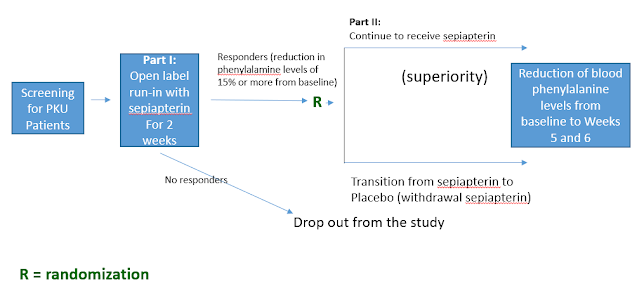
The pivotal license trial is called APHENITY trial and the randomized withdrawal design was used for the trial even though the randomized withdrawal design was not explicitly mentioned. According to PTC's new release, the APHENITY study is described as the following:
APHENITY was a global double-blind, placebo-controlled, registration-directed study which enrolled 156 children and adults with PKU. Participants were randomized to receive sepiapterin or placebo for six weeks with the primary endpoint being reduction in blood phenylalanine levels. The trial consisted of two parts. Part 1 was a run-in phase, during which all screened subjects received sepiapterin for two weeks. Only those subjects who demonstrated a reduction in phenylalanine levels of 15% or more from baseline in Part 1 were randomized to receive either sepiapterin or placebo in Part 2 of the clinical trial. The primary analysis population consists of those who had greater than 30% reduction in phenylalanine levels from baseline during Part 1 of the trial. The primary outcome measure is the reduction of blood phenylalanine levels from baseline compared to Weeks 5 and 6 in patients from Part 2 of the clinical trial. All patients are eligible to enroll in an open label long term clinical trial designed to further evaluate the long-term safety and durable effect of sepiapterin.

The study design (randomized withdrawal design) can be depicted in the following diagram: 


Through the APHENITY trial, it is demonstrated that the randomized withdrawal design can be successfully used in the pivotal study of the rare, inherited metabolic disease.

Refer to the previous posts on randomized withdrawal design:

Tuesday, November 29, 2022

Randomized withdrawal design in action - Accord trial in Alzheimer's agitation

The biotech company, Axsome Therapeutics, announced the positive results from one of their pivotal phase 3 studies (Accord study). 

Axsome's approved depression drug clears Alzheimer's agitation trial months after Lundbeck-Otsuka duo

The unique side of the Accord study is the use of a randomized withdrawal design. The study was registered on clinicaltrials.gov as "A Double-blind, Placebo-controlled, Randomized Withdrawal Trial to Assess the Efficacy and Safety of AXS-05 for the Treatment of Agitation in Subjects With Dementia of the Alzheimer's Type"

With the randomized withdrawal design, all participants were given the active drug (AXS-05) in a run-in phase in an open-label manner. Then, those patients who responded to treatment during the run-in phase were randomly assigned, in a double-blind manner, to either continue treatment with AXS-05 or switch to a placebo.

According to the sponsor, the basic idea behind this randomized withdrawal study design is to see whether those who initially experience a benefit stop doing so when moved to a placebo, indicating that the therapy itself is effective — as opposed to results being due to a placebo effect. The randomized-withdrawal design of this phase 3 trial simultaneously improved signal detection and mitigated placebo response. 

With the randomized withdrawal design, the sample size was reduced. Total 178 patients with Alzheimer's disease agitation were enrolled into the study run-in phase. 108 patients who achieved a sustained clinical response were then included in the randomized withdrawal period. 
"The ACCORD study was a double-blind, placebo-controlled, multi-center, randomized withdrawal, U.S. trial which treated 178 patients with Alzheimer’s disease agitation. Patients achieving a sustained clinical response after open-label treatment with AXS-05 were randomized (n=108) in a 1:1 ratio to continue treatment with AXS-05 or to discontinue AXS-05 and switch to placebo."
According to an article on evaluate.com:

"When Axsome decided to stop the Accord study of AXS-05 in Alzheimer’s disease agitation early, hopes for that trial took a nosedive. So it was clearly a pleasant surprise today when the company announced that the study had hit. Axsome’s stock opened up 33%, and some investors might be hoping for an earlier-than-expected filing, despite the fact that results from the pivotal Advance-2 study are not due until 2025. Accord had initially been intended as a second pivotal, alongside the previously completed Advance-1, but when the number of agitation events turned out lower than expected, management decided to switch focus to Advance-2. Despite this, Accord met its primary endpoint, time to relapse of agitation, and a key secondary, relapse prevention. One potential fly in the ointment could be Accord’s randomised withdrawal design; it comprised an open-label lead-in phase in which all 178 patients were given AXS-05, and those that had a sustained clinical response to the agent were randomised to either continue treatment or switch to placebo. AXS-05, a combination of dextromethorphan and bupropion, is approved in depression as Auvelity and moving into Alzheimer’s agitation would be an important expansion."

Given that Alzheimer's agitation is a common disease (70% of Alzheimer's disease patients may have agitation), more than one adequate and well-controlled study (or pivotal, confirmatory studies) are needed to demonstrate substantial evidence for effectiveness. Besides the Accord study (with randomized withdrawal design), two additional studies were conducted by the sponsor: ADVANCE-1 trial was a Phase 2/3 study with an active control arm. ADVANCE-2 trial is a phase 3 confirmatory study with the largest sample size (350 patients in a 1:1 randomization ratio). ADVANCE-1 study results had already been announced. ADVANCE-2 study has just started the enrollment. Both ADVANCE-1 and ADVANCE-2 studies were designed as traditional RCT design - randomized, double-blind, placebo-controlled, parallel groups. 

In a clinical program containing multiple pivotal clinical trials, it is appropriate to select different clinical trial designs. In Axsome's Alzheimer's agitation clinical program, a randomized withdrawal design was used in one of the three pivotal trials, and a traditional RCT design was used in the other two pivotal trials. If all these three trials are successful, the evidence for effectiveness will be more substantial and stronger than three studies with the same study design.