Friday, August 30, 2024

Understanding Patent and FDA Exclusivity: Protecting Innovation and Encouraging Drug Development

In the world of pharmaceuticals, innovation is the lifeblood of progress. Developing a new drug is an incredibly complex and expensive process, often taking over a decade and costing billions of dollars. To encourage this kind of investment, the U.S. legal and regulatory system provides mechanisms to protect and reward the creators of new drugs. Two of the most critical tools in this arsenal are patent protection and FDA exclusivity. While they serve different purposes and are governed by different bodies, together they create a robust framework that supports pharmaceutical innovation.

What is a Patent?

A patent is a form of intellectual property protection granted by the U.S. Patent and Trademark Office (USPTO). It gives the patent holder the exclusive right to make, use, sell, or distribute an invention for a set period, typically 20 years from the date of filing. The purpose of a patent is to incentivize innovation by giving inventors a temporary monopoly, allowing them to recoup their investment and profit from their ingenuity.

In the pharmaceutical industry, patents can cover various aspects of a drug, including the active chemical compound, the formulation, the method of manufacturing, and even the method of use. For example, a company might patent a novel drug molecule, but they could also seek patents for a specific drug delivery system or a new therapeutic use for an existing drug.

However, it’s important to note that a patent alone does not give a company the right to market a drug. The drug must still undergo the rigorous approval process overseen by the U.S. Food and Drug Administration (FDA). This is where FDA exclusivity comes into play.

What is FDA Exclusivity?

FDA exclusivity refers to the period during which the FDA grants a drug manufacturer the sole right to market a drug. This exclusivity is separate from and independent of any patent protection. The FDA awards exclusivity to incentivize drug development, especially in areas where there is a significant unmet medical need.

The length and type of exclusivity vary depending on the nature of the drug and its approval pathway:

  • New Chemical Entity (NCE) Exclusivity: Granted to drugs containing an active moiety that has never been approved by the FDA. This provides 5 years of exclusivity.
  • Orphan Drug Exclusivity: Awarded to drugs that treat rare diseases affecting fewer than 200,000 people in the U.S. This offers 7 years of exclusivity.
  • Pediatric Exclusivity: Provides an additional 6 months of exclusivity if the manufacturer conducts FDA-requested pediatric studies.
  • Biologics Exclusivity: Under the Biologics Price Competition and Innovation Act (BPCIA), biologics are granted 12 years of exclusivity.

During the exclusivity period, the FDA cannot approve any generic versions of the drug, even if the original drug’s patents have expired. This creates a significant commercial advantage for the innovator, allowing them to maximize their return on investment.

Here are some useful links discussing the patent and FDA exclusivity:

The Interplay Between Patents and FDA Exclusivity

While patents and FDA exclusivity both serve to protect new drugs, they do so in different ways and often overlap. A new drug may have several patents associated with it, protecting various aspects of the invention. However, these patents may expire before the FDA exclusivity does, or vice versa.

For instance, a drug might be protected by a patent on its active ingredient, which expires 15 years after the drug is approved. However, if the drug is also granted FDA exclusivity, the manufacturer might enjoy additional years without competition, even after the patent expires.

This interplay becomes particularly significant when considering the entry of generic drugs into the market. Generic manufacturers often challenge the validity of patents or wait for them to expire before seeking FDA approval. However, they must also wait for any FDA exclusivity periods to lapse before they can launch their generic versions, which can significantly delay their market entry.

The Impact on Innovation and Access

The combination of patents and FDA exclusivity creates a delicate balance between encouraging innovation and ensuring that patients have access to affordable medications. On one hand, these protections are essential for incentivizing pharmaceutical companies to invest in research and development. Without the prospect of a temporary monopoly, the financial risk associated with drug development might outweigh the potential rewards, leading to fewer new drugs entering the market.

On the other hand, extended periods of market exclusivity can delay the availability of lower-cost generic drugs, impacting patients’ access to affordable treatments. This tension is at the heart of ongoing debates about drug pricing and healthcare policy.

Patent vs. FDA Exclusivity – a Comparison

Aspect

Patent

FDA Exclusivity

Definition

Legal protection granted for an invention, giving the holder the right to exclude others from making, using, or selling the invention for a certain period.

Market exclusivity granted by the FDA to a drug manufacturer, preventing competitors from entering the market with similar products.

Governing Body

U.S. Patent and Trademark Office (USPTO)

U.S. Food and Drug Administration (FDA)

Issuing & Granting

Patents can be issued or expire at any time regardless of the drug's approval status

Exclusivity can be granted upon approval of a drug product if the statutory requirements are met.

Enforceable

a patent in the United States is only enforceable in the United States. To enforce a patent in other countries, you have to obtain a patent in those foreign countries

FDA exclusivity is only applicable in the United States.

Other countries may have their own exclusivities. For example, The European Medicines Agency (EMA) has two types of exclusivity for medicines: data exclusivity and market exclusivity

Purpose

To incentivize innovation by protecting intellectual property.

To encourage the development of new drugs and to reward clinical research, especially for rare diseases or conditions.

Duration

20 years from the filing date of the patent application (can vary slightly depending on the type of patent).

Varies by type: 6-month for six-month "pediatric exclusivity." 5 years for new chemical entities, 7 years for orphan drugs, 3 years for changes in previously approved drugs, and up to 12 years for biologics.

Cost for maintenance

In order to maintain the enforceability of the utility Patent,  maintenance fees must be paid at regular intervals throughout the 20-year term of the Patent.

No fees for receiving the exclusivity.

Fees (PDUFA Fees) may be paid for NDA/BLA submission

Scope

Protects the invention itself, which could be a drug, a process, a device, or a formulation.

Provides exclusive marketing rights in the U.S., blocking generic competition regardless of patent status.

When It Starts

From the date the patent is filed (though it becomes enforceable upon approval). If the drug development takes a long time, the patent protection period will be significantly shortened by the time of the drug approval

Starts when the FDA approves the drug for marketing.

Eligibility

Must meet patentability criteria: novelty, non-obviousness, and usefulness.

Dependent on FDA approval for new drugs, orphan drugs, biologics, or significant changes to existing drugs.

Extension Possibility

Possible through mechanisms like patent term extension (PTE) under the Hatch-Waxman Act, typically for up to 5 years.

Exclusivity periods are generally fixed but can be extended under certain conditions, like pediatric exclusivity (additional 6 months).

Effect on Market

Prevents others from making or selling the patented product or process, potentially creating a monopoly.

Prevents the FDA from approving generic versions or biosimilars, maintaining market exclusivity for the brand-name drug.

Impact of Expiry

After expiry, competitors can produce and market the product, assuming no other patents or exclusivities apply.

After expiry, generic or biosimilar competitors can be approved and enter the market.

Conclusion

In summary, patent protection and FDA exclusivity are two critical tools that work together to support pharmaceutical innovation. While patents protect the intellectual property of drug inventions, FDA exclusivity ensures that innovators have a period of time to market their drugs without competition. Understanding the nuances of these mechanisms is essential for anyone involved in the pharmaceutical industry, from researchers and developers to policymakers and healthcare providers.

By carefully navigating the landscape of patents and FDA exclusivity, pharmaceutical and biotechnology companies can maximize the value of their innovations while contributing to the advancement of medical science and the improvement of public health.

Friday, August 23, 2024

Estimand Framework - discussions at JSM 2024

In the Joint Statistical Meetings 2024, there was a session "Global Impact of the ICH E9(R1) Addendum - 5-Year Anniversary for the Trial Estimand Framework". In this session, panel members discussed the global impact of this guidance at its 5-year anniversary. Members from different regulatory agencies and the pharmaceutical industry, including members from the ICH E9(R1) Expert Working Group, reflected on multiple aspects of the impact of the estimand framework and the current stage of its broad implementation across clinical trials, including:
  • impact of the estimand framework to regulatory interactions, trial planning, drug approval process and labeling
  • examples of estimand framework implementation
  • disease-specific regulatory guidance documents using the estimand framework, including future plans
  • implementation of the ICH E9(R1) Addendum in clinical trial practice, from start (planning a trial, protocol development) to finish (reporting, communication and dissemination of results) and any remaining challenges
  • estimand thinking process and multi-disciplinary collaborations
  • estimand-related initiatives and their global impact
  • development of statistical methodologies (e.g. missing data and causal inference methods) triggered by the ICH E9(R1) Addendum;
  • standardizations efforts that facilitate the implementation of this framework; opportunities for the future.
The ICH E9(R1) guideline has been formally endorsed by major regulatory agencies such as the EMA, FDA, HC, and PMDA. The concepts of estimands and intercurrent events are frequently addressed in regulatory feedback on study protocols and statistical analysis plans. However, these topics have yet to gain traction in disease-specific scientific conferences. For instance, at several conferences and congresses focused on cardiovascular and pulmonary diseases, I observed a notable absence of presentations or abstracts discussing the estimand framework. Within the industry, estimands and intercurrent events are often seen as purely statistical concepts, primarily relevant to statisticians.

Estimand: A precise description of the treatment effect reflecting the clinical question posed by the trial objective. It summarises at a population-level what the outcomes would be in the same patients under different treatment conditions being compared. 

Estimator: A method of analysis to compute an estimate of the estimand using clinical trial data.
Estimate: A numerical value computed by an estimator. 

A question arose regarding the lack of an appropriate estimator for the corresponding estimand. Stephen Ruberg, from the audience, provided an insightful response by quoting John Tukey: 'An approximate answer to the right problem is worth a good deal more than an exact answer to an approximate problem. The greatest value of a picture is when it forces us to notice what we never expected to see. An approximate answer to the right question is worth far more than a precise answer to the wrong one.' In the context of the estimand framework, it is crucial to ask the right question and define the estimand accurately. While an exact estimator for the proposed estimand may not exist, it can often be reasonably approximated.

The estimand framework has been built into some disease-specific regulatory guidance documents. For example, in FDA's guidance for industry "Graft-versus-Host Diseases: Developing Drugs, Biological Products, and Certain Devices for Prevention or Treatment", the estimand and intercurrent events are extensively discussed and example estimands are provided. 


Sunday, July 28, 2024

Five most frequently used strategies for handling intercurrent events

The original ICH E9 guideline, titled "Statistical Principles for Clinical Trials," was established in 1992. An updated version, ICH E9 (R1), was released in November 2019 and is known as the "Addendum on Estimands and Sensitivity Analysis in Clinical Trials to the Guideline on Statistical Principles for Clinical Trials." Since its publication, regulatory agencies have gradually adopted the ICH E9 (R1) guidelines. As a result, regulatory reviewers commonly require sponsors to define estimands, identify intercurrent events, and propose strategies for handling these events in the study protocol and/or the statistical analysis plan (SAP).

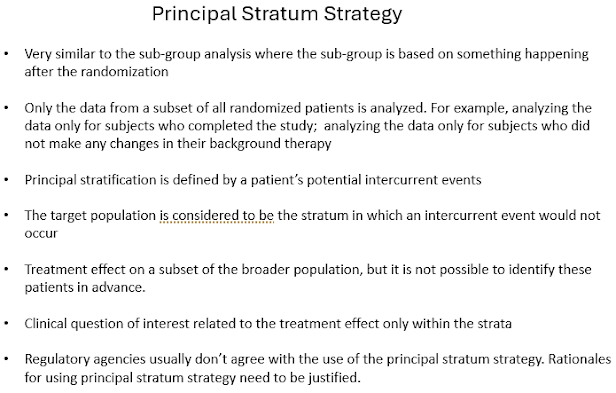
The ICH E9 (R1) guideline, along with its accompanying training slides, provides detailed information on the concepts of estimands, intercurrent events, and various strategies for managing intercurrent events. The five most commonly used strategies for handling intercurrent events are: treatment policy, Composite, hypothetical, while on treatment, and principal stratum.


Below are five slides discussing the five most commonly used strategies:


Wednesday, July 24, 2024

Clinical trial succussed in phase 2, but failed in phase 3

Clinical trials are the backbone of drug developments, acting as the gateway between laboratory research and practical, commercial, real-world treatments. These trials typically progress through several phases, with Phase 2 and Phase 3 being crucial stages in the journey of a new treatment or drug. However, it is not uncommon for a treatment to show promise in Phase 2, only to stumble and fail in Phase 3. Understanding why these failures occur is key to improving future trials and ultimately enhancing patient care.

Several years ago, FDA published a report called "22 CASE STUDIES WHERE PHASE 2 AND PHASE 3 TRIALS HAD DIVERGENT RESULTS ". Raps.org had an article to discuss this report "22 Case Studies Where Phase 2 and 3 Results Diverge: New FDA Report". There are a lot of examples that the early phase (phase 2) clinical trial was successful, but the late phase (confirmatory, phase 3) study failed. As a matter of fact, when the drug development program moved to the phase 3 study stage, there was usually successful results from the early phase clinical trials and there was an expectation that the phase 3 study would reproduce the success observed from the phase 2 studies. However, we often see that the promising results from phase 2 can not be reproduced in the large scale phase 3 studies. 

Fiercebiotech.com tracks these trial flops (clinical trials succussed in phase 2, but failed in phase 3). 

The Reality Check of Phase 3

Phase 3 trials are more extensive, involving several hundred to several thousand participants. These trials are designed to confirm the efficacy and safety of the treatment on a larger scale, comparing it directly to existing standard treatments or placebos. Phase 3 trials are pivotal because they provide the comprehensive data needed for regulatory approval- so called 'licensure trial'.

Despite the promise shown in Phase 2 study, many treatments fail in Phase 3 study. The reasons for these failures are multifaceted and can be broadly categorized into four main areas:

  1. Differences in Population and Scale:

    • Population Diversity: Phase 2 trials often involve more homogeneous patient groups, while Phase 3 trials encompass a broader and more diverse population. This diversity can introduce variables that were not accounted for in the smaller, more controlled Phase 2 trials. For example, genetic differences, comorbidities, and concurrent medications can all influence treatment outcomes.
    • Sample Size: The larger sample size in Phase 3 trials can reveal less common side effects or variations in treatment efficacy that were not apparent in Phase 2. What appeared as a clear benefit in a smaller group may not hold up when tested on a larger scale. The large sample size requires more clinical trial sites for patient enrollment and the study needs to be designed as the multi-regional clinical trial.
  2. Study Design and Execution:

    • Study Rigidity: Phase 3 trials often have more rigid protocols and endpoints compared to Phase 2. The stringent criteria and predefined outcomes might not fully capture the treatment’s potential benefits, leading to negative results. Phase 3 trials are usually more statistically rigor. More stringent statistical analysis approaches are used in the analyses of the phase 3 study data including controlling type-1 error, adjustment for multiplicity, missing data handling, estimands and strategies for handling the intercurrent events...
    • Execution Challenges: The complexity of conducting large-scale trials can introduce logistical issues, variations in study conduct across different sites, and difficulties in maintaining consistent treatment administration. Execution challenges may also include the difficulties in patient retention, treatment compliance, and maintaining the treatment blinding,...
  3. Efficacy and Endpoint Discrepancies:

    • Efficacy Overestimation: Positive results in Phase 2 might be due to smaller sample sizes, shorter follow-up periods, or more lenient statistical thresholds. When scaled up, the actual efficacy might be less impressive.
    • Endpoints and Metrics: The primary and secondary endpoints in Phase 3 trials may differ from those in Phase 2. A treatment might show improvement in a specific metric in Phase 2 but fail to meet the broader, more comprehensive endpoints required in Phase 3. Phase 2 study may be based on surrogate endpoints and biomarkers while phase 3 study needs to use the endpoints that measure patients' feel, function, and survival to meet the regulatory requirements. Phase 2 study is usually shorter in duration while phase 3 study is usually longer.
  4. Unanticipated Safety Concerns:

    • Rare Adverse Events: Larger trials can uncover rare but serious adverse events that were not evident in the smaller Phase 2 trials. These safety concerns can overshadow the benefits observed, leading to a failed trial.
    • Long-Term Effects: Phase 3 trials typically have longer follow-up periods, which can reveal long-term side effects or diminishing efficacy over time.
In a paper by Fogel (2018) "Factors associated with clinical trials that fail and opportunities for improving the likelihood of success: A review", the following reasons were given:
"There are many reasons that potentially efficacious drugs can still fail to demonstrate efficacy, including a flawed study design, an inappropriate statistical endpoint, or simply having an underpowered clinical trial (i.e., sample size too small to reject the null hypothesis), which may result from patient dropouts and insufficient enrollment."

Here are two new examples with promising phase 2 study results, but failed phase 3 study: 

The StarScape study is a Phase 3 trial designed to evaluate the efficacy and safety of Zinpentraxin Alfa in patients with Idiopathic Pulmonary Fibrosis (IPF). It was based on a Phase 2 trial that showed promising results over a 28-week period. However, the StarScape study failed significantly, as it did not meet the primary efficacy endpoint of change from baseline to week 52 in forced vital capacity (FVC), nor did it succeed in any of the secondary efficacy endpoints. A companion editorial suggested that the failure of the StarScape study might have been due to outliers in the FVC measurements of two patients in the placebo group, that resulted in false positive results in Phase 2 study. 
"...Prompted by these negative results, a post hoc reevaluation of the phase II trial revealed that the apparent benefit of zinpentraxin alfa was primarily driven by two outliers in the placebo group who had an FVC decrease of more than 2,000ml/yr."
The biotech company Amylyx conducted a Phase 2 trial, known as the CENTAUR trial, to evaluate the safety and efficacy of AMX0035 for the treatment of Amyotrophic Lateral Sclerosis (ALS). Despite the relatively small sample size, the CENTAUR study demonstrated statistically significant results in the primary efficacy endpoint, which was the ALS Functional Rating Scale-Revised (ALSFRS-R) slope change. As a result, Amylyx received regulatory approval from both Health Canada and the US FDA. However, as a condition of approval, the FDA required the completion of an ongoing Phase 3 study called the PHOENIX trial. When the results of the PHOENIX study were released, none of the primary, secondary, or subgroup analyses showed statistical significance, marking the study as a total failure.

The likely reason for the failure of the Phase 3 study is the difference in geographic regions and patient populations. The Phase 2 CENTAUR study was conducted entirely in the United States, with 25 sites across the country. In contrast, the Phase 3 PHOENIX study was a multinational trial conducted at 69 sites across 12 countries in the US and Europe. Unfortunately, due to the failure of the Phase 3 study, the already approved and marketed drug had to be withdrawn from the market.

Sunday, June 23, 2024

Elevidys in DMD: Approved Despite Trial Failed in Primary Efficacy Endpoint

The US Food and Drug Administration has given the green light for the first gene therapy that treats a rare form of muscular dystrophy (Duchenne muscular dystrophy, DMD) to be used in most people who have the disease and a certain genetic mutation. Last year, the drug – Elevidys, from the biotech company Sarepta Therapeutics – was approved (through accelerated approval pathway) to treat only children ages 4 and 5 with Duchenne muscular dystrophy, one of the most severe forms of inherited muscular dystrophies, who have a confirmed mutation in a gene called DMD that is associated with muscle strength. The FDA announced this past Thursday (June 20, 2024) that it had given traditional approval for Elevidys for ambulatory people 4 and older with a confirmed mutation in the DMD gene and accelerated approval for non-ambulatory people 4 and older with this mutation. There’s not enough data on safety to support its use in children under 4, the agency says.

This is another drug approved by the FDA although the pivotal study (so called EMBARK study) failed in the primary efficacy endpoint (the North Star Ambulatory Assessment (NSAA)). While secondary efficacy endpoints (such as Time to Rise From the Floor) were statistically significant in favor of the Elevidys treatment group, the secondary efficacy endpoints were supposed not to be tested if the primary efficacy endpoint was not statistically significant. 

FDA's action of giving Elevidys traditional approval is controversial. According to FDA's review documents, some of FDA internal reviewers (such as statistical reviewer) were against the approval citing there wasn't sufficient evidence, however, the head of FDA CBER division, Dr Peter Marks, overruled the functional group reviewers to approve this gene therapy.  

Perhaps, Dr Peter Marks is right. We should not base the approval on the single p-value from the primary efficacy endpoint and we should not be a slave of the p-values. FDA's announcement says "In making this decision, the FDA considered the totality of the evidence, including the potential risks associated with the product, the life-threatening and debilitating nature of the disease and the urgent unmet medical need." In the rare disease setting, selecting a clinical scale as the primary efficacy endpoint can sometimes be a gambling decision. in DMD situation, FDA published a guidance for industry "Duchenne Muscular Dystrophy and Related Dystrophinopathies:  Developing Drugs for Treatment". The guidance did not recommend which endpoint should be used the primary efficacy endpoint. The guidance was indecisive in efficacy endpoints. 

"FDA has no defined set of required or recommended clinical outcome measures for studies in dystrophinopathies.  Although existing outcome measures developed for clinical trials and/or clinical care in dystrophinopathies or related conditions may be appropriate, FDA will also consider proposals for the use of novel outcome measures that are capable of measuring clinically meaningful effects in patients.  FDA encourages sponsors to propose and, if necessary, develop endpoints that can validly and reliably assess patients with a wide spectrum of symptoms and disease stages.  Sponsors should engage FDA early during the selection and/or development of efficacy endpoints.  The sponsor should include an assessment of multiple efficacy endpoints, when feasible, to characterize the breadth of effects on dystrophin-related pathologies, including skeletal, respiratory, and cardiac muscle function, even if the primary endpoint is only one of these measures. "

Even if the drug is effective, the statistical significance for the selected primary efficacy endpoint (NSAA total score in EMBARK study) may not be demonstrated. In the rare disease setting with the urgent unmet medical need, the strict statistical rules may need to be loosened, the sequential testing rule for controlling the overall alpha may need to be skipped, and the totality evidence from the trial needs to be considered in the decision making.

DMD, like the ALS amyotrophic lateral sclerosis, is a challenging disease for clinical trials. Majority of the late phase DMD trials failed. FDA's approval of Elevidys in DMD comes right after two recent failed trials in DMD by Pfizer and NS Pharma. Their clinical programs in DMD were stopped. 
Sarepta's Elevidys in DMD (EMBARK trial) and Amylyx's RELYVRIO in ALS (PHOENIX trial) faced similar situations: they received preliminary approval from the FDA but were required to conduct confirmatory studies to demonstrate clinical benefit. However, both trials failed to achieve statistical significance in their primary efficacy endpoints. The key difference lies in the EMBARK study, which showed significant differences in secondary efficacy endpoints, whereas the PHOENIX study failed to demonstrate statistical significance in any endpoints - therefore, the fate for Elevidys (traditional approval is obtained) and Relyvrio (the product was withdrawn from the market) is totally different now.  

Wednesday, June 19, 2024

Functional Unblinding in Double-blind, Randomized, Controlled Trials (RCTs)

Earlier this month, FDA advisory committee declined to endorse Lykos Therapeutics’ application to market its psychedelic drug MDNA, also known as ecstasy, as a treatment for post-traumatic stress disorder (PTSD). The panel voted 9-to-2 against the treatment when asked if data showed MDMA’s effectiveness, and 10-to-1 against when asked if the benefits of MDMA outweighed its risks. Both of Lykos Therapeutics’ pivotal studies (MAPP1 study and MAPP2 study) are positive. With relatively small sample sizes, both studies showed highly statistically significant results that MDNA-assisted therapy is highly efficacious in individuals with severe PTSD. The failure in earning the endorsement from FDA advisory committee was not due to the study results, but due to the concerns about the study design and the study conduct, specifically, potential abuse, functional unblinding, and expectation biases. Functional Unblinding was one of the sticky issues discussed during the advisory committee meeting. 

Functional unblinding refers to the situation in a clinical trial or research study where individuals involved (such as participants, investigators, or assessors) gain access to information that reveals the identity of the treatment or intervention being administered. Functional unblinding can happen inadvertently due to various reasons, such as unintended disclosure of treatment details (accidental unblinding), observation of side effects specific to a treatment, or recognition of differences between treatment groups. Clinical trial sponsors usually implement strict procedures to prevent accidental unblinding and manufacture the matched control treatments/using double-dummy technique to prevent recognition of differences between treatment groups. 

However, functional unblinding due to side effects (or treatment emergent adverse events (TEAEs)) may occur with any investigational drug. If the treatment group (or investigational drug) can cause significantly more side effects, study participants, investigators, or assessors can guestimate which treatment group the study participants are assigned to. For example, IGIV causes headache events; niacin causes red or flushed skin, sotatercept causes telangiectasia, bleeding events, and increased hemoglobin levels,... participants or investigators may be able to guesstimate if the participants are receiving the investigational drug based on these unique side effects (adverse events). 

Functional unblinding is an especially important issue in psychedelic drug (such as Lykos' therapeutics's MDNA) clinical trials. In FDA's guidance for industry (June 2023) "Psychedelic Drugs: Considerations for Clinical Investigations", 'functional unblinding' was discussed as the following. It raised the functional unblinding issue and provided some solutions for preventing/handling the functional unblinding: 


Functional unblinding is a critical concern in clinical trials where the investigational drugs have unique and distinctive side effects. Functional unblinding can introduce bias (consciously or unconsciously), affect participant behavior, influence how outcomes are measured and interpreted, and compromise the objectivity of the study's outcome.

If functional unblinding is suspected, it is difficult for sponsors to demonstrate that the functional unblinding does not occur. One approach to investigate/assess the functional unblinding is to employ questionnaires before the study unblinding to ask the participants and investigators which treatment group they think the participants are receiving. However, I see no or very few sponsors doing this. I described this in an earlier post "Assessing potential unblinding due to imbalance in side effects through exit questionnaires".

Sunday, May 19, 2024

Master protocol: umbrella-trial-based platform trial versus basket-trial-based platform trial

Biotech company Aerami Therapeutics announced that they are going to design a platform trial to test their pulmonary hypertension drug simultaneously in multiple indications (in this case, multiple WHO groups of pulmonary hypertension).

uniPHied: A Novel Platform Study Design for a Phase 2 Clinical Trial to Assess the Safety and Efficacy of AER-901 in Pulmonary Hypertension Associated With Interstitial Lung Disease and Pulmonary Arterial Hypertension


They stated the following "Phase 2 studies in pulmonary hypertension have been confined to one etiology, with large participant numbers relative to rare disease demographics. This platform study design allows for assessment of AER-901 across multiple forms of pulmonary hypertension within one efficient trial. The uniPHied study aims to assess AER-901 in pulmonary hypertension associated with interstitial lung disease (PH-ILD) and pulmonary arterial hypertension (PAH), with the option to expand to other forms of pulmonary hypertension via a protocol amendment".

Pulmonary Hypertension (PH) comes in multiple forms (phenotypes or genotypes). According to the WHO Pulmonary Hypertension classification, there are five different groups (see the table below). Each WHO PH class is considered a separate indication. Drug development programs in PH will include clinical trials for each WHO PH class. 

It is natural to think of a master protocol that can combine the clinical trials in different WHO PH classes into a single clinical trial (a platform trial). 

However, there are two issues in the uniPHied study design. 

This is not a typical platform trial design. the platform trial is usually based on an umbrella trial where multiple drugs are evaluated for the same indication. The platform trial has not been used for basket trials where the same drug is evaluated for multiple indications (here in multiple WHO PH classes). Here are the definitions for master protocol, umbrella trial, platform trial, and basket trial. 

FDA's guidance for industry "Master Protocols for Drug and Biological Product Development"

Master protocol: a protocol designed with multiple substudies, which may have different 22 objectives and involve coordinated efforts to evaluate one or more medical products in 23 one or more diseases or conditions within the overall study structure.   

Substudy: the information and design features (e.g., objectives, design, methodology, 26 statistical considerations) related to evaluation of a single medical product in a single 27 disease, condition, or disease subtype in the master protocol.  


The control group can not be shared across different sub-studies in different WHO PH classes. 

The uniPHied study is a basket-trial-based platform trial. Each indication (each WHO PH classes) needs to have its own control group. The data from control groups in different WHO PH classes can not be combined or pooled.

The platform trial in the FDA's guidance refers to the umbrella-trial-based platform trial. FDA guidance discussed the shared control group extensively. The control group in the umbrella-trial-based platform trial needs to be separated into a concurrent control and a nonconcurrent control. For a specific drug in the platform trial, FDA recommended the following: 
The control group used for the primary comparison of any given drug in a master protocol should generally include only concurrently randomized subjects (i.e., a concurrent control) and should not include nonconcurrently randomized subjects. 

Monday, May 06, 2024

eIND: exploratory IND versus emergency IND

eIND may be referred to as either exploratory Investigational New Drug (IND) or emergency Investigational New Drug (IND). An "Exploratory IND" and an "Emergency IND" are both regulatory mechanisms used in the United States by the Food and Drug Administration (FDA) to allow for the use of investigational drugs in certain circumstances. It's important to note that the exploratory IND and emergency IND represent distinct concepts.

Exploratory IND (eIND):

exploratory IND may be called 'Phase 0' clinical trial. Exploratory IND was described in FDA Guidance for Industry, Investigators, and Reviewers "Exploratory IND Studies". The guidance defined the exploratory IND as the following:


Purpose: Used for early-stage clinical trials to explore the preliminary pharmacokinetics and the pharmacodynamics features, not the safety and efficacy of a new drug or treatment. The dose is sub-therapeutic level or micro-dose.

Timing: Typically used in the early stages of drug development, before a drug has been extensively studied in humans and before the phase 1 study

Process: Requires submission of an IND application to the FDA, detailing the proposed clinical trial protocol, preclinical data, and any available safety information. However, less pre-clinical data or animal data is required for the eIND study than for the typical phase 1 study.

Review: The FDA reviews the eIND application and provides feedback before the trial can proceed.

Requirements: Investigators must adhere strictly to the protocol outlined in the IND application, and any deviations must be reported to the FDA.

Emergency IND (eIND):

Emergency Use Investigational New Drug (IND) applications are part of expanded access program (also referred to as compassionate use). expanded access program was described in 21 CRF Part 312 "Subpart I—Expanded Access to Investigational Drugs for Treatment Use". FDA has a designated page to describe the "Expanded Access" process. 

emergency INDs may also be called single-patient INDs, Individual Patient Expanded Access, or Single Patient Expanded Access. They are initiated in urgent scenarios where immediate access to an unapproved drug is necessary, and the clinical circumstances do not permit the time required for a standard IND submission. emergency INDs are primarily utilized in cases of life-threatening conditions where no established treatment options are available.

21 CRF Part 312.310 described the process for expanded access for individual patients, including for emergency use. 


Purpose: Used in emergency situations where there is no alternative treatment available, and the patient's condition is serious or life-threatening.

Timing: Typically used when there is an urgent need to provide access to an investigational drug outside of a clinical trial setting.

Conditions: Reserved for cases where standard treatments have failed, are unavailable, or are not suitable for the patient.

Review: The FDA still needs to review the emergency IND application, but needs to provide feedback / approval in a very short period (hours/days).

Monday, April 29, 2024

Phased clinical trials, seamless clinical trials, phaseless clinical development process

The drug development process encompasses a series of phased clinical trials, typically categorized as phases 0 (optional), 1, 2, 3, and 4. Phases 0, 1, 2, and 3 primarily serve for premarket assessment, while phase 4 focuses on post-marketing evaluation. Phase 1 and 2 trials are often referred to as 'early phase trials,' while phase 3 trials are known as 'late phase trials,' 'pivotal studies,' or 'confirmatory trials.' Notably, the Code of Federal Regulations (Title 21 pertaining to the FDA) does not explicitly describe each phase of clinical trials. Instead, it mandates 'adequate and well-controlled investigations' to substantiate effectiveness. The Code of Federal Regulations does require the specification in IND application form "Identification of the phase or phases of the clinical investigation to be conducted."

The reliance on phased clinical trials can lead to significant delays and cost escalation in the drug development process, potentially impeding timely access to innovative therapies for patients. To address this challenge, incremental innovations, such as adaptive (seamless) clinical trials and cohort expansion designs, have been explored to streamline clinical trial procedures.

The FDA's guidance for industry titled "Demonstrating Substantial Evidence of Effectiveness With One Adequate and Well-Controlled Clinical Investigation and Confirmatory Evidence" acknowledges the evolving landscape. It emphasizes that confirmatory evidence regarding effectiveness may not solely derive from clinical trials but can also encompass other sources like natural history evidence, real-world data, and evidence from expanded access programs. In certain scenarios, the conventional phased approach to clinical development may not be universally applicable. Embracing a phaseless clinical development process may offer a more pragmatic and suitable alternative in specific contexts.

Phased Clinical Trials

In a previous discussion, we delved into the realm of phased clinical trials, exploring the sequential stages denoted as Phases 0, 1, 2, 3, and 4.

Seamless (phases) Clinical Trials

The concept of seamless phases in clinical trials involves the integration of two distinct phases, such as seamless phase 1/2 trials or seamless phase 2/3 trials. It's worth noting that the FDA's guidance document titled "Adaptive Designs for Clinical Trials of Drugs and Biologics" has evolved beyond the specific term "seamless design." Instead, it incorporates seamless elements within the broader framework of "Adaptations to Treatment Arm Selection." This approach encompasses not only dose selection but also the confirmation of efficacy for the selected dose within a single study.

When registering clinical trials on ClinicalTrials.gov, it is necessary to specify the phases of the trial. Categories such as "Phase 1/Phase 2" and "Phase 2/Phase 3" are utilized to denote seamless designs, reflecting the integration of multiple phases within a single trial protocol. There is no option for "Phase 1/Phase 3" and 'Phase 1/2/3'.


The utilization of expansion cohorts design has gained significant traction within oncology drug development and is now widely recognized as a specialized variant of seamless design. Pioneered by Merck and described in NEJM paper by Prowell et al. in 2016, this approach has garnered attention for its potential to streamline the development process for oncology drugs.

In 2022, the FDA released guidance specifically addressing the use of expansion cohorts, titled "Expansion Cohorts: Use in First-In-Human Clinical Trials to Expedite Development of Oncology Drugs and Biologics Guidance for Industry." This guidance outlines best practices for incorporating expansion cohorts into early-phase clinical trials, with the aim of accelerating the development of oncology therapies.

Studies employing expansion cohorts design may be categorized as "Phase 1/Phase 2" or "Phase 1/Phase 3" trials, depending on the primary objectives of the expanded cohorts. If the focus is on assessing anti-tumor activities, the study may be labeled as a "Phase 1/Phase 2" trial. Conversely, if the expanded cohorts are intended to evaluate efficacy endpoints, the study may be classified as a "Phase 1/Phase 3" trial.

In their 2018 paper "Advancing Clinical Trials to Streamline Drug Development," Bates et al. introduced a notable departure from the traditional clinical trial progression. Instead of adhering to the sequential phases of safety evaluation in Phase 1, efficacy assessment in Phase 2, and comparative efficacy testing in Phase 3, they advocated for the adoption of expansion cohorts. This innovative approach created what they termed a "continuum" or "phaseless" trial model, characterized by the seamless integration of various trial components through the use of protocol amendments and ongoing discussions with the FDA.

By embracing expansion cohorts and the phaseless trial concept, the drug development process could expedite the delivery of new therapies to patients. Moreover, this approach showcased the FDA's willingness to embrace flexibility and innovation in regulatory practices.

A particularly intriguing aspect of this "continuum" expansion cohort model is its circumvention of the conventional drug development paradigm and the intricate regulatory framework that often poses challenges for both investigators and regulators. This departure from the norm represents a significant shift towards a more agile and patient-centric approach to drug development, potentially opening avenues for greater efficiency and accessibility in the advancement of medical therapies.

Phaseless Drug Development Process

In certain contexts, traditional phased clinical trials may not be applicable, particularly in the development of therapies for ultra-rare diseases or in the realm of gene therapy. This divergence from the traditional paradigm has led to the emergence of the term "phaseless" to signify scenarios where the sequential numbering of clinical trial phases becomes less relevant.

There are two primary scenarios where the phaseless approach is observed:

  • Single-Trial Clinical Development: In this scenario, the entire clinical development program revolves around a single clinical trial, regardless of whether it would conventionally be labeled as phase 1, 2, or 3. Regulatory approval, such as a New Drug Application (NDA) or Biologics License Application (BLA), may rely on the data from this singular study, which can be supplemented by various other types of evidence outlined in FDA guidance documents.

    An example of this approach is seen in the development of the first CRISPR-Cas9 gene-edited therapy by Vertex/CRISPR Therapeutics for severe sickle cell disease (SCD). FDA approval for this product was based on a single-arm, open-label, multi-site, single-dose Phase 1/2/3 study.

  • Seamless Phase 1/2/3 Trials: Alternatively, a phaseless approach can involve the integration of all three traditional phases into a single seamless clinical trial. Pfizer/BioNTech's COVID-19 vaccine study serves as an illustrative example of this approach. Their study, labeled as phase 1/2/3, encompassed a randomized, placebo-controlled, observer-blind, dose-finding investigation to identify preferred vaccine candidates and dose levels in phase 1, followed by an expanded cohort and efficacy assessment in phase 2/3.

Phases of clinical trials become vague nowadays and there is a growing sentiment that the reliance on the numbered phases of clinical trials may become outdated and potentially misleading in the era of innovative trial designs. Instead, regulatory drug approval processes should prioritize the totality of evidence, which can stem from a combination of exploratory and confirmatory trial designs, as well as other sources such as natural history data, real-world evidence, expanded access studies, and animal models. In this context, the numbering of clinical trial phases becomes less crucial, emphasizing the need for a more holistic and adaptable approach to evaluating the efficacy and safety of medical interventions.